Forty Martyrs of Sebaste

Forty soldiers, one order
Around the year 320, the Roman province of Armenia was under the rule of the emperor Licinius, who — despite having co-signed the Edict of Milan tolerating Christianity a few years earlier — turned against Christian soldiers within his own army as his rivalry with Constantine intensified. In the garrison at Sebaste, a group of forty soldiers, all of them Christian, refused an order to offer sacrifice to the pagan gods. Their commanding officer, rather than executing them outright, chose a slower and more deliberately cruel method: exposure to the elements, on the theory that cold and discomfort might succeed where threats had failed.
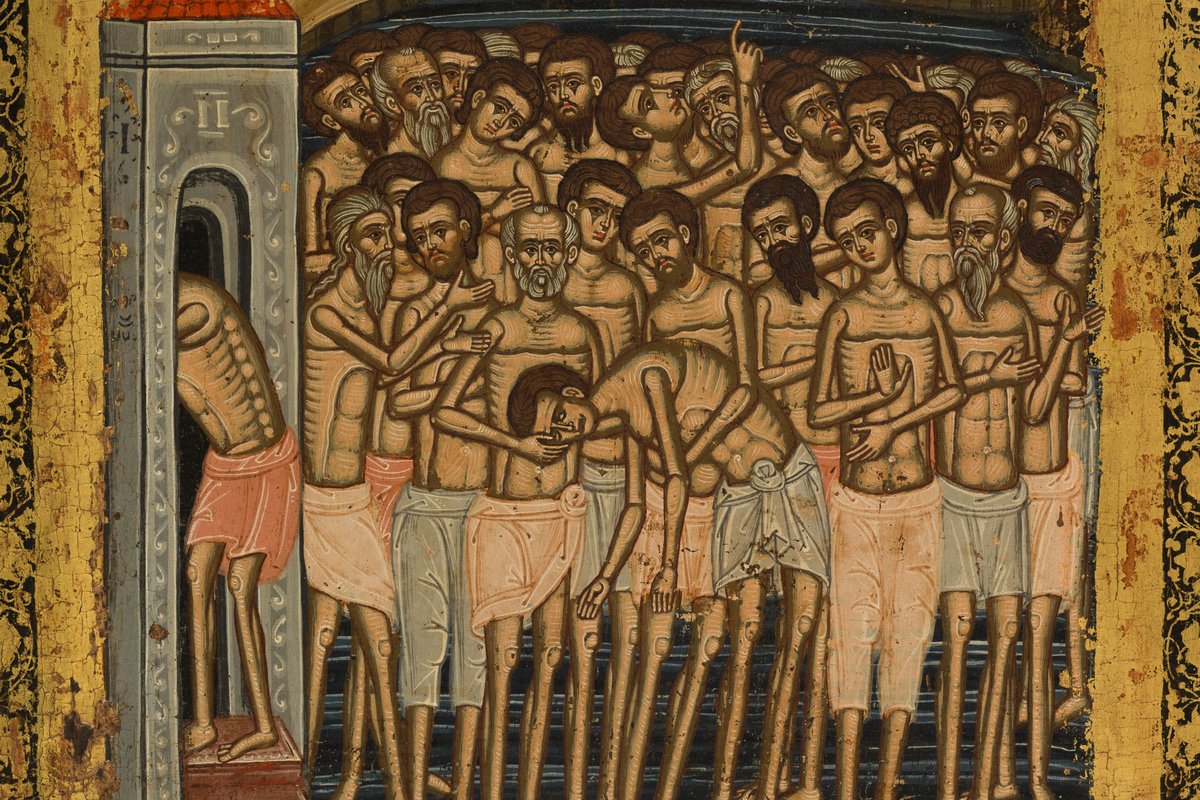
Nikitarea, The Forty Martyrs of Sebaste, 1701–1725, Petit Palais, Paris Musées — public domain (CC0).
A frozen lake, and a fire left burning
According to the account, the forty men were stripped of their clothing and forced out onto a frozen lake near the city to stand through the night in brutal winter conditions. Their captors placed a heated bathhouse in clear view on the shore — close enough to see, warm enough to imagine — specifically so that any soldier who broke under the cold could walk to comfort simply by renouncing his faith. It was less a mass execution than a slow, visible test of resolve, staged so the temptation to give in was always right there in front of them.
The soldier who ran, and the guard who joined them
The account's most famous and dramatic detail concerns what happened as the night wore on. One of the forty reportedly lost his nerve, broke from the group, and ran for the warm bathhouse — only to collapse and die almost immediately upon entering it, whether from the shock of the sudden temperature change or, as the tradition frames it, a kind of immediate judgment on his choice. Watching from the shore was a Roman guard named Aglaius, assigned to keep watch over the condemned men. According to the story, Aglaius saw a vision of crowns descending from heaven onto the heads of the remaining thirty-nine soldiers — and, moved by what he'd seen, stripped off his own uniform, walked out onto the ice, and joined them, professing Christian faith on the spot and restoring their number to the original forty. All forty died from the exposure before morning. It's a vivid, symmetrical, deeply memorable detail — and it's also exactly the kind of dramatic narrative beat that later hagiographic retellings tend to sharpen and elaborate, so it's worth holding as cherished tradition rather than a verified eyewitness transcript, even as the broader outline of the martyrdom is comparatively well attested.
Burned, and cast into a river
The account doesn't end with the night on the ice. Some of the martyrs were reportedly still alive, if barely, by dawn, and their remains — along with those who had already died — were burned, with the ashes cast into a nearby river specifically to prevent Christians from recovering relics for veneration. Despite that effort, tradition holds that some remains were still gathered and preserved, and relics associated with the Forty Martyrs went on to spread widely across both the Eastern and Western Church in the centuries that followed.
The youngest soldier and his mother
One of the most repeated details from the tradition surrounding the Forty concerns the youngest of the group, a soldier young enough that some accounts describe him as barely more than a boy. As the night wore on and his strength failed faster than the others', his mother — said to have followed the group to the lakeshore — reportedly refused to let him give in, urging him to hold on rather than come to her alive but faithless. When he died with the rest before dawn, tradition holds that she herself helped carry his body onto the cart taking the martyrs' remains away, unwilling to let anyone else perform that final act for her son. Whether every detail of this account reflects an eyewitness memory or a later devotional elaboration, it captures something the broader Sebaste story keeps returning to: faithfulness under this kind of pressure was rarely a purely individual matter, but something reinforced, and sometimes demanded, by the people who loved the ones being tested.
Crowns, and why that image mattered
The vision of descending crowns that convinced Aglaius to join the condemned men on the ice draws on imagery familiar to any early Christian audience steeped in Scripture: the New Testament repeatedly describes a "crown" awaiting the faithful after death, not a symbol of earthly royalty but of a reward given for endurance under trial. That image is why artists across the centuries — including the gold-ground icon used for this article's hero image — so often show the Forty standing together on the ice beneath rows of crowns descending from a blessing figure of Christ above them. The composition isn't just decorative; it's a visual argument about what the soldiers actually won that night, framing their deaths not as a loss inflicted on them by Licinius's army but as a reward already being handed down even as the cold took their lives.
An old and widely shared devotion
What lends the Forty Martyrs of Sebaste real historical weight, distinct from many later and more obviously legendary martyr accounts, is the source: Bishop Eusebius of Sebaste is credited with an early written account of their deaths, reasonably close in time to the events themselves, which later writers expanded with additional narrative detail. That gives the core story — forty Christian soldiers, a frozen lake, a refusal to recant — a firmer historical footing than many ancient martyrdoms enjoy, even as specific dramatic flourishes like Aglaius's vision belong more to the realm of cherished tradition. The devotion that grew up around them spread quickly and durably across both East and West; Saint Basil the Great preached on them within a few decades of their deaths, and their feast, kept on March 9 in the Western calendar, remains a significant observance in Eastern Christian tradition especially. They are venerated as patrons of soldiers and, more broadly, of those enduring hardship or persecution for their faith.
Trivia
Who were the Forty Martyrs of Sebaste?
How were the Forty Martyrs of Sebaste killed?
What is the story of the fortieth martyr, Aglaius?
Why is the Forty Martyrs of Sebaste account considered reasonably historical?
What is the Forty Martyrs of Sebaste feast day, and what are they patrons of?
You May Also Like
Related Reading