Saint Sebastian

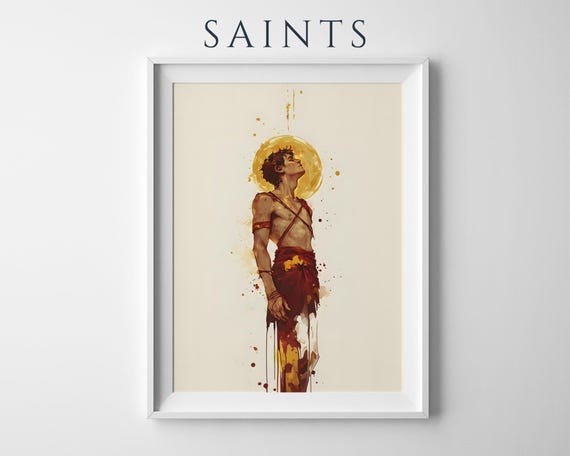
A soldier working against the empire he served
Sebastian held a position of real trust within the Roman military — a captain in the Praetorian Guard, the elite unit responsible for the emperor's own protection, serving under Emperor Diocletian at a time when Christians faced active, organized persecution across the empire. According to tradition, he had joined the army in part precisely because his rank gave him access and cover: as an officer above suspicion, he could move freely among soldiers and prisoners alike, visiting Christians condemned to death and encouraging them to hold to their faith even as execution approached. He used his position for exactly the opposite of what it was meant to serve: quietly supporting and converting fellow soldiers to Christianity from within the very institution charged with suppressing it, reportedly winning over even members of the prefect's own household before his activities came to light.
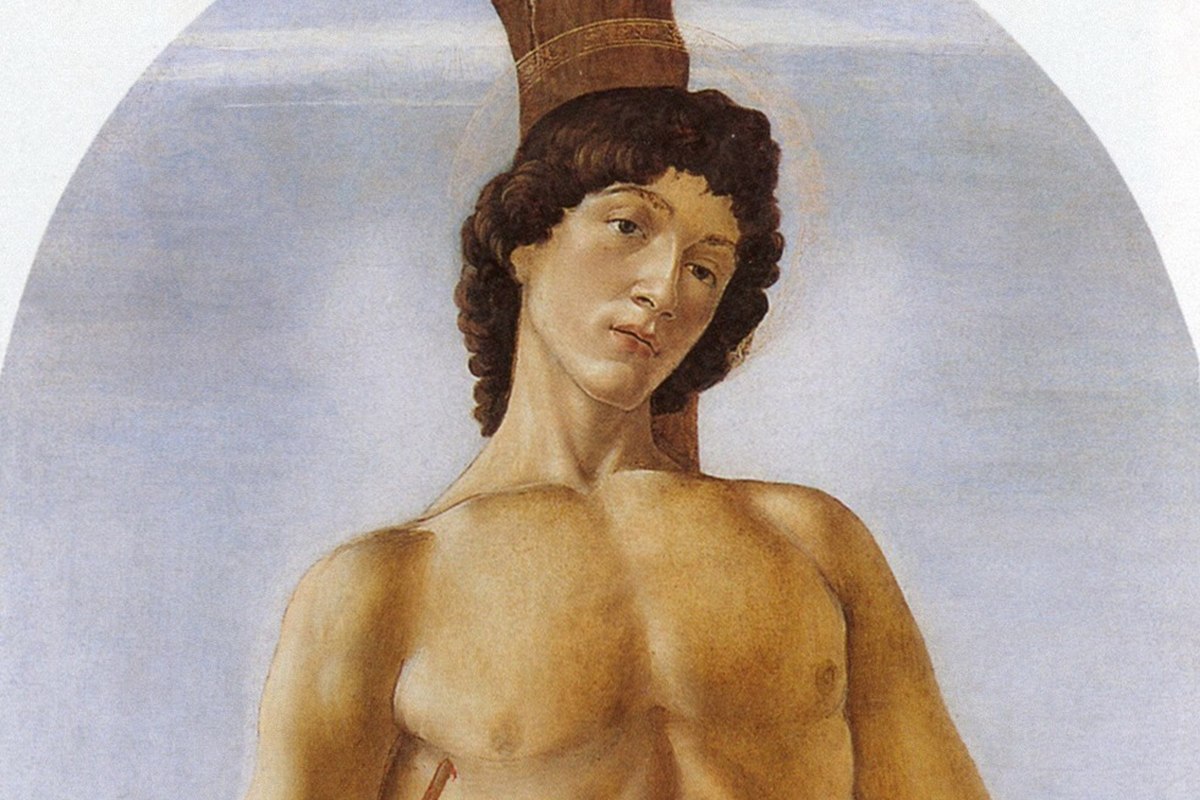
Sandro Botticelli, "Saint Sebastian," 1474 — public domain.
An execution he wasn't supposed to survive
When his double life was discovered, the sentence was direct: death by arrows, a punishment usually reserved as a warning to other soldiers tempted toward the same disobedience. Archers carried it out, and Sebastian was left for dead, pierced through in a scene that would go on to become one of the most frequently painted images in Christian art — captured, in the Botticelli version above, at the exact moment of impact rather than its aftermath, a composition artists returned to again and again over the centuries in part because it let them study the human form in a posture of both suffering and calm endurance. But he didn't die. A widow named Irene of Rome, who had come to recover his body for burial, found him still breathing and nursed him back to health in secret over a period of weeks, giving him a survival that, by any practical measure, should have ended his story right there.
Choosing confrontation over safety
It's what Sebastian does with that unlikely second chance that sets his story apart from most martyr accounts. Rather than disappearing into hiding once he had recovered, he deliberately positioned himself on a staircase Diocletian was known to use and confronted the emperor directly, openly condemning him for his cruelty toward Christians — a confrontation so bold that Diocletian reportedly did not at first recognize the man he believed he had already had executed. It could only end one way: he was arrested again and executed a second time, this time by beating with clubs inside the imperial hippodrome, a death from which there would be no quiet recovery, and his body was thrown into Rome's main sewer, the Cloaca Maxima, to prevent Christians from recovering and venerating it as a relic.
A survivor's reputation that outlived him
That first, improbable survival is precisely what shaped how Sebastian would be remembered for centuries afterward. Communities facing the plague turned to him specifically as a protector — reasoning, in a sense, that a man who had already endured being shot through with arrows and lived understood something about surviving what seemed certain to kill you. This association deepened during the great plagues of medieval Europe, when arrows themselves were often understood as a symbol of sudden, unseen disease striking down victims at random, making Sebastian's ordeal feel directly relevant to communities living in fear of contagion. Devotion to him surged again during outbreaks in Renaissance Italy, which is part of why so many of the era's greatest painters, not only Botticelli but also Titian and Mantegna, produced their own versions of his arrow-pierced form. It's a patronage built less on a single miracle and more on the simple, remembered fact that Sebastian's story didn't end where everyone assumed it would — a resilience that later inspired devotion to other soldier-saints, including Saint Michael the Archangel, venerated in a very different but related role as heaven's own defender against danger.
An enduring presence in art and civic life
Few martyrs have been depicted as often, or in as physically striking a form, as Sebastian, whose youthful, athletic body bound to a post or tree became one of the great recurring subjects of Western painting and sculpture from the early Renaissance onward. Beyond his role as protector against plague, cities across Italy and beyond adopted him as a civic patron, with confraternities dedicated to him organizing processions, charitable works, and public prayers particularly during times of epidemic disease, a pattern that repeated itself across Europe for centuries whenever contagion struck. He remains today the patron of athletes and soldiers as well, a patronage that grows naturally out of the physical endurance his story emphasizes, and his feast day, January 20, continues to be marked with particular devotion in Rome, where the Basilica of San Sebastiano fuori le mura, built over the catacombs where his relics were once venerated, still stands along the ancient Appian Way.
Trivia
What was Sebastian's role before his martyrdom?
How was Sebastian first executed?
What did Sebastian do after he recovered?
Why is Sebastian associated with protection from plague?
Related Reading