Saint Joan of Arc


Voices a teenage girl was believed about
Joan of Arc grew up in Domrémy, a small village in northeastern France, during one of the darkest stretches of the Hundred Years' War, when large parts of the country were under English control and the rightful heir to the French throne, Charles VII, had not yet been crowned. The war had already dragged on for nearly a century by the time Joan was born around 1412, and France itself was effectively split in two: territory loyal to Charles in the south and center, and territory controlled by England and its Burgundian allies in the north, including Paris itself. As a teenager, Joan reported hearing voices and experiencing visions she attributed to Saint Michael, Saint Catherine of Alexandria, and Saint Margaret of Antioch, telling her to support Charles and help drive out the English.
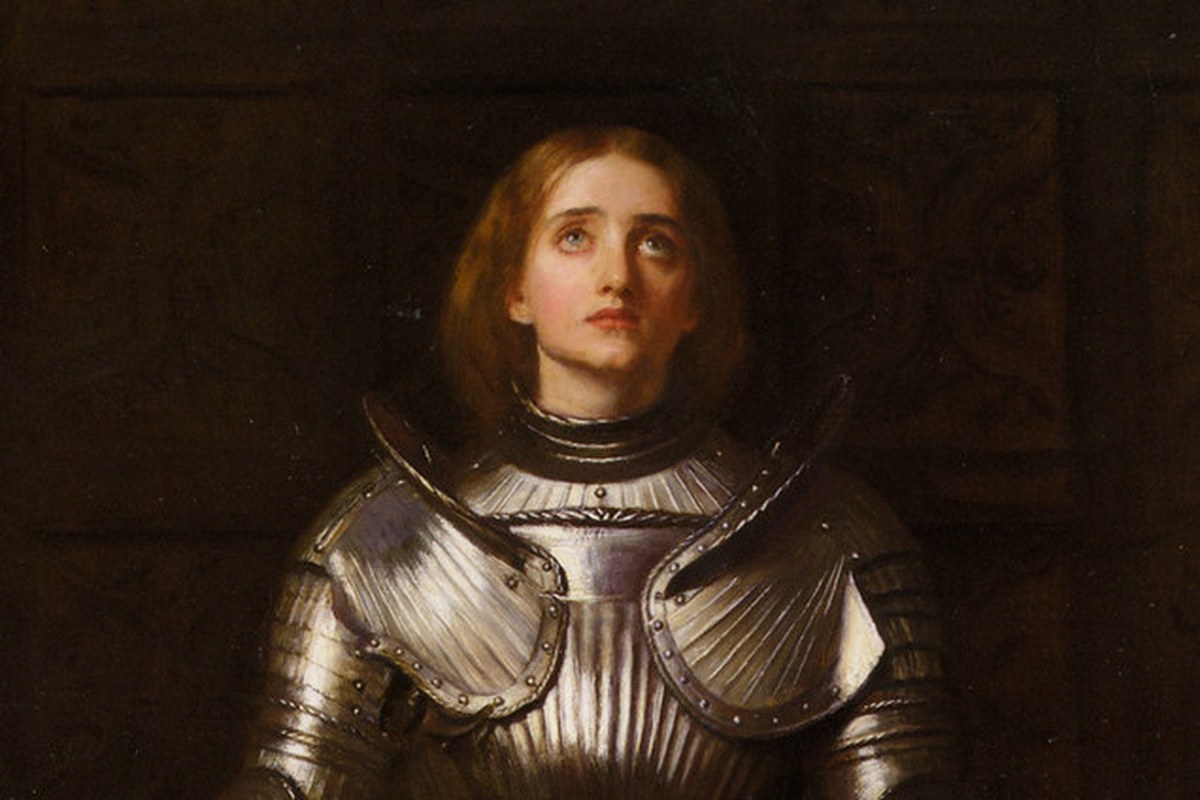
John Everett Millais, "Joan of Arc," 1865 — public domain.
Getting anyone to listen to her at all took persistence. Joan first approached a local garrison commander, Robert de Baudricourt, in 1428 and was turned away; she returned the following year and was finally granted an escort to the royal court at Chinon. Before she was allowed anywhere near Charles or his army, churchmen at Poitiers spent several weeks examining her — questioning her about her voices, her conduct, and her claims of virginity, since a woman claiming direct divine guidance was not something any medieval court took at face value. What's remarkable isn't only that a seventeen-year-old peasant girl claimed this — it's that the royal court, after real scrutiny, chose to believe her enough to act on it.
From village girl to battlefield leader
In 1429, Joan traveled to the besieged city of Orléans and played a central role in breaking the English siege — a turning point in the war that reversed years of French losses almost overnight. She went on to accompany French forces through further victories, and within months Charles VII was crowned at Reims, exactly as Joan's voices had reportedly told her he would be. Her authority in these campaigns came less from formal military rank than from the sheer conviction she projected, and the morale that conviction visibly gave to the soldiers around her.
She wore armor made to fit her and carried a banner rather than a sword into most engagements, and by her own account she avoided personal killing even in the thick of battle — her role, as she and her soldiers understood it, was to lead and to inspire rather than to fight hand-to-hand. Veteran commanders who had spent years fighting the English found themselves taking orders, in effect, from a teenage girl with no formal training, because the army's morale and momentum had become inseparable from her presence at its head.
Captured, tried, and executed at nineteen
Joan's success was short-lived. She was captured by Burgundian forces allied with England in 1430 and handed over for trial by a church court aligned with English interests, on charges that included heresy and wearing men's clothing. The trial was politically motivated from the start, aimed at discrediting the king she had helped crown by discrediting her. She was burned at the stake in Rouen on May 30, 1431, at about nineteen years old.
The trial record itself, ironically, is a large part of why Joan's story survives in such detail. Notaries kept extensive minutes of her interrogations, and what comes through in them is not a confused or broken girl but someone sharp enough to sidestep theological traps set by trained clergy. Asked at one point whether she believed she was in a state of God's grace — a question with no safe answer, since claiming certainty was itself heretical and denying it undermined her mission — she reportedly answered that if she was not, may God put her there, and if she was, may God so keep her. Charles VII, whose throne she had helped secure, made no serious effort to ransom or rescue her once she fell into Burgundian hands, a fact that has troubled historians ever since.
A verdict overturned, and a canonization centuries later
The story doesn't end at the stake. In 1456, a Church-ordered retrial examined the original trial's conduct and annulled the verdict entirely, declaring Joan innocent. It would take far longer for formal sainthood to follow — Pope Benedict XV canonized her on May 16, 1920, nearly five centuries after her death. Today she's honored as a patroness of France, a peasant girl whose claimed visions were believed just long enough to change the course of a war, and whose execution the Church itself would later call an injustice.
Joan has gone on to become one of the most depicted women in Western art and one of the most frequently invoked patrons in France, honored alongside figures like Saint Genevieve of Paris as a protector of the nation. Beyond France, she's often named a patroness of soldiers and, in a more modern development, of women in the military. Her feast day falls on May 30, the anniversary of her execution — a choice that turns the date of her death into the date the Church chose to celebrate her life, much as it does for other martyrs whose deaths became, in hindsight, the beginning rather than the end of their story.
Trivia
What did Joan of Arc claim guided her?
Did Joan of Arc actually lead troops into battle?
Why was Joan of Arc executed?
When was Joan of Arc declared a saint?
Related Reading