Pope Saint Pius X

A postman's son, and an emperor who tried to keep him off the throne
Giuseppe Sarto was born in 1835 in Riese, a small town in the Veneto region of Italy, the son of a village postman — one of the humbler backgrounds of any pope in the Church's modern history. He was one of ten children, and the family's modest means meant a local priest and the mayor of Riese helped fund his early education, without which a career in the Church would likely have been closed to him entirely. He rose through the ranks slowly and conventionally — parish priest, seminary spiritual director, bishop of Mantua — before being named Patriarch of Venice in 1893, a prestigious see, but not one that typically produced popes.
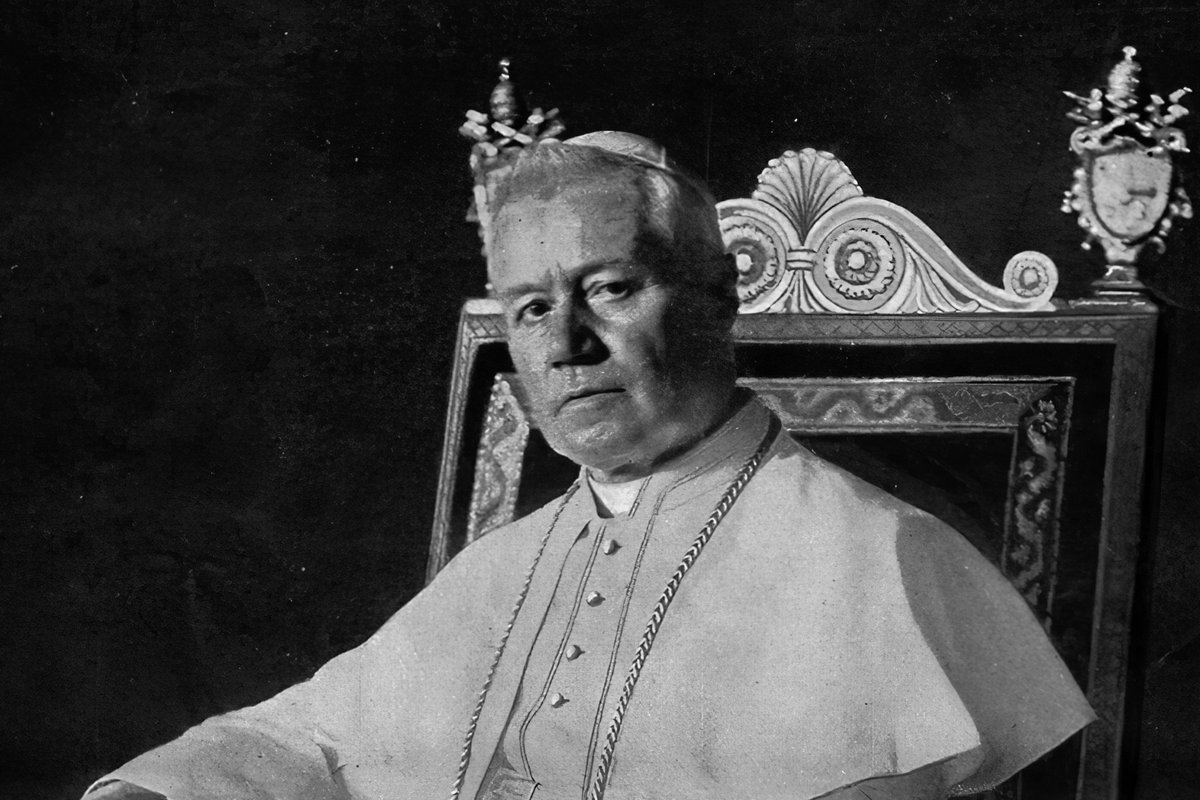
Photograph of Pope Pius X by Francesco De Federicis, October 1903, published in "Die katholischen Missionen," Herder Verlag — public domain.
By 1903 he had risen to Patriarch of Venice, respected but not considered a frontrunner when that year's conclave opened. The clear favorite was Cardinal Mariano Rampolla, the Vatican's Secretary of State, whose foreign-policy views leaned toward closer ties with France and Russia rather than the Central European powers, a preference that had made him unwelcome to Austria-Hungary's government specifically. Then Austria-Hungary's emperor, Franz Joseph, exercised the jus exclusivae — an old, informally tolerated privilege that let a handful of Catholic monarchies veto a single candidate in a conclave — and had a cardinal announce the objection to Rampolla on his behalf. With the frontrunner blocked, the cardinals turned to Sarto instead, and he was elected pope, taking the name Pius X.
Making sure no monarch could ever do that again
Rather than quietly accept the maneuver that had put him on the throne, Pius X moved almost immediately to abolish it. In his 1904 constitution Commissum Nobis, he formally banned any civil government from exercising a veto in future papal elections and threatened excommunication for any cardinal who tried to transmit one — closing off, permanently, the practice that had just worked in his own favor. It's a rare case of a leader dismantling the very mechanism that elevated him, and it remains the last time in history a secular monarch attempted to block a papal candidate.
Reportedly, Rampolla himself, informed of the veto during the conclave, reacted with visible anger at the interference before the cardinals moved on to elect Sarto instead — a detail that underscores just how unusual and unwelcome the intervention was even among churchmen used to centuries of entangled relations between the papacy and Catholic monarchies. Pius X's decisive response afterward wasn't simply principled housekeeping; it permanently reshaped how conclaves have been run ever since, removing secular political leverage from a process the Church has, since 1904, insisted belongs to the College of Cardinals alone.
Restoring all things in Christ
Pius X took as his motto Instaurare Omnia in Christo — "To restore all things in Christ" — and it captured the practical, reforming character of his papacy. He reorganized the Roman Curia, set in motion the project that became the Church's first unified Code of Canon Law, eventually promulgated in 1917 under his successor, and pushed back against theological trends he judged incompatible with traditional Catholic doctrine, most notably in his 1907 encyclical Pascendi Dominici Gregis, which condemned a cluster of ideas he grouped together under the label "Modernism." He is not counted among the Doctors of the Church — a title reserved for figures recognized for a substantial body of theological writing — and his legacy rests instead on pastoral and administrative reform rather than scholarship.
He also promoted frequent, even daily, reception of Communion for all the faithful, at a time when many Catholics still approached the sacrament only occasionally out of a sense of personal unworthiness. His 1905 decree on the subject reframed Communion less as a reward for already achieved holiness and more as spiritual nourishment meant to help ordinary believers grow in holiness in the first place — a shift in emphasis that, combined with his lowering of the First Communion age a few years later, reshaped how ordinary Catholic parishes approached the Eucharist for the rest of the century.
Lowering the age for First Communion
Perhaps his most lasting change for ordinary Catholic families came in 1910, with the decree Quam Singulari. For generations, children had typically been kept from receiving First Communion until early adolescence. Pius X's decree lowered the standard to around age seven — the traditional "age of reason" — arguing that children capable of basic understanding shouldn't be kept from the sacrament for years longer than necessary. The change held, and it's still the norm followed in Catholic parishes today.
A pope who never stopped living like a postman's son
Pius X died in 1914 and was canonized in 1954; his feast is kept on August 21. He has no single formal universal patronage, though he's informally associated with catechists, honoring his emphasis on religious instruction for ordinary believers. What stayed with people most, though, was how little the papacy changed him personally — by multiple accounts, drawn from his own last will and testament, he wrote plainly near the end of his life: "I was born poor, I have lived poor, I wish to die poor."
He died just as the First World War was breaking out across Europe, reportedly deeply distressed by the outbreak of a conflict he had tried, unsuccessfully, to help prevent through diplomatic appeals in his final weeks. Contemporaries described him as visibly worn down by the crisis in his last days, a final chapter that fit a pattern running through his whole papacy: a man who reached the highest office in the Church almost by accident of imperial politics, and who spent the years afterward trying, with a postman's son's plain instincts, to keep the institution he led focused on ordinary pastoral care rather than the grander political games that had briefly interrupted his own election.
Trivia
What was the 'jus exclusivae' that affected Pius X's election?
Did Pius X actually abolish that veto power?
Is Pope Pius X a Doctor of the Church?
What did Pius X change about First Communion?
When was Pius X canonized, and what is he remembered for personally?
You May Also Like
Related Reading