Saint Agatha of Sicily

A name older than any record of her life
What can be said with confidence about Agatha is frustratingly little, and it's worth being upfront about that from the start. A young Christian woman by that name was venerated in Sicily — either Catania or Palermo, sources disagree — from a very early date, almost certainly during the persecutions of the 3rd century under the Decian program of forcing Christians to sacrifice to Roman gods. That veneration is ancient enough and widespread enough that the Church included her among the virgin martyrs named in the Roman Canon, the oldest eucharistic prayer still used at Mass today, placing her in company with figures like Lucy and Agnes. Beyond that bare outline — a real woman, a real martyrdom, honored almost immediately by the communities who remembered her — the historical trail runs out.
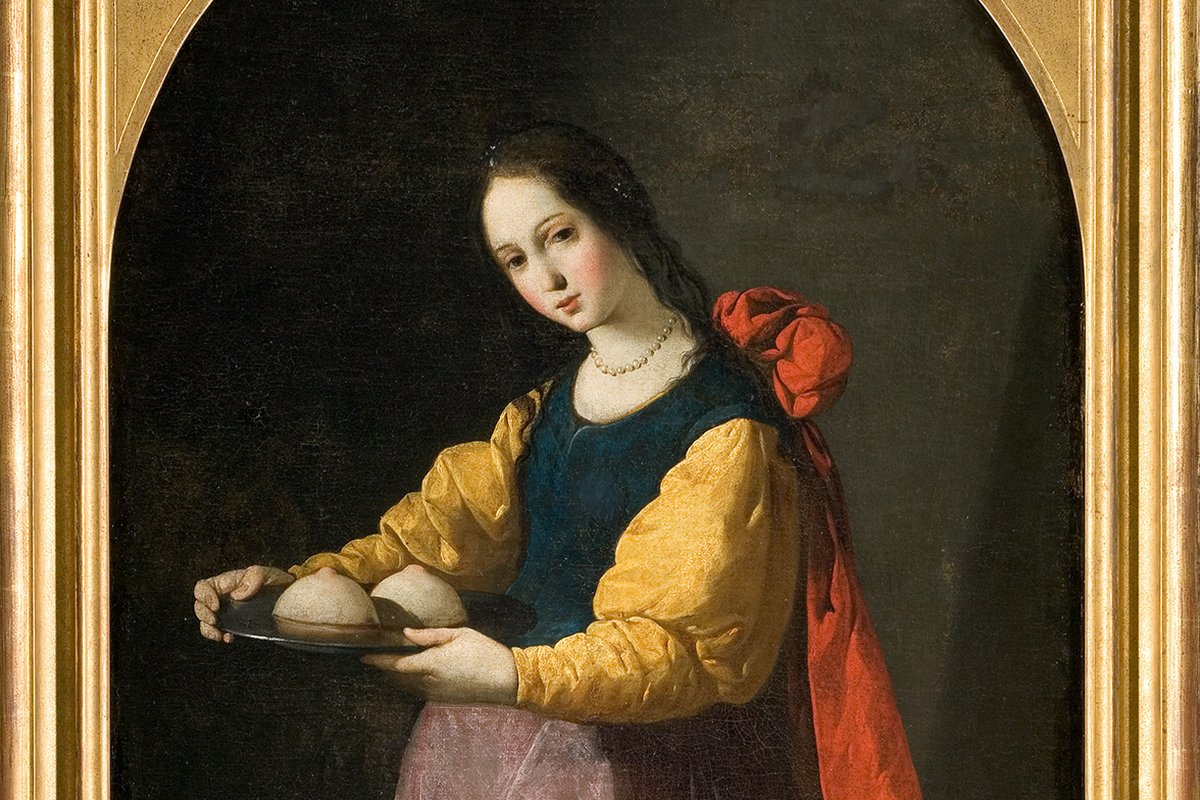
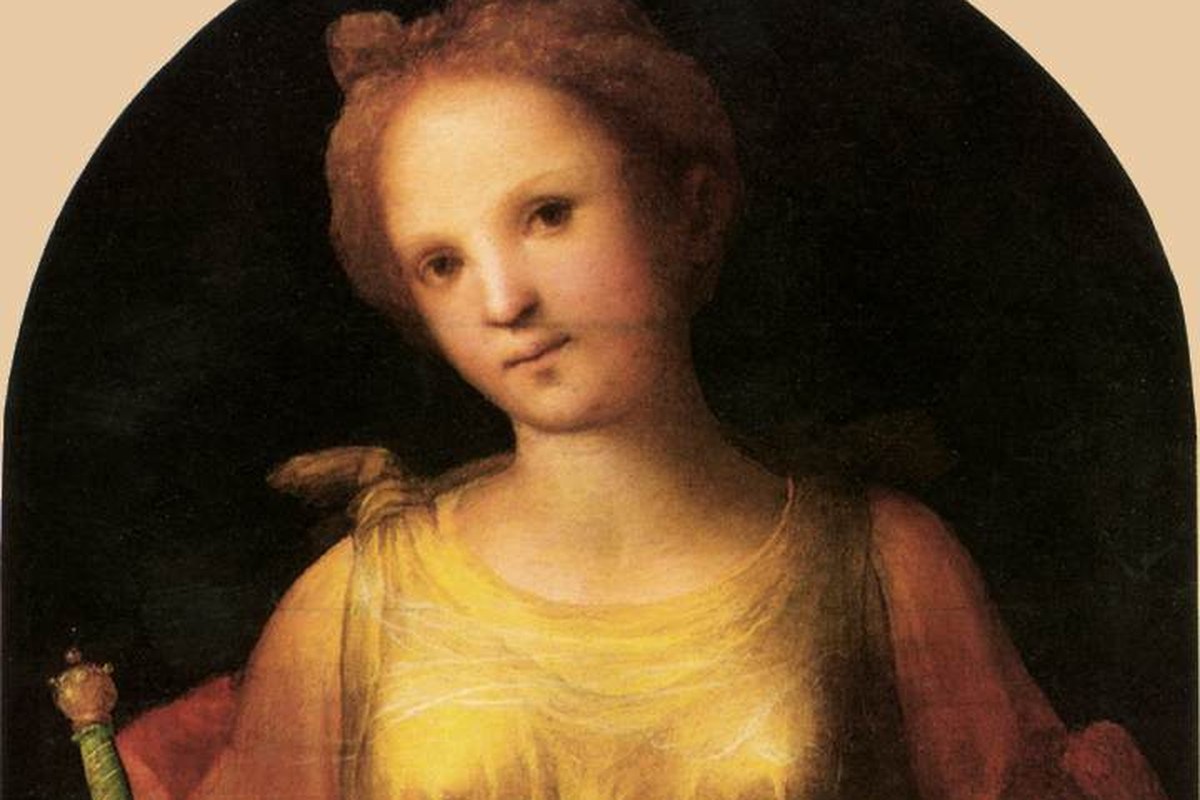
Francisco de Zurbarán, "Saint Agatha," 1630, Musée Fabre, Montpellier — public domain.
The legend, and why it has to be labeled as one
The vivid story most people associate with Agatha comes from her Acts, an ancient hagiographical text — a genre of writing focused on glorifying a saint's life and death, not on the kind of sourced, cross-checked reporting a modern historian would recognize as reliable. According to that account, Agatha refused marriage to Quintianus, the Roman prefect governing Sicily, because she had already consecrated her life to Christ. When she wouldn't yield, he had her arrested during the Decian persecution and subjected her to brutal torture, including having her breasts cut off. The legend adds a consoling vision afterward: Saint Peter the Apostle appearing to her in prison and miraculously healing her wounds before she ultimately died in captivity. It's a dramatic and often-painted scene — and it needs to be read as exactly that. The Catholic Encyclopedia states plainly that her Acts "cannot lay claim to historical credibility," meaning none of these specific details can be verified as fact. What's solid is the veneration itself, not the narrative built around it centuries later.
Bells, breasts, and a patronage built on imagery
Two of Agatha's patronages trace directly back to the imagery in that legendary account, which is worth understanding as a matter of tradition even where the underlying story can't be verified. She's invoked by breast cancer patients precisely because her legend centers on that specific suffering — women facing that disease have turned to her for comfort across centuries, regardless of whether the ancient details are historically airtight. Bell-founders claim her too, through a visual link popular devotion drew between the shape of a church bell and imagery tied to her story. Neither connection depends on Agatha having actually done anything related to medicine or metalworking in her lifetime; both grew organically out of how her legend was remembered and depicted in art.
Catania's saint
Nowhere is Agatha honored more intensely than in Catania, Sicily, where she's venerated as principal patroness of the city and, more broadly, of the whole island. Her feast, February 5, still draws one of the largest religious festivals in Italy, with her relics processed through the city streets in a tradition that stretches back centuries. That living, continuous devotion is itself part of the historical record in a way the martyrdom narrative isn't — it documents how thoroughly a community adopted a saint as its own, even when the specific facts of her death were never something anyone could pin down with certainty.
A patronage tied to a volcano, too
Agatha's connection to Sicily runs deeper than civic pride — it's tied directly to the island's most dominant physical feature, Mount Etna. Local tradition holds that during a major eruption not long after her death, Catania's residents carried her veil, believed to be a relic of hers, toward the advancing lava, and that the flow stopped or diverted before reaching the city. Whether or not any particular eruption actually behaved that way, the story has been repeated and reenacted for centuries, and Agatha's intercession against Etna's eruptions became, in local devotion, almost as central to her identity as the martyrdom account itself. Even today, when Etna is active, it's not unusual for Catanians to invoke her protection specifically — a patronage grown out of geography and repeated local memory rather than anything in her formal Acts.
Bread, veils, and how a feast becomes a festival
The Festa di Sant'Agata, held each February in Catania, has grown into a multi-day event involving a massive silver reliquary bust and processional carriage (the fercolo), pulled through the city by devotees in traditional white robes called sacco, alongside fireworks, music, and food specific to the occasion — including small pastries called minne di Sant'Agata ("Saint Agatha's breasts"), a sweet, direct reference to her legend that Sicilians treat as an ordinary feast-day tradition rather than anything morbid. UNESCO has recognized the festival among Italy's most significant intangible cultural heritage events, drawing participants and visitors from well beyond Sicily each year. It's a striking example of how a story that can't be verified as history has nonetheless generated an enormous, living, continuously renewed cultural tradition — proof that a community's devotion doesn't require documentary certainty to remain genuinely powerful.
Agatha among the Roman Canon's named women
Agatha's inclusion in the Roman Canon places her alongside a short, specific list of women the early Church singled out by name in its oldest surviving eucharistic prayer, including Felicity, Perpetua, Lucy, Agnes, Cecilia, and Anastasia. That list, essentially unchanged since antiquity, offers its own kind of historical evidence — not proof of the details in any one woman's individual Acts, but solid proof that these particular names carried enough weight in the Church's earliest liturgical memory to be preserved in its most central prayer, recited at Mass continuously for well over a thousand years, regardless of how much or how little could later be verified about the specifics of what happened to each of them.
Trivia
Who was Saint Agatha of Sicily?
Is the story of Agatha's torture historically documented?
Why is Saint Agatha the patron saint of bell-founders?
Why is Saint Agatha invoked by breast cancer patients?
When is the feast of Saint Agatha, and where is she especially honored?
You May Also Like
Related Reading