Saint Anastasia

What's actually known — and it isn't much
Start with the honest baseline: a woman named Anastasia was martyred, by tradition around 304 AD, and venerated from a very early date at Sirmium, an important Roman city in the province of Pannonia, in what's now Serbia. That veneration was real and it was ancient — early enough and significant enough that her name eventually entered the Roman Canon, the Church's oldest surviving eucharistic prayer, placing her among a short list of martyred women, including Perpetua, Felicity, Agnes, and Agatha, considered too important to Christian memory to leave unnamed at Mass. Beyond that — a real martyr, a real city, an early cult — the verifiable record stops.
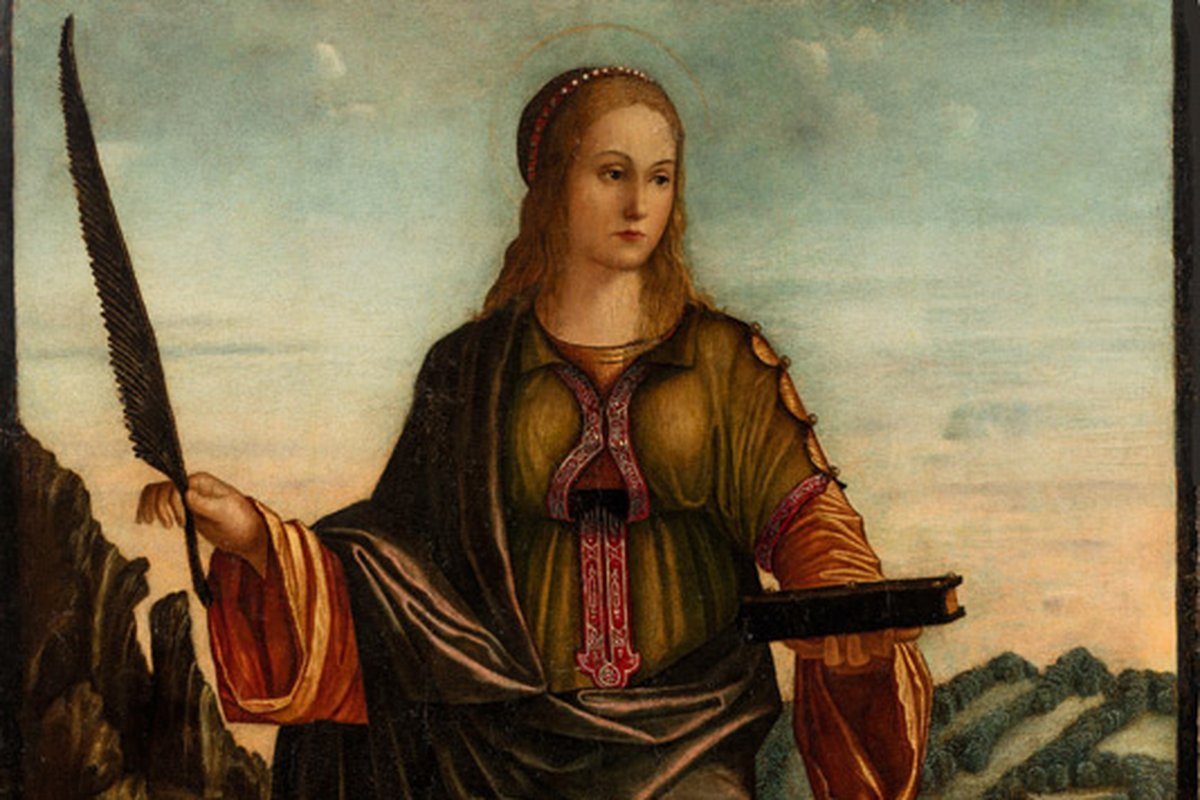
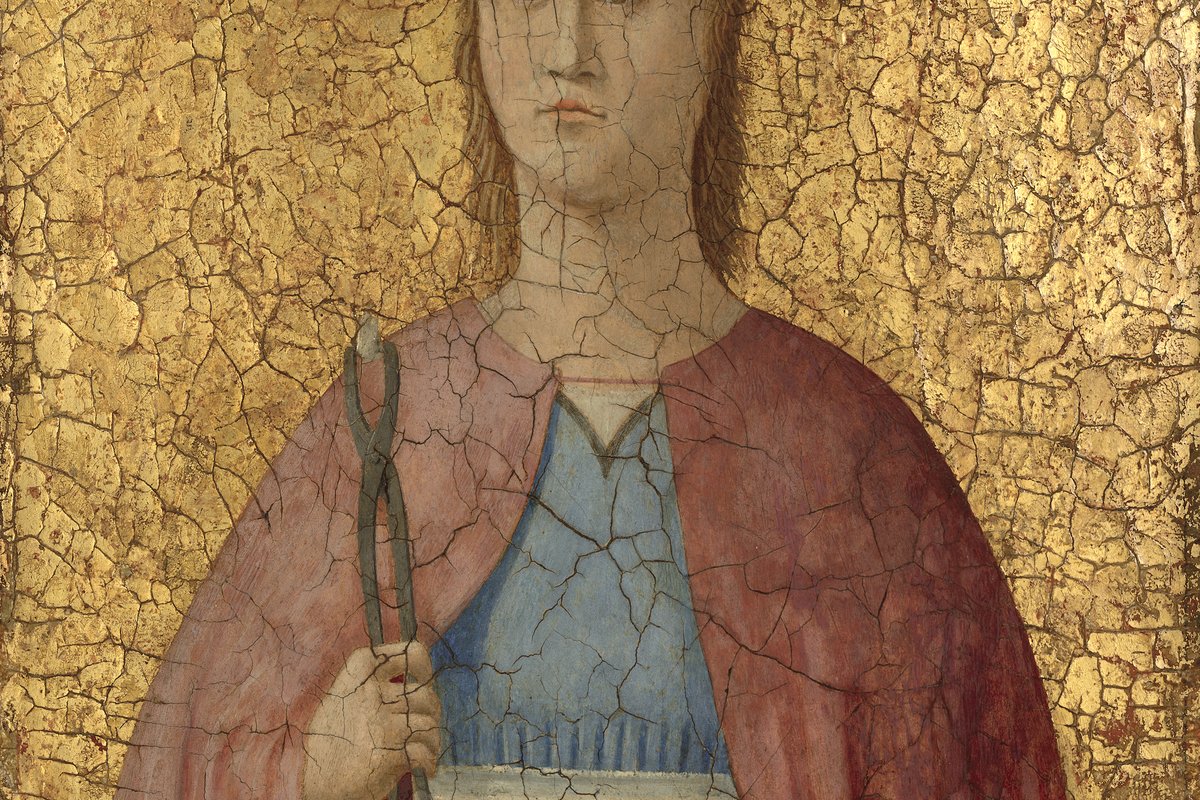
Vittore Carpaccio, "Saint Anastasia," panel from the Zadar Polyptych, c. 1480–90 — public domain.
A passio the Church's own scholars call legendary
Everything more specific that circulates about Anastasia's life comes from her passio, the ancient narrative account of her suffering and death, and it needs to be treated with real skepticism. The Catholic Encyclopedia doesn't hedge on this point: it states outright that her surviving passio "is purely legendary and rests on no historical foundations." That's about as direct a warning label as a Church reference source ever attaches to a saint's story. Whatever specific details you might come across elsewhere — about her family, her trials, the particulars of her death — belong to later legendary elaboration, not to anything that can be traced back to a contemporary or near-contemporary record. It's worth being explicit about that rather than repeating an unverifiable narrative as if it were settled history.
What the legend says, even if it can't be verified
Since the legendary passio is what most later devotional writing drew on, it's worth summarizing briefly, with the caveat already firmly in place. The story describes Anastasia as a Roman noblewoman, daughter of a pagan father and a Christian mother, secretly instructed in the faith and eventually widowed by a pagan husband who, in this telling, had treated her cruelly for her beliefs. She is said to have used her freedom and resources after his death to minister to imprisoned Christians during a period of persecution, before eventually being arrested herself and put to death, traditionally associated with the persecution under Emperor Diocletian in the early 4th century. It's a narrative that follows a recognizable pattern found in many early virgin-martyr legends — noble birth, secret conversion, charitable ministry to fellow Christians, and a final martyrdom — a pattern common enough across these legendary accounts that scholars generally treat it as evidence of later hagiographical convention rather than an individually documented biography.
A saint tied to two places
Anastasia's cult developed a dual geography that reflects how early Christian veneration often worked, spreading and layering across regions rather than staying fixed to one site. Her strongest and earliest roots are at Sirmium, but by the early medieval period she was also venerated in Rome, where a church dedicated to her — Sant'Anastasia, near the Palatine Hill — became one of the city's ancient titular churches, the parish-like foundations tied to the earliest Roman Christian communities. That Roman connection is part of why she ended up woven into the city's liturgical calendar so prominently, including the custom that still defines her feast today.
The saint of Christmas morning
The most distinctive thing about Anastasia's ongoing place in Catholic worship is the second Mass said in her honor on December 25 — a custom rooted in the ancient Roman liturgical calendar, where her feast fell on the same day as the Nativity itself. In the traditional Roman Rite, this produced a set of Masses for Christmas Day that included one offered specifically for Anastasia, layered alongside the principal Christmas liturgies. It's a striking arrangement precisely because so little can be verified about who she actually was — a testament to how durable ancient veneration can be, even when the story attached to a name turns out, on closer historical inspection, to be legend rather than record.
Why the Church keeps venerating a saint it can't fully verify
Anastasia's case is a useful, honest example of how the Church actually handles its oldest saints, and it's worth explaining that plainly rather than glossing over it. Sainthood, in the earliest centuries of Christianity, wasn't established through the careful, document-based process used today — no formal investigation, no canonically verified miracles, no postulator gathering testimony. Early martyrs were venerated locally, often at their place of death or burial, based on the community's own memory and devotion, sometimes generations before anyone wrote down a fuller account of their life. By the time a written passio was composed for a figure like Anastasia, decades or even centuries after her death, the author was often working from fragments of oral tradition mixed freely with stock hagiographical conventions borrowed from other martyr stories — which is exactly why the Catholic Encyclopedia can affirm both that a real Anastasia was genuinely martyred and venerated, and that the detailed narrative attached to her name centuries later doesn't hold up as history. The Church distinguishes, in cases like this, between the fact of ancient, authentic veneration — which it continues to honor liturgically — and the legendary elaboration built up around it later, which it does not present as verified biography. Saints such as Saint Apollonia, another early martyr whose surviving legend likewise outpaces the verifiable historical record, follow a similar pattern.
Trivia
Who was Saint Anastasia?
Is the story of Saint Anastasia's life historically documented?
Why does Saint Anastasia get a special Mass on Christmas Day?
Is Saint Anastasia the patron saint of anything specific?
When is the feast of Saint Anastasia?
You May Also Like

Related Reading