Saint Lucy of Syracuse

Born to privilege in Roman Sicily
Lucy was born around 283 AD to rich and noble parents in Syracuse, a prosperous port city on the eastern coast of Sicily that had been under Roman control for centuries. Her father, of Roman origin, died when she was only five, leaving Lucy and her mother, Eutychia, without a male guardian in a household that still carried considerable wealth. That wealth mattered: in Roman Sicily, a woman without a husband or father to manage her affairs was vulnerable, and Eutychia, in poor health, was anxious to see her daughter settled before anything happened to her.
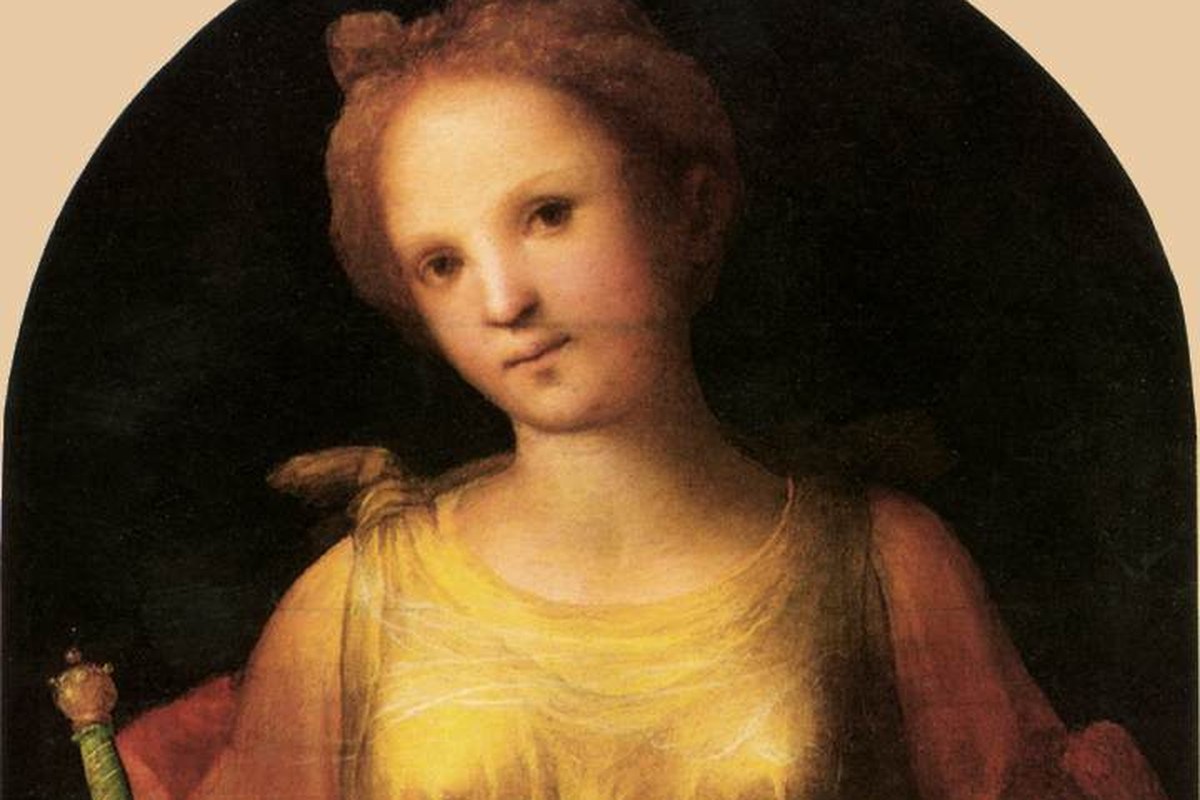
Traditional depiction of Saint Lucy of Syracuse, public domain.
A pilgrimage, a healing, and a vow that collided with her mother's plans
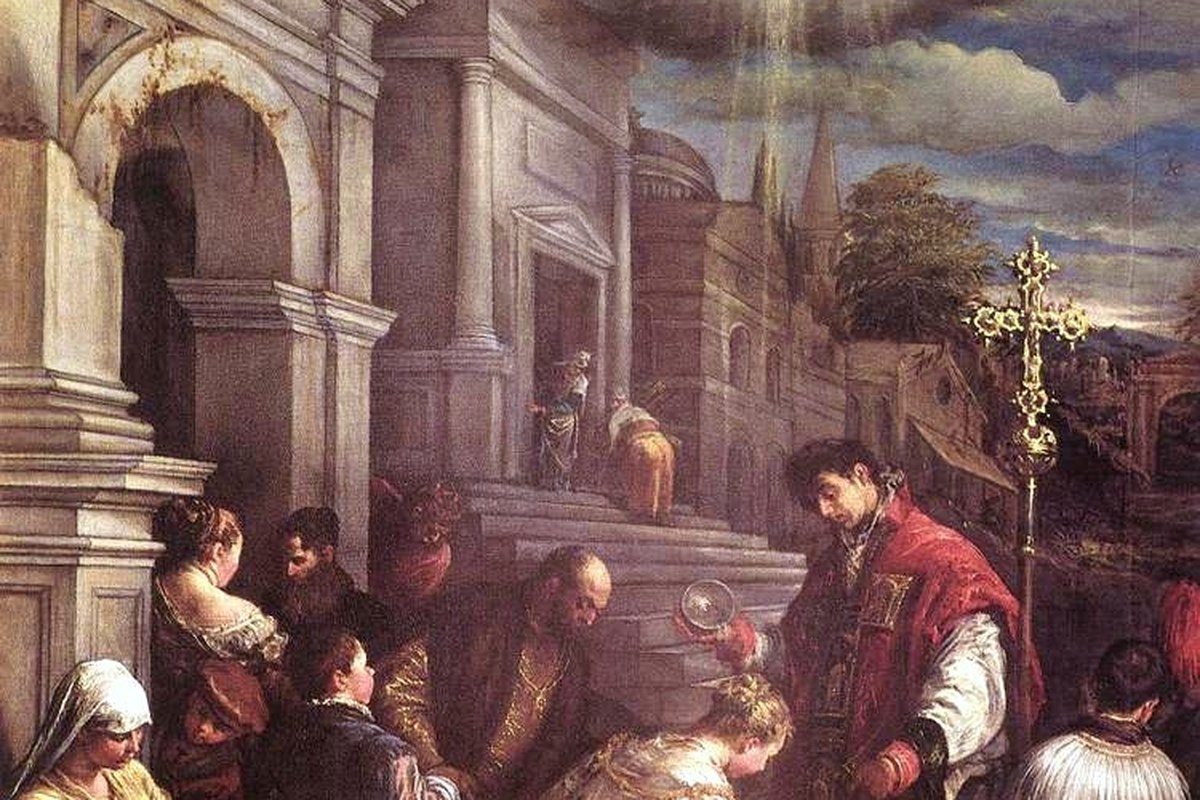
Like many early Christian martyrs, Lucy had secretly consecrated her virginity to God and intended to give away her dowry to the poor rather than marry. According to tradition, her mother Eutychia suffered for years from a chronic bleeding disorder, and the two women traveled together to the shrine of Saint Agatha in Catania — another young Sicilian martyr put to death a generation earlier — to pray for a cure. Eutychia was healed, and in gratitude, Lucy persuaded her mother to release her from the marriage that had already been arranged and to let her distribute her dowry to the poor of Syracuse instead. That decision put Lucy on a collision course with the young pagan nobleman she had been promised to, who had been counting on her fortune.
Betrayed, and repeatedly spared
The spurned suitor, angry at losing both a bride and a dowry, reported Lucy's Christian faith to the local Roman authorities during the Diocletianic Persecution, the last and most severe wave of Roman state violence against Christians before Constantine's Edict of Milan legalized the faith in 313. Lucy was first sentenced to forced prostitution in a brothel as a punishment meant to humiliate her, but tradition holds that when the guards came to drag her away, she became immovable — neither soldiers nor a team of oxen could move her from the spot. Condemned next to be burned alive, she reportedly stood untouched in the flames while bundles of wood were piled around her. She was finally killed by a sword thrust through the neck, dying in Syracuse in 304 AD, still in her early twenties.
The patroness of the blind
Another strand of her legend, popular in art and devotion though not part of the earliest accounts, holds that Lucy removed her own eyes to discourage a persistent suitor who had praised them, and that when her body was prepared for burial, her eyes were found miraculously restored, more beautiful than before. This is pious legend rather than a claim of the Church's official teaching, but it shaped centuries of religious art: Lucy is traditionally shown holding a small dish or plate bearing a pair of eyes, alongside the palm branch that marks her as a martyr. Whether through that legend or through the simple meaning of her own name — Lucia, from the Latin lux, "light" — she became the patroness of the blind and of those with eye trouble, and is also invoked against various diseases of the eyes.
A name that outlasted an empire
Lucy's feast, observed on December 13, fell close to the winter solstice under the old Julian calendar, which gave rise to the saying "Lucy light, Lucy light, shortest day and longest night" in parts of northern Europe. In Sweden and Norway, Saint Lucy's Day became a major midwinter festival centuries later, with girls wearing crowns of candles in her honor to carry light into the darkest time of year — a tradition that has little to do with her Sicilian origins but everything to do with how thoroughly her name became bound up with light itself. In Syracuse, she remains the city's principal patroness, and her relics have been moved and fought over by various rulers across the centuries, a testament to how highly her intercession was valued. She remains one of only eight women, alongside the Virgin Mary, explicitly named in the Roman Canon of the Mass — the Eucharistic Prayer used at Mass since the earliest centuries of the Church — placing her among a small group of early martyrs whose names Catholics have recited at the altar for some seventeen hundred years.
A life documented mostly through legend
As with many martyrs of the earliest centuries of the Church, no account of Lucy's life survives from her own lifetime; the narrative familiar today was written down generations later, blending a core of historical memory with details that grew in the retelling, a pattern common to hagiography (the literary genre devoted to the lives of saints) from this period. What historians consider solidly established is simply that a young Christian woman named Lucy was martyred in Syracuse during the Diocletianic persecution and quickly became the object of intense local devotion — evidenced by early inscriptions and by the fact that her name was added to the Roman Canon within a few centuries of her death, an honor reserved for figures whose cult had already become widespread and firmly rooted. The specific details of the brothel sentence, the fire, and the self-inflicted blinding belong to the realm of pious tradition built up around that historical core, offered by the Church not as literal verified fact but as a way of expressing the totality of her courage and the price of her fidelity.
Trivia
Who was Saint Lucy of Syracuse?
Why was she martyred?
Why is she the patron saint of the blind?
How is she honored in the Mass itself?
Related Reading