Saint Alban of Britain

An unlikely host
Alban lived as a pagan citizen of Verulamium, a substantial Roman town on the site of what's now the English city that bears his name, St Albans. Verulamium was no backwater — it was one of the largest towns in Roman Britain, with a forum, a basilica, and a theater, the kind of place where a well-off citizen like Alban would have had standing to lose. According to the tradition Bede later recorded, a Christian priest fleeing persecution came to Alban's door seeking shelter, and Alban took him in — an act of simple hospitality that, in the climate of Roman persecution of Christians, carried real risk. Later medieval versions of the story name the priest Amphibalus, though that name doesn't appear in Bede's earlier account and may have arisen from a simple misreading of the Latin word for "cloak," which plays such a central role in what happens next.
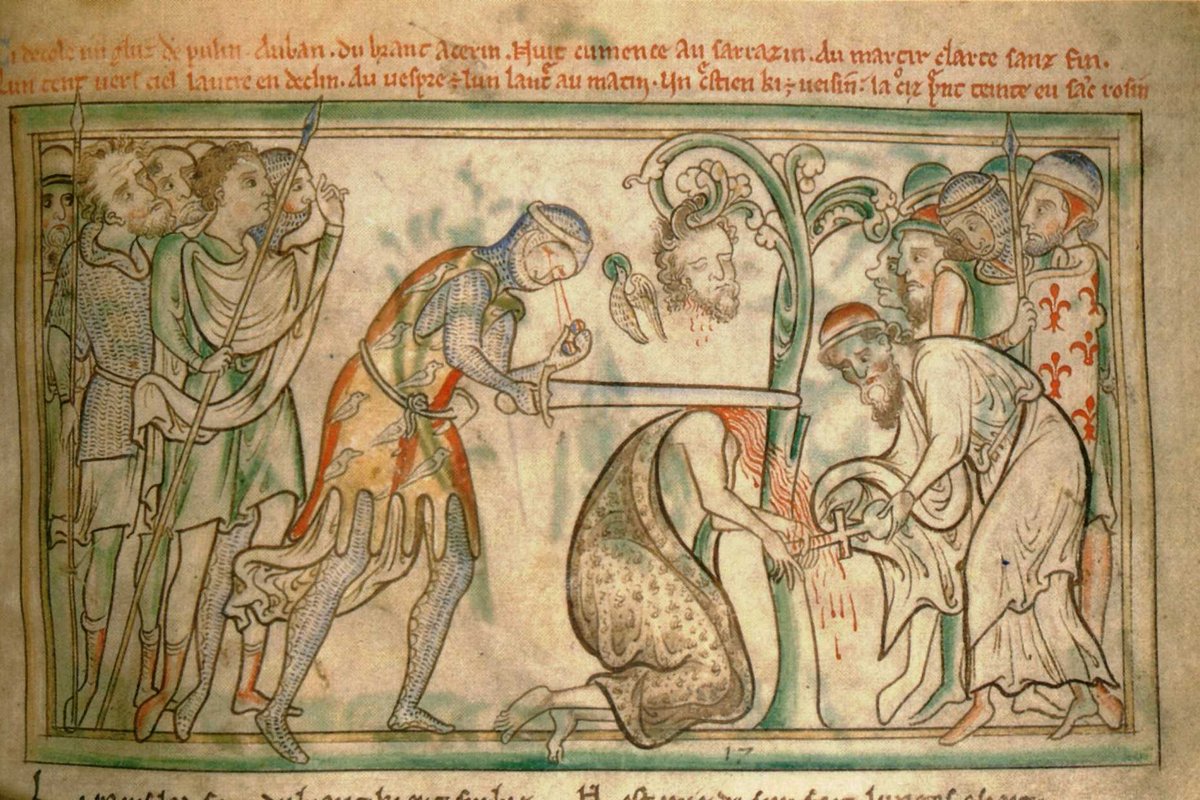
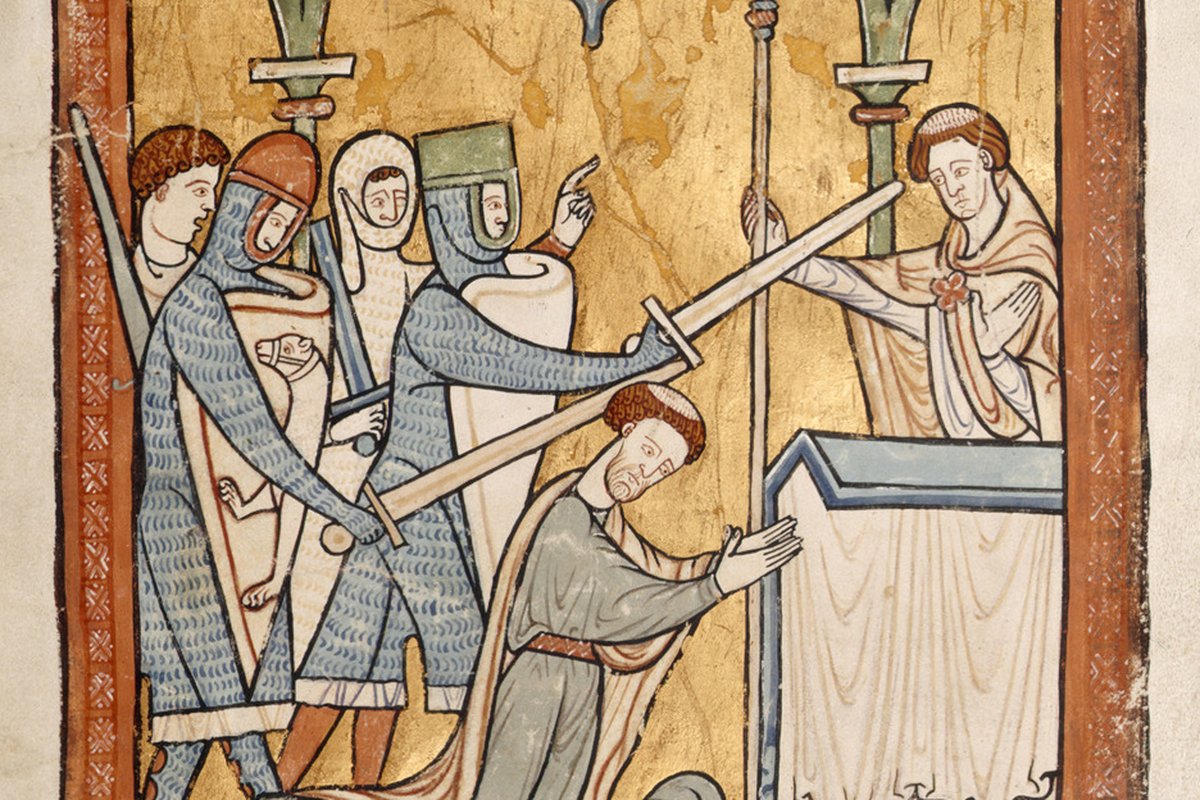
Matthew Paris, "The Martyrdom of Saint Alban," Life of St Alban manuscript, MS E.I.40, folio 38r, 13th century, Trinity College Dublin — public domain.
Living alongside the priest for some days, Alban was struck by his visitor's faith and devotion, and by his own account was converted to Christianity through that direct exposure, before any soldier ever came looking. It's worth pausing on that detail, because it sets Alban apart from most of the martyrs venerated from this period: he wasn't a lifelong believer condemned for a faith he'd always held, but a recent convert, still new to what he professed, when the test came.
The trade that cost him his life
When Roman soldiers finally arrived to search Alban's house for the priest, Alban made the decision that defines his entire story: he put on the priest's cloak, presented himself in the priest's place, and allowed himself to be led away in his stead, buying the real fugitive time to escape. When the deception was discovered, Alban was brought before a judge and ordered to sacrifice to the Roman gods. He refused, declaring himself a Christian, and was condemned to execution. It's a comparatively spare, direct account by the standards of ancient martyr stories — there's no elaborate torture sequence, no lengthy theological debate, just a decisive act of substitution and the consequence that followed it.
Bede records that on the way to his execution, Alban's escort had to cross a river, and the crowd gathered to watch was so large that the bridge couldn't hold them. Whether or not every detail of the journey happened exactly as later retold, the shape of the account — a public procession, a crowd, a hill outside the town chosen for the execution — reads like the memory of a real event that mattered enough to the local community to be preserved and passed down, even in an era before the story was formally written.
A date historians still argue about
Unlike many entries in this blog's saints archive, Alban's story doesn't come from ancient hagiography written in the immediate aftermath of a persecution. The earliest full account is Bede's Ecclesiastical History of the English People, composed in the 8th century — centuries after Alban is supposed to have died. That gap is exactly why his death date remains genuinely unsettled: some historians place it around 209 AD, during an earlier wave of persecution, while others argue for a date closer to 304, under the persecution of Diocletian. Later medieval retellings added miraculous embellishments around his execution — reported wonders at the moment of his death that don't appear in the earliest layer of the tradition. Those later flourishes should be read as legendary elaboration layered onto a comparatively well-attested core story, not as part of the original record.
What historians do largely agree on is that Alban's veneration is old — older than the written accounts that survive. The 4th-century bishop and writer Constantius of Lyon, in his life of Saint Germanus of Auxerre (see our article on Saint Germanus for a different Germanus active in the same broad era of the early Church), mentions a shrine to Alban already standing in Britain when Germanus visited in 429 AD. That's a full three centuries before Bede wrote his account, which means the cult of Alban was already established, with a physical site of pilgrimage, well before anyone put his story into the form we now read.
Britain's first martyr, and a patron for the displaced
Whatever the precise date, Alban holds the distinction of being Britain's first recorded Christian martyr, and his cult grew into one of the most significant in early English Christianity — a great abbey and later cathedral were built on the traditional site of his execution, and the town that grew up around it eventually took his name. The abbey, founded in the 8th century by King Offa of Mercia and rebuilt in grand Norman style after the Conquest, still stands today as St Albans Cathedral, and a shrine to Alban remains inside it, restored in the 20th century after having been dismantled during the Reformation. His feast is kept on June 22.
In devotional art, Alban is most often shown at the moment of his martyrdom — kneeling, dressed in the priest's borrowed cloak, sometimes holding a sword or standing before a headsman, as in the 13th-century manuscript illumination that accompanies this article. That image, painted by the monk and chronicler Matthew Paris at St Albans Abbey itself, is one of the earliest surviving depictions of the saint and comes from a full illustrated life of Alban produced by the community that had cared for his shrine for centuries.
In recent devotion, Alban has become an invoked patron of refugees, converts, and torture victims, a patronage that flows naturally from the shape of his own story: a man who sheltered someone in flight, was changed by that encounter, and ultimately gave his own life rather than hand the fugitive over. It's a story that keeps finding new resonance — a reminder that the impulse to protect a stranger at real cost to oneself is as old as the Church in Britain itself.
Trivia
Who was Saint Alban of Britain?
When did Saint Alban die?
What is the earliest source for the story of Saint Alban?
Did Saint Alban really switch clothes with the priest he sheltered?
Why is Saint Alban invoked as a patron of refugees?
You May Also Like
Related Reading