Saint Thomas Becket

From chancellor to archbishop
Thomas Becket was born around 1119 or 1120 in London, the son of a merchant family, and rose through a combination of talent and connections to become King Henry II's Lord Chancellor — effectively the king's chief administrator and closest confidant, a role in which Becket proved himself entirely loyal to royal interests, even when that meant leaning on the Church itself. The two men were genuinely close, hunting and feasting together as friends as much as king and servant, and when the see of Canterbury — once held by reforming archbishops like Saint Dunstan of Canterbury — fell vacant in 1162, Henry pushed hard for Becket's appointment as archbishop, expecting to gain a compliant ally at the very top of the English Church, someone who would keep royal and ecclesiastical power comfortably aligned. Becket himself is said to have warned Henry that the appointment would end their friendship, since he would have no choice but to put the Church's interests ahead of the crown's the moment he took the office seriously. Henry apparently dismissed the warning as false modesty. It wasn't.
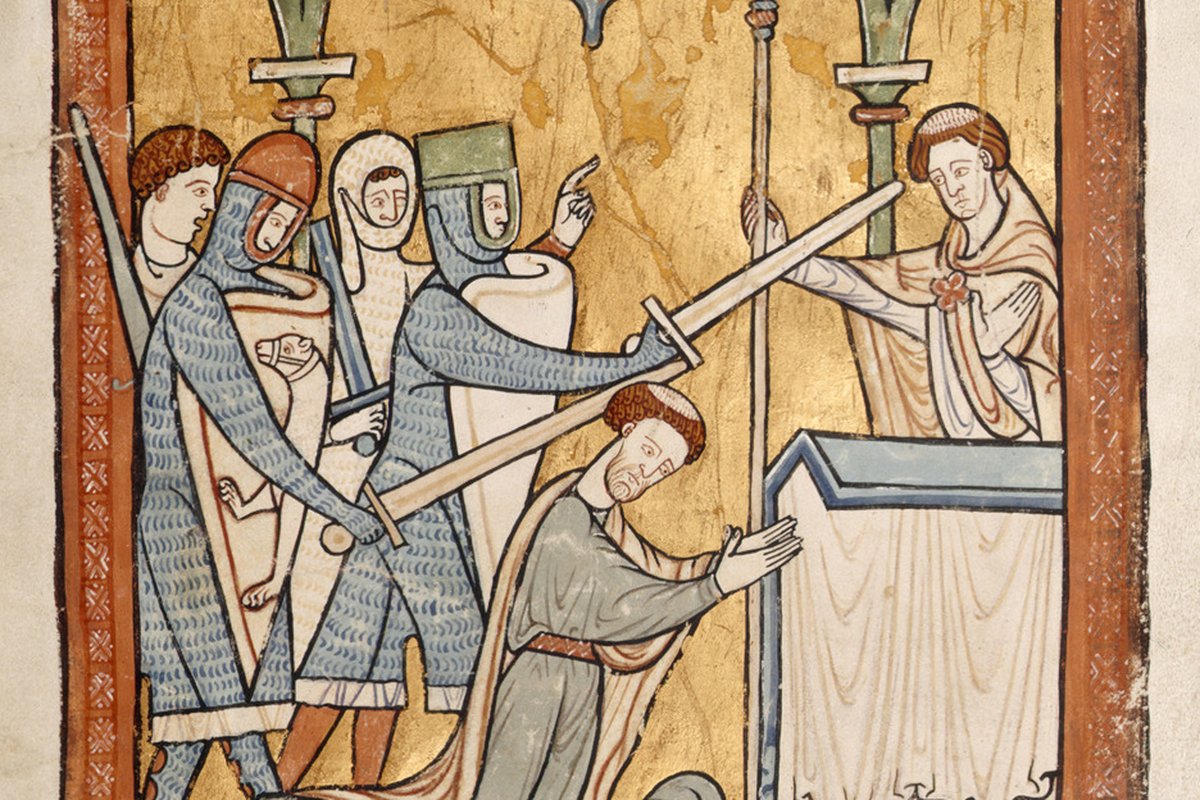
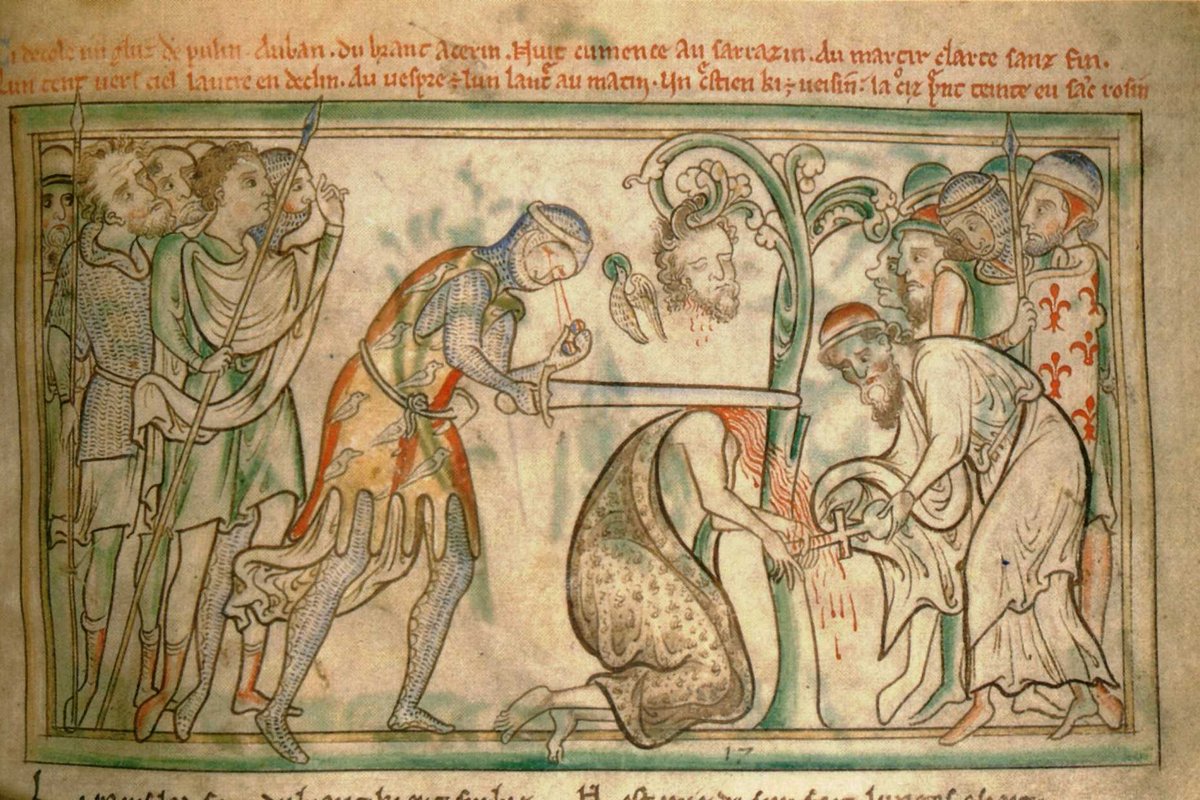
Unknown English illuminator, the earliest known depiction of the murder of Thomas Becket, circa 1200, British Library, Harley MS 5102, f. 32 — public domain.
It didn't work out that way. Almost as soon as he was consecrated, Becket underwent what looked to contemporaries like a genuine transformation, trading the political flexibility of his chancellorship for a fierce, uncompromising defense of the Church's independence from royal interference. The break came to a head over the Constitutions of Clarendon in 1164, a set of measures Henry pushed through asserting greater crown authority over clergy accused of crimes — traditionally tried in Church courts rather than royal ones — among other efforts to bring ecclesiastical power under tighter royal control. Becket resisted, was driven into exile in France for several years, living under the protection of King Louis VII and at times sheltering in Cistercian monasteries, and returned to England in 1170 still refusing to back down, reigniting a conflict that had never actually been resolved. His return was meant to be a reconciliation, brokered after tense negotiations, but Becket immediately excommunicated several bishops who had sided with Henry during the dispute — a move that reopened the wound within days of his arrival and set the final confrontation in motion.
Words that became a death sentence
The conflict reached its breaking point over Becket's continued defiance after his return, and Henry, by every account genuinely furious, is reported to have exploded into an angry outburst about being rid of his troublesome archbishop. The exact wording of what he said has never been settled with certainty — several medieval chroniclers preserve the moment in slightly different phrasings, and the version now famous, "Will no one rid me of this turbulent priest?", is best understood as the general sense later tradition distilled from those variant accounts rather than a verified transcript of Henry's actual words. Whatever he said, four knights in his court took it as a command. They crossed from Normandy to Canterbury Cathedral with the clear intention of confronting Becket, and possibly forcing his arrest or exile — though what actually followed went well past that.
Murder during vespers
On December 29, 1170, the knights found Becket in Canterbury Cathedral during vespers and demanded he submit to the king's authority. He refused. What happened next is unusually well documented for a medieval event, because multiple people who were actually present wrote independent accounts shortly afterward — most notably Edward Grim, a cleric who was there and was himself wounded trying to shield the archbishop from the knights' swords. According to these eyewitness accounts, the knights struck Becket down with their swords before the cathedral altar, one blow reportedly slicing off the crown of his head. It's the kind of eyewitness-corroborated detail that sets Becket's death apart from so many of the legendary, centuries-removed martyr accounts covered elsewhere on this blog — this is documented history, not later hagiographic reconstruction.
Scandal, penance, and a fast canonization
The killing of an archbishop inside his own cathedral, during a liturgical service, produced immediate and enormous scandal across Christendom. Henry II, whether or not he'd intended the murder his words provoked, faced a wave of outrage he couldn't ignore, and in 1174 he performed public penance at Canterbury — walking barefoot through the city, kneeling at Becket's tomb, and submitting to ritual whipping by the cathedral's monks in a deliberate act of atonement watched by crowds who had come to regard the murdered archbishop as a martyr almost from the moment of his death. The Church, for its part, moved with unusual speed: Pope Alexander III canonized Becket in 1173, just three years after his death, a remarkably fast process by the standards of the era, driven by the sheer volume of miracles reported at his tomb almost immediately and by widespread popular conviction that he had died defending the Church rather than merely losing a political argument.
Canterbury's pilgrimage, and a lasting patronage
Becket's tomb at Canterbury quickly became one of medieval Europe's most important pilgrimage destinations, drawing travelers from across the continent for centuries — the setting, eventually, for Geoffrey Chaucer's Canterbury Tales, whose pilgrim narrators are all bound for Becket's shrine. His feast is kept on December 29, the anniversary of his death, and he's venerated today as patron of the clergy generally, of secular or diocesan priests specifically, and of the city of Canterbury itself — a legacy built on one of the clearest, most thoroughly documented martyrdoms in the medieval Church's history.
The shrine itself didn't survive intact. In 1538, during the English Reformation, Henry VIII ordered Becket's tomb destroyed and his relics scattered, striking his name from official prayer books as part of a broader campaign against what the Tudor crown considered dangerous examples of a churchman defying royal authority — a pointed irony, given that royal authority was exactly what had made Becket a martyr in the first place. The site of the shrine in Canterbury Cathedral is marked today by a simple lit candle rather than any physical tomb, and pilgrims still visit it in numbers that would likely have satisfied even the medieval crowds who first made Canterbury one of Europe's great pilgrimage routes.
Trivia
Who was Saint Thomas Becket?
Why did his friendship with King Henry II collapse?
Did Henry II literally say 'Will no one rid me of this turbulent priest?'
How is Becket's murder so well documented?
What is Saint Thomas Becket the patron saint of?
You May Also Like
Related Reading