Saint Boniface of Tarsus

A saint no longer on the calendar
It's worth starting with the fact that popular retellings of this story tend to skip: Boniface of Tarsus does not appear on the Catholic Church's General Roman Calendar anymore. His feast, once observed on May 14, was formally removed during the 1969 liturgical reform under Pope Paul VI — the same reform that reviewed the historical basis for a number of traditional saints' feasts and quietly dropped several whose stories couldn't be supported by reliable evidence. That reform, which produced the Calendarium Romanum Generale, was itself a deliberate response to centuries of accumulated legendary material in the Church's liturgical books; scholars working on the revision went through entry after entry checking each saint's historical footing against the best available evidence, and where a figure's traditional Acts turned out to rest on nothing earlier than a later, clearly embellished narrative, the entry was either revised, made optional for local calendars only, or dropped from the universal calendar altogether. Boniface fell into that last category.
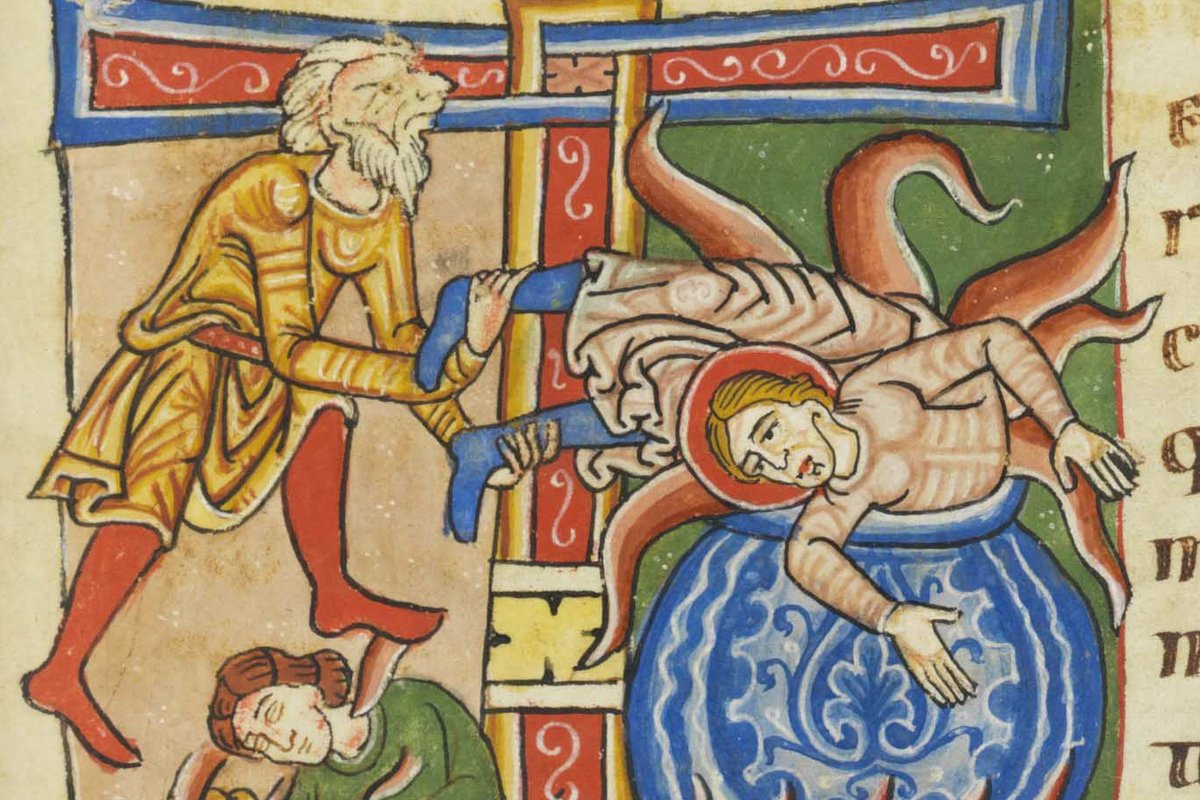
Passionary of Weissenau, Incipit passio Sancti Bonifatii, Fondation Bodmer, Coligny, c. 1170–1200 — public domain.
Reference sources describing Boniface's traditional Acts don't mince words about why: the narrative is characterized as a "totally fabulous" composition, meaning invented rather than historically documented. This article tells his traditional story anyway, because it's a genuinely striking piece of Christian legend with a long devotional history — medieval illuminators clearly found it compelling enough to illustrate, as the manuscript miniature accompanying this article shows — but every part of it should be read as legend, not as a record of real events.
The errand that became a conversion
By tradition, Boniface was a steward in the household of a wealthy Roman woman named Aglaida, and — depending on which version of the legend is told — the two were involved in a relationship the story frames as morally troubled, which the rest of the narrative is partly designed to redeem. Aglaida, wanting to build a shrine using relics of Christian martyrs, sent Boniface east to Tarsus in Cilicia (in modern-day Turkey) specifically to acquire the remains of Christians who had died for their faith. It's the kind of task that assumes a purely transactional errand — buy bones, bring them home — and that's precisely what makes the twist in the story work: Boniface arrived in Tarsus and found himself watching, in person, the very thing the martyrs he'd been sent to collect had already gone through.
Witnessing torture, declaring a faith
According to the legend, the sight of Christians being tortured for refusing to renounce their faith moved Boniface so deeply that he stepped forward and declared himself a Christian in front of the same authorities carrying out the persecution — an act with an utterly predictable outcome under Roman law at the time. He was arrested, tortured, and beheaded. The story's sharpest piece of irony is built into what happened next: the servants who had accompanied Boniface to Tarsus, sent only to retrieve martyrs' relics, now had a martyr's body of their own to bring home. Boniface's remains were carried back to Rome as the very kind of relic he'd originally been dispatched to collect — and, by tradition, his death converted Aglaida as well, closing the story with the same reversal that opened it.
Why the Church now treats this as legend, not history
None of the specific details in Boniface's story — the household relationship with Aglaida, the exact circumstances in Tarsus, even the precise date given for his death around 307 AD — rest on documentation contemporary with the events. Unlike the account of Saint Blandina, which survives in a letter written by eyewitnesses within a year or two of her martyrdom, Boniface's Acts read like the kind of edifying narrative that circulated in later centuries to teach a moral lesson about conversion and redemption, not like a document anchored to verifiable events. Stories of this shape — a person sent to acquire something holy who is themselves transformed by the encounter — recur often enough in early Christian storytelling that scholars treat the pattern itself as a sign of a later, deliberately constructed narrative rather than an eyewitness report of a single unrepeatable event.
That distinction is exactly why the 1969 calendar reform removed his feast rather than simply leaving it in place out of tradition. It's worth noting, too, that removal from the General Roman Calendar isn't the same as a declaration that Boniface never existed at all, or an act of formal "decanonization" — there was never a canonization process in the modern sense to reverse, since ancient martyrs like Boniface were recognized through popular acclaim centuries before formal canonization procedures existed. The calendar reform simply concluded there wasn't reliable enough evidence to keep giving his story a fixed, universal place in the Church's liturgical year.
A pattern repeated across other legendary martyrs
Boniface of Tarsus is far from the only figure whose story fell into this category during the same reform. Several other traditional martyrs with vivid, dramatic Acts but thin historical documentation were quietly removed or made optional in local calendars at the same time, part of a broader effort to distinguish devotional legend from documented Church history more carefully than earlier centuries had bothered to. That doesn't make figures like Boniface worthless as devotional material — their stories shaped centuries of Christian art, preaching, and moral imagination, exactly the kind of legacy visible in the illuminated manuscript image accompanying this article — but it does mean readers today are better served knowing which category a given saint's story actually belongs to: verified history, or a legend that once did real spiritual work for the people who told and retold it, regardless of whether it happened exactly as described.
Trivia
Who was Saint Boniface of Tarsus?
Was Saint Boniface of Tarsus removed from the Church's official calendar?
Is the story of Boniface of Tarsus considered historically true?
Does Saint Boniface of Tarsus have an established patron saint role?
Why would the Church tell a legendary story about a saint at all?
You May Also Like

Related Reading