Saint Blandina

A letter written by people who were there
Most stories about early Christian martyrs reach us through hagiography written decades or centuries after the fact, filtered through legend and pious embellishment. Blandina's story is different, and it's worth saying so plainly: the account of her death comes from a letter written by the surviving Christian community of Lyon and Vienne, sent to fellow believers in Asia Minor within a year or two of the events it describes. The historian Eusebius, writing his Ecclesiastical History in the early 4th century, quotes long passages of that letter directly in Book 5 — which means large portions of what we know about Blandina aren't legend passed down through generations, but something closer to contemporary reporting from people who watched it happen.
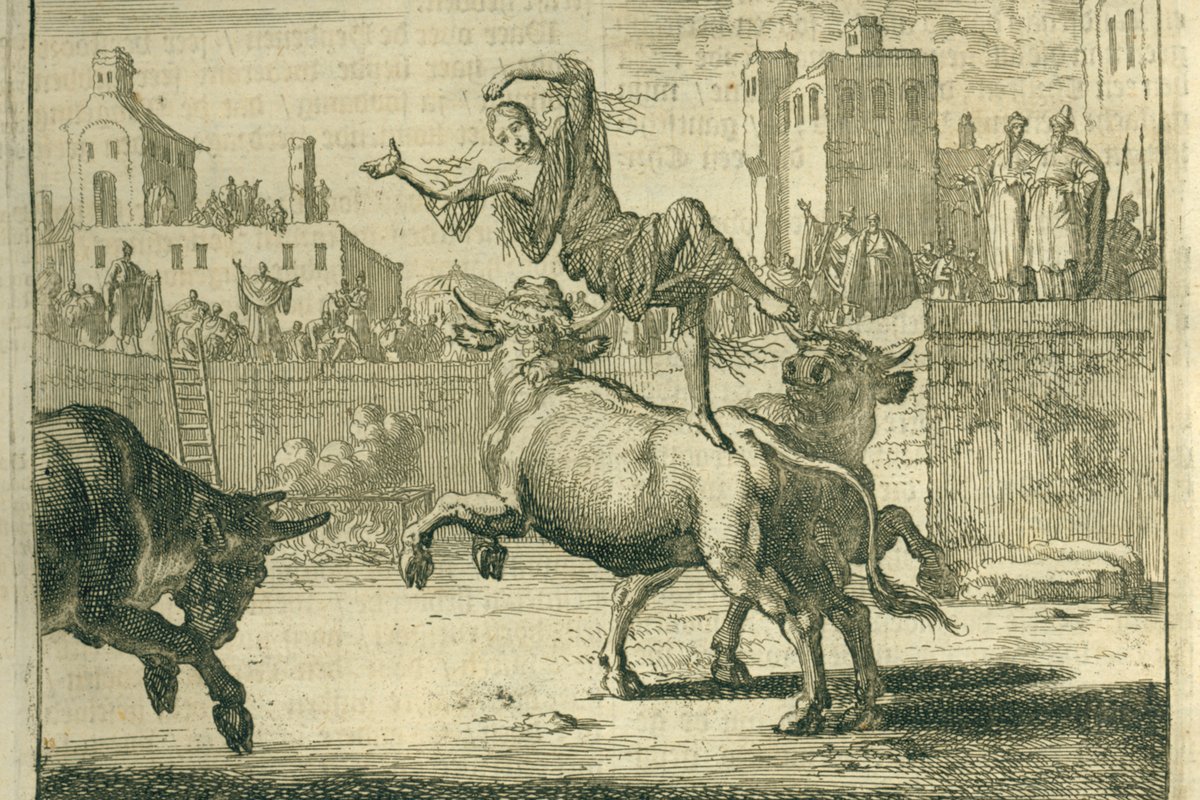
Jan Luyken, Santa Blandina (Martyrs Mirror), 1660 — public domain.
Arrested with a household, tortured beyond expectation
Blandina was a slave, arrested along with a larger group of Christians — including her own mistress — during a wave of local hostility toward the Christian community in Lugdunum (modern Lyon) in the summer of 177 AD, under the reign of Emperor Marcus Aurelius. The letter records that her fellow Christians, and even she herself beforehand, worried she might be the one to break under torture, given her low social standing and, presumably, her youth. What happened instead surprised everyone watching. Her interrogators tortured her from morning until evening, cycling through methods and taking turns because they physically exhausted themselves before she gave them anything more than a single, unchanging answer: "I am a Christian, and we commit no wrongdoing." The letter states that this reply alone was enough to sustain her — that "she was refreshed and forgot her present distress" every time she repeated it.
A pose the other martyrs recognized
Blandina's execution in the amphitheater came in stages, spread across more than one day of public spectacle. At one point she was bound to a wooden stake and exposed to wild beasts, and the surviving Christians watching from among the condemned reported that her posture on the stake — arms outstretched — reminded them of Christ crucified, which they said gave the other martyrs facing death that day real courage as they watched her. She survived that exposure and was returned to prison. On a later day, back in the arena, she was finally killed: tossed repeatedly by a bull, and then, when that did not finish her, dispatched with a dagger — the last of her group to die, having outlasted companions who by tradition included a slight fifteen-year-old boy named Ponticus, whom witnesses said she had encouraged and comforted through his own death just before her own.
A body denied burial, and a Church that remembered anyway
The letter from Lyon doesn't end with Blandina's death. It goes on to describe something the Roman authorities apparently intended as a final insult: the bodies of the martyrs were left unburied and guarded for six days, then burned, and their ashes swept into the river Rhône, specifically — the letter says — so that the Christians of Lyon would have no relics, no grave, and no hope of resurrection to point to. It's a detail that tells you something about how early the cult of martyrs' relics had already taken hold in Christian practice, and how well the persecutors understood what it meant to Christians. The plan didn't work in the way its architects hoped. Denied a tomb to visit, the community wrote the letter instead, and it's that letter — not a grave, not a relic — that carried Blandina's memory forward for nineteen centuries.
Patroness of a city, remembered in stone and stained glass
Lyon never forgot her. Blandina is honored today as one of the patron saints of the city, and the nineteenth-century Basilica of Notre-Dame de Fourvière, which overlooks Lyon from its hilltop, includes imagery recalling the martyrs of 177 AD, Blandina among them. Older devotion placed her relics, along with those of the other Lyon martyrs, in the abbey church of Saint-Martin d'Ainay, one of the city's oldest religious sites. In devotional art she's typically shown as a slight young woman bound to a stake with animals nearby, sometimes with a bull close by in reference to the arena, iconography that keeps her tied visually to the account in the letter rather than to any invented martyrdom scene. That restraint is fitting: almost everything reliably known about her comes from that single eyewitness source, which is part of what makes her so unusual among early martyrs.
Why this account matters beyond one martyrdom
Blandina's story sits in a different category from many of the saints covered on this blog — figures like Saint Eustace or Saint Genesius of Rome, whose surviving Acts are centuries removed from the events they describe and openly treated by scholars as legend. Blandina's account has the opposite problem historians usually face: it's almost too well attested to doubt. The letter from Lyon is considered one of the most valuable surviving documents on the early persecutions precisely because it wasn't written to inspire devotion generations later — it was written by people mourning friends they had just watched die, describing what they'd seen because they thought the wider Church needed to know.
That's a different kind of witness than a saint's Acts composed generations after the fact, and it's part of why Blandina has held a steady place in the Church's memory of its earliest martyrs. She's often mentioned alongside Saint Athanasius of Alexandria and other early defenders of the faith not because their situations were alike, but because both left behind writing — hers about her, his by his own hand — that lets modern readers hear the early Church's voice directly rather than through later retelling. For a slave girl whose own words survive only as a single repeated sentence, that voice has proven remarkably durable.
Trivia
Who was Saint Blandina?
What did Saint Blandina say when she was tortured?
How did Saint Blandina die?
How do we know so much about Blandina's martyrdom?
When is the feast of Saint Blandina?
You May Also Like
Related Reading