Saint Genesius of Rome

A comedy written to mock the faith
By tradition, Genesius led a troupe of comic actors in Rome during the reign of Emperor Diocletian, at a time when public performance often served as a tool of imperial propaganda against the empire's Christian minority. According to the legend, Genesius and his troupe were commissioned to stage a comedy that parodied Christian rituals for the emperor's entertainment — and the ritual chosen for mockery was baptism, staged as farce for a paying, laughing audience that very much included Diocletian himself.
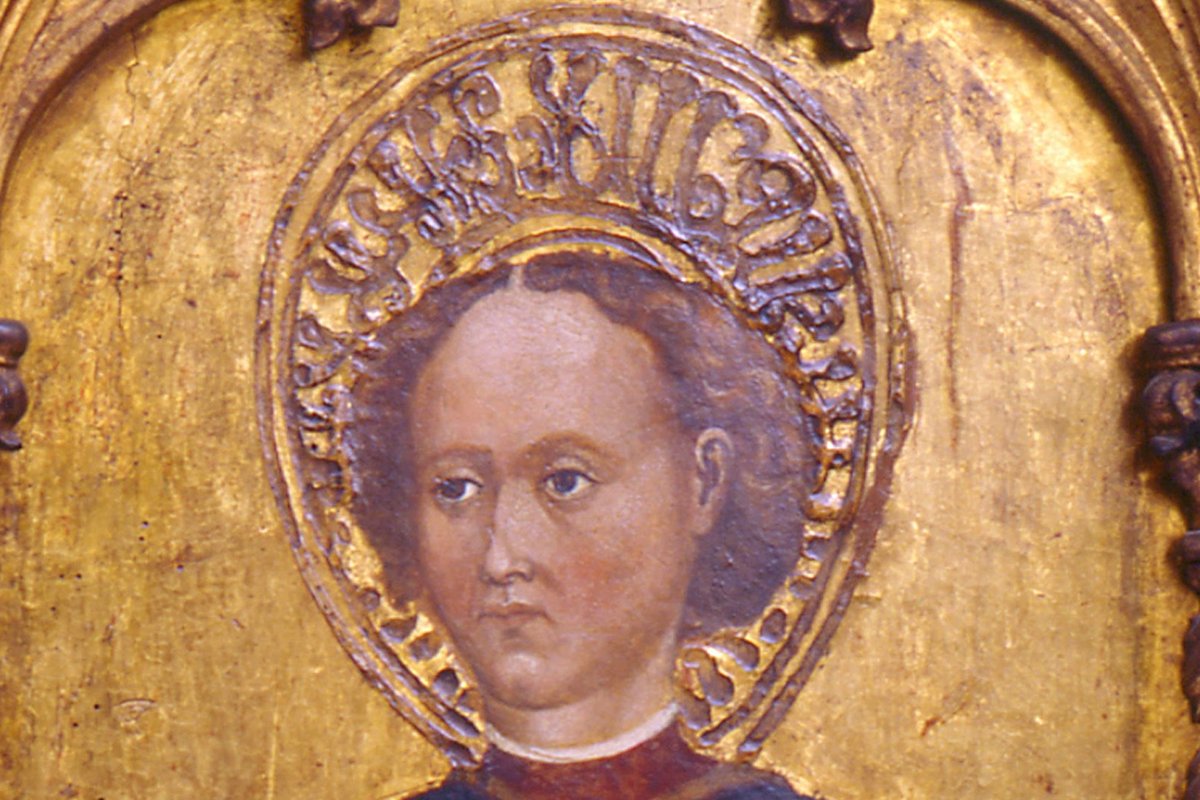
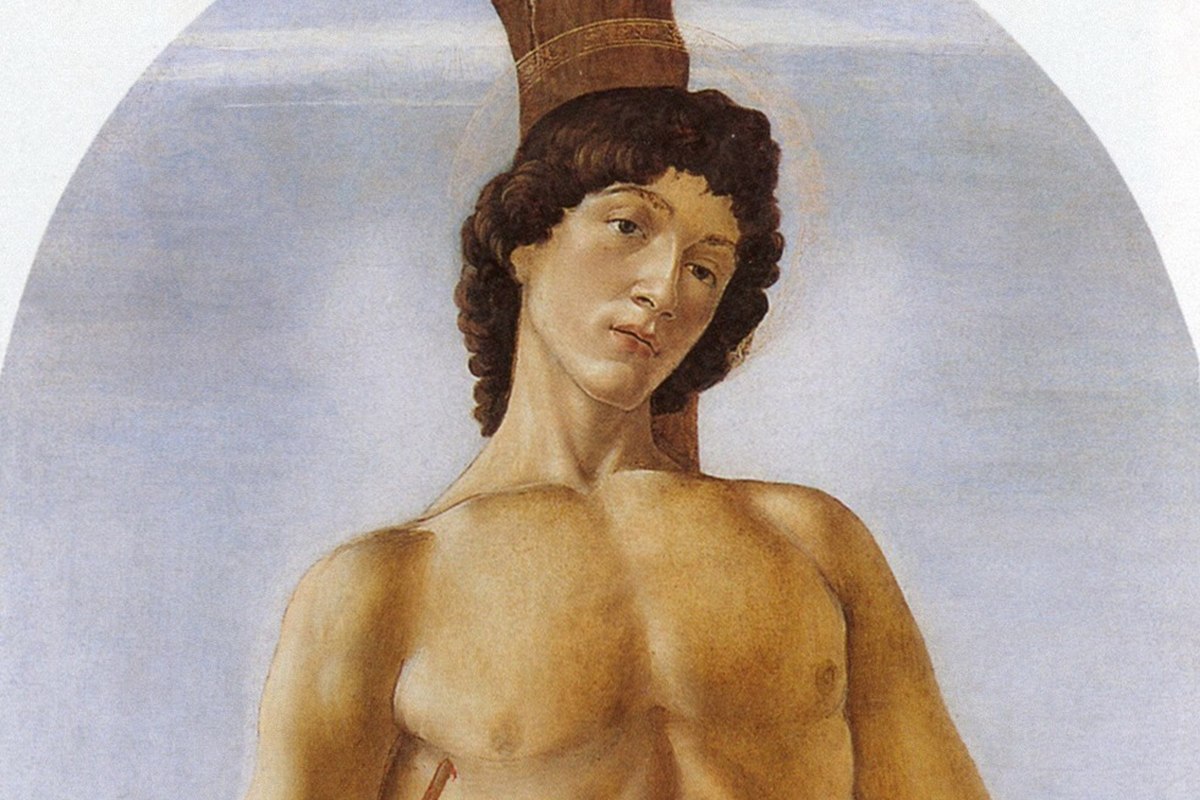
Cristoforo Moretti, Saint Genesius, c. 1451–1485 — public domain (Google Art Project via Wikimedia Commons).
A performance that stopped being a performance
The story's turning point comes in the middle of the mock baptism scene. Genesius, playing a role written purely for laughs, is said to have experienced something genuinely overwhelming partway through — by the traditional telling, a vision so real that the line between acting a conversion and living one simply dissolved. Rather than finishing the joke, Genesius broke character entirely and announced, in front of the emperor and the full audience, that he was now a real Christian. It's hard to imagine a more dramatic setting for the moment: a man whose entire profession was convincing an audience that fiction was real, suddenly insisting the opposite — that what looked like fiction had just become the truest thing he'd ever said.
Refusal, and its cost
Diocletian, unsurprisingly, didn't take the announcement as a change of script. By tradition, Genesius was pressed to recant, refused, and was executed for his new and very public faith. The theatrical framing of his martyrdom — a performer whose greatest and final performance was also his most sincere act — is precisely what made his story so resonant for the specific communities that later claimed him as their patron.
What scholarship actually says about the story
It's worth being direct here, in the same way this blog treats other saints whose historical footing is uncertain, such as Saint Eustace or Saint Boniface of Tarsus. The Catholic Encyclopedia notes that the surviving Acts of Genesius date only from the 7th century — several hundred years removed from the events they claim to describe — and describes the account as "very doubtful." Some scholars go further, proposing that the Roman Genesius may actually be a literary doublet of an Eastern martyr story, Gelasinus of Heliopolis, whose narrative follows a strikingly similar pattern, rather than a genuinely separate historical person. What isn't in doubt is that devotion to a martyr named Genesius was real and organized well before any of that doubt existed as a scholarly question: a church in Rome was dedicated to him by the 4th century, and Pope Gregory III restored it in 741 — solid architectural history sitting alongside a legend that may or may not describe an actual man.
A patron saint built on his own legend's logic
Genesius is remembered today as the patron saint of actors and entertainers, kept on a feast day of August 25 — a patronage that needs no explaining once you know the story, legendary or not. It's a fitting kind of sainthood for a figure whose entire claim to holiness rests on the moment an actor's performance and an actor's actual belief became impossible to tell apart, whether or not it happened exactly the way it's been told for the last thirteen centuries.
Theater and Christianity's uneasy early relationship
The setting of the Genesius legend reflects a genuinely tense relationship between the early Church and Roman public entertainment. Roman theater in this period often ridiculed Christian practices for laughs, and actors themselves — along with gladiators, prostitutes, and a handful of other professions — were frequently barred from receiving baptism unless they left their trade entirely, since so much of Roman performance was tied to pagan religious festivals or, as in the legend itself, outright mockery of Christian belief. That context is precisely what gives the Genesius story its edge: it imagines conversion breaking out not in spite of the theater's hostility toward Christianity but from directly inside a performance designed to attack it, turning the very tool of mockery into the occasion for genuine faith.
More than one Genesius
Adding to the story's uncertainty, there is also a distinct Saint Genesius of Arles, a Roman notary martyred around the same period for refusing to record an imperial edict he considered unjust — a separate figure with his own feast day and his own, somewhat more historically grounded, tradition. The two Genesius traditions were sometimes confused or merged in later medieval retellings, which adds another layer to the "very doubtful" verdict the Catholic Encyclopedia gives the Roman actor's Acts. Even careful historians of the early Church, including the Bollandists — a group of scholars who have spent centuries critically examining the lives of the saints for the Acta Sanctorum — have long flagged this kind of duplication as a common pattern among early martyr accounts, where popular devotion sometimes outran reliable documentation.
Why the legend endured anyway
None of that scholarly caution stopped devotion to Genesius from spreading widely across medieval Europe, particularly among the very professional communities his story speaks to most directly. Guilds of actors and performers in medieval France and Italy adopted him as their patron, and troupes would invoke his name before performances much the way other tradespeople invoked the patron saints of their own crafts. The uncertainty around the historical Genesius hasn't diminished that devotion, in part because the story's core image — an actor whose performed conversion becomes real in the performing of it — speaks to something performers have recognized in their own craft for centuries: the strange, sometimes serious blurring between playing a role and becoming, if only briefly, the person in it.
Trivia
Who was Saint Genesius of Rome?
Is the story of Saint Genesius historically reliable?
What happened during the performance that supposedly converted Genesius?
What is one solid historical fact connected to Saint Genesius, even if his own story is uncertain?
What is Saint Genesius of Rome the patron saint of?
You May Also Like

Related Reading