Saint Boniface

An English monk headed for the Continent
Boniface — born with the name Winfrid in England, though the exact year is unknown — entered monastic life and might easily have spent his career quietly within an English monastery. Instead, he set his sights on the largely pagan Germanic territories across the Channel, following in the footsteps of earlier English missionaries who had already begun evangelizing the Continent. After an initial attempt at missionary work in Frisia fell through, he traveled to Rome, where Pope Gregory II commissioned him for the work that would define the rest of his life and gave him the name by which history remembers him: Boniface. From that point on, he worked methodically across Germanic territories — modern Hesse, Thuringia, Bavaria, and beyond — preaching, founding monasteries, and organizing a still-scattered Christian presence into a functioning church structure with bishops, clergy, and monastic communities built to outlast him.
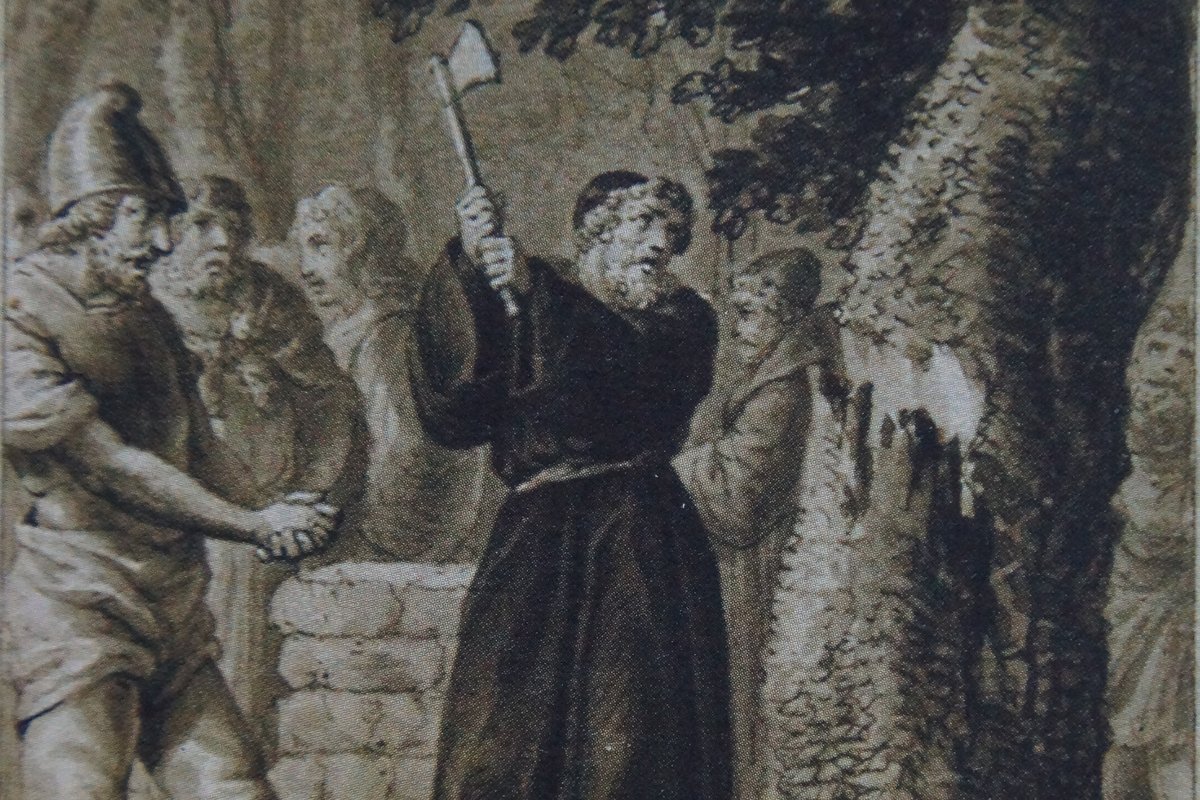
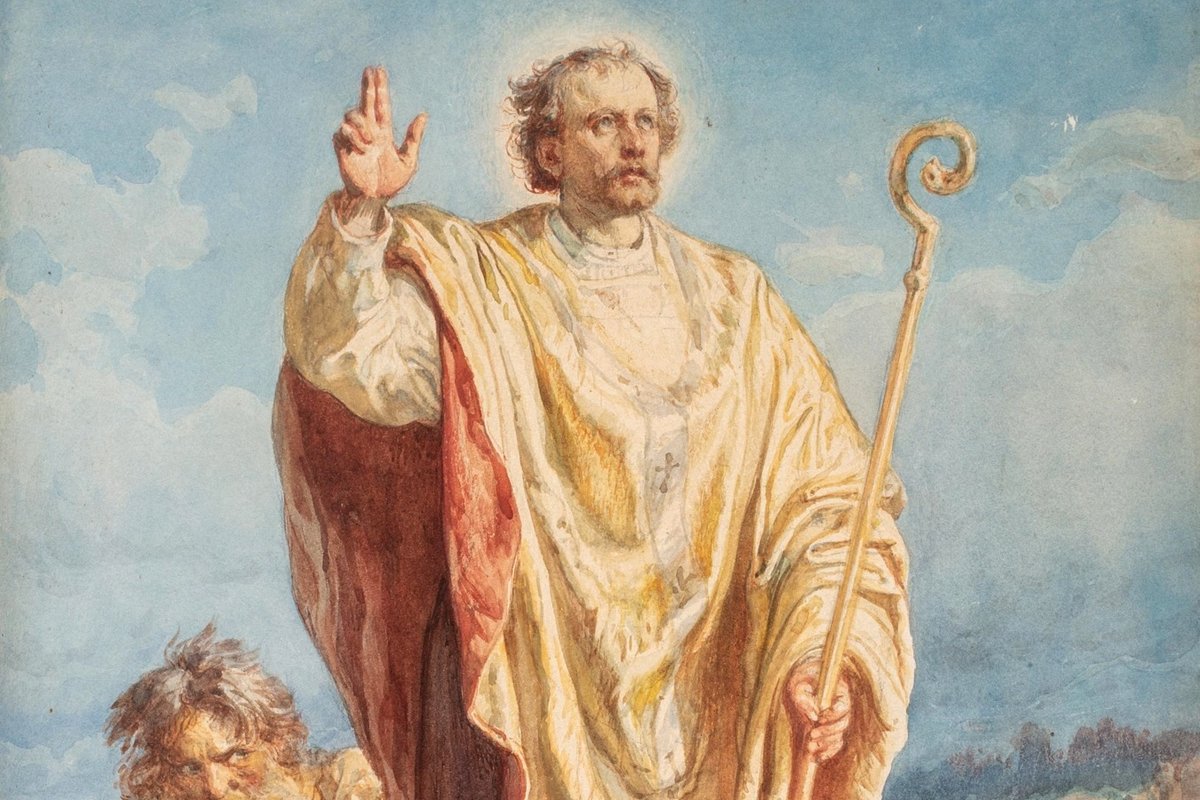
Daniel Nikolaus Chodowiecki, Bonifatius fällt die Donareiche (Boniface Fells the Donar Oak), 1780 — public domain.
Boniface's early years show a stubborn, almost restless streak. He'd already tried missionary work once before, in Frisia in 716, and it had failed outright — the local ruler, Radbod, was at war with the Franks at the time, and any missionary arriving under Frankish protection was treated as a political enemy rather than a spiritual guest. Most monks would have taken that as a sign to stay home. Boniface instead went to Rome, secured a formal commission from the pope, and tried again elsewhere, this time with far better timing and far more institutional backing behind him.
The oak that didn't fight back
Boniface's most famous act of ministry took direct aim at the old religion's most visible symbol of power. Near Fritzlar, at a place called Geismar, stood a great oak sacred to Donar — the Germanic thunder-god better known today by his Norse name, Thor — and revered by the local population as something no mortal would dare touch. In front of an assembled crowd, expecting either a demonstration of Boniface's foolishness or a swift and violent divine response, Boniface took an axe to the tree himself. According to the traditional account, the oak came down, no lightning struck, no retribution followed, and the god the crowd had feared did nothing at all. Boniface then had the timber used to build a chapel on the very spot — a deliberate, practical statement built from the wreckage of the old faith. The conversions that reportedly followed weren't won by argument; they were won by the old gods simply failing to show up.
The story has stayed alive for over a thousand years partly because it's such a vivid piece of theater, but also because it captures something true about how conversion actually spread across early medieval Europe: not primarily through theological argument, but through public tests of power that the old religion visibly lost. Later legend embroidered the episode further, claiming that a small fir tree sprang up in the oak's place — an image some trace, loosely and much later, to the folk origins of the Christmas tree, though that connection is far more popular tradition than documented history.
Organizing a church, not just planting one
What set Boniface apart from many missionaries of his era wasn't just his willingness to take dramatic risks — it was his instinct for structure. He didn't simply preach and move on; he established monasteries, most famously Fulda, which became a major center of learning and monastic life, and worked to bring the Germanic church into closer, more orderly alignment with Rome, reforming lax clergy and establishing new dioceses with resident bishops. It's a less dramatic legacy than an axe and a sacred oak, but arguably the more consequential one: Boniface didn't just introduce Christianity to Germanic Europe, he built the institutional scaffolding that let it survive and grow long after he was gone.
Fulda in particular became something Boniface himself seems to have planned for: a place where he wanted to be buried, and where his memory and his library of manuscripts could keep shaping Germanic Christianity long after any single missionary's lifetime ran out. He also corresponded constantly with Rome and with fellow clergy back in England, a paper trail of letters that historians still rely on today to reconstruct not just his own travels but the daily texture of church life on the Continent in the eighth century — synods called, disputes settled, clergy disciplined for drunkenness or ignorance of the most basic Latin prayers. It's unglamorous work, but it's the kind of work that turns a missionary breakthrough into a lasting institution.
Martyrdom in Frisia
Even in old age, Boniface kept returning to missionary frontlines rather than settling into a comfortable, senior church post. In 754 or 755, while in Frisia preparing to confirm a large group of recent converts, he and a group of companions were attacked and killed — by tradition, a band of pagan raiders looking for plunder rather than specifically targeting Boniface for his faith, though the Church has long honored his death as martyrdom regardless of the attackers' exact motive. He was canonized by ancient popular acclaim rather than through the formal process the Church developed centuries later, and his feast is kept on June 5. What's genuinely unusual about his legacy is how far it reaches across later Christian divisions: Boniface is honored not just by Catholics but by Lutherans, Anglicans, and Orthodox Christians as well — a missionary whose reputation somehow survived intact through a millennium of Christian schism that split apart so much else.
His relics were eventually returned to Fulda, the monastery he'd founded and clearly loved, and the abbey he built there is still a pilgrimage site today, a direct physical link to the man who once stood in front of a hostile crowd with an axe and no obvious way of knowing whether he'd survive the afternoon. Readers interested in other missionary saints who took the Gospel to unfamiliar and sometimes hostile territory may also want to read about Saints Cyril and Methodius, who carried Christianity — and a new alphabet — to the Slavic peoples of Central Europe roughly a century after Boniface's death.
Trivia
Who was Saint Boniface?
What happened at the Donar Oak at Geismar?
How did Saint Boniface die?
Is Saint Boniface venerated outside the Catholic Church?
When is the feast of Saint Boniface?
You May Also Like
Related Reading