Saint Carlo Acutis

A teenager who built a website about miracles
Carlo Acutis was born in London in 1991, where his Italian parents were living for work at the time, and the family relocated to Milan while he was still an infant. From a young age he showed a natural gift for computers — the kind of self-taught technical fluency that, in another life, might have pointed toward a career in tech, teaching himself programming languages years before most of his peers had touched a line of code. Alongside that technical bent, those who knew him described a boy with an unusually mature prayer life for his age: he reportedly attended daily Mass from childhood, prayed the Rosary regularly, and spent time in Eucharistic adoration well before most children his age were even required to.
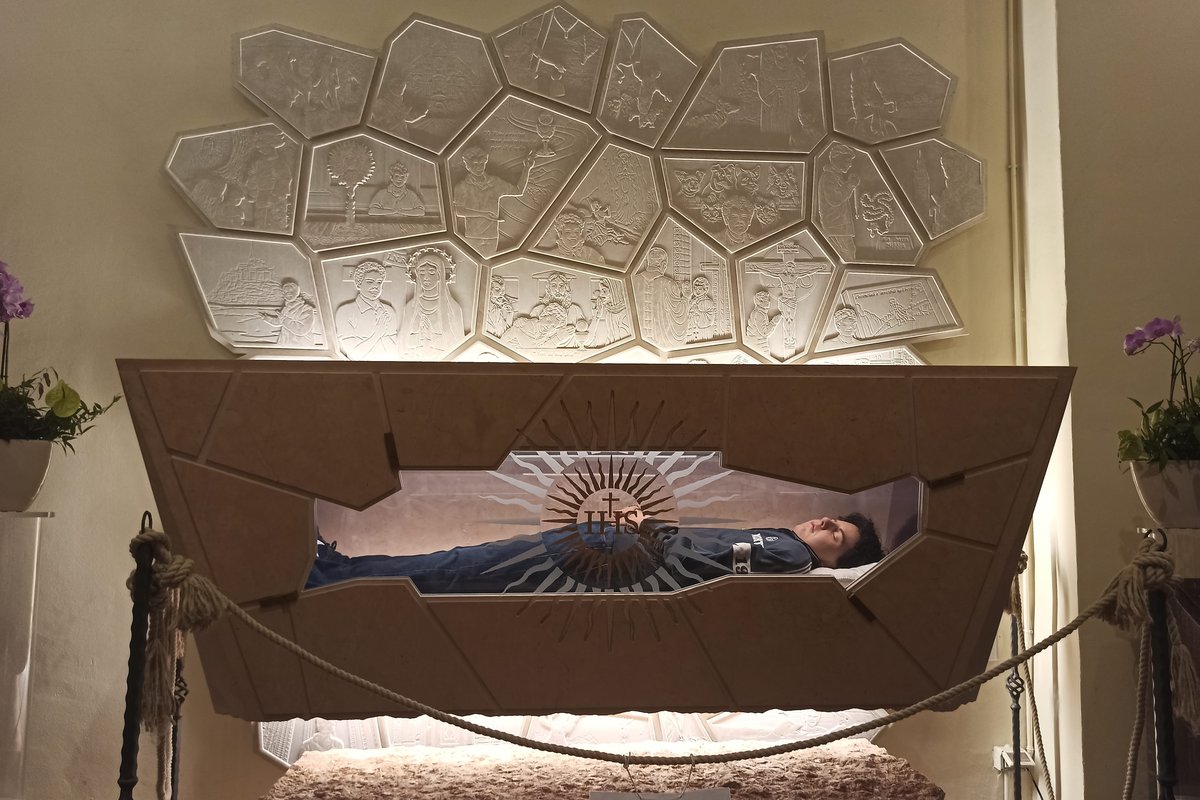
Photograph of the tomb of Carlo Acutis, Santa Maria Maggiore, Assisi, 2022 — CC BY-SA 4.0, Dulceridentem, via Wikimedia Commons.
Instead of aiming that computer skill toward games or social media, he turned it toward his own deep devotion to the Eucharist — the consecrated bread and wine Catholics believe becomes the actual body and blood of Christ at Mass — spending his early teenage years building and maintaining a website that catalogued Eucharistic miracles reported across history and around the world. These were reports, going back centuries in some cases, of consecrated hosts said to have shown physical or otherwise inexplicable signs pointing to Christ's real presence; Carlo organized accounts that had previously been scattered across obscure regional sources, often only documented in local languages or archived in individual parishes, into one accessible online archive that volunteers have since translated into multiple languages and exhibited as a traveling display in parishes worldwide. It's an unusual body of work for anyone, let alone a boy still in his early teens — a bridge between a very old form of piety and a very new medium for sharing it.
Offering his own suffering "for the Pope and for the Church"
In 2006, Carlo was diagnosed with an aggressive form of leukemia, and he died within weeks of the diagnosis, at just 15 years old. Those close to him during his final illness reported that he faced it with a striking sense of purpose, saying he was offering his suffering for the Pope and for the Church rather than treating it as senseless loss. Friends and family who later gave testimony for his canonization cause also described a teenager who, outside his religious life, seemed remarkably ordinary — he liked video games, enjoyed the Italian mountains, and had close friendships at school — which is part of why his story struck such a chord: nothing about his daily life looked like conventional sainthood until his final illness revealed the depth of the faith underneath it.
That combination — a highly online, technically gifted teenager who also held a deeply traditional, almost old-fashioned piety — is a large part of why his story resonated so quickly and so widely after his death.
An exhumation that drew the world's attention
Carlo was beatified in 2020, and ahead of that beatification his tomb was opened in 2019 as part of the Church's formal investigation into his life and cause. Those present at the exhumation reported that his facial features were unusually well preserved. The Church is careful not to treat this kind of physical detail as evidence of sanctity in itself — canonization rests on a person's life, virtue, and confirmed miracles of intercession, not on the condition of their remains — but the detail spread quickly in Catholic media and drew large numbers of pilgrims, many of them young people, to see him at his tomb in the Assisi church of Santa Maria Maggiore, where he now rests dressed simply in jeans and sneakers rather than traditional vestments.
Canonized alongside another young layman
Carlo Acutis was canonized on September 7, 2025, by Pope Leo XIV, in a ceremony held jointly with Pier Giorgio Frassati, another young Italian layman recognized for holiness lived out in ordinary, modern life rather than in a monastery or mission field. The double canonization had originally been scheduled for April 2025 but was postponed following the death of Pope Francis. Pairing the two together was itself a deliberate signal from the Vatican: both were laypeople rather than clergy or religious, both died young, and both are held up as evidence that a rich, disciplined spiritual life is possible within ordinary school, work, and family routines, not only within a convent or seminary.
Carlo's feast is now kept on October 12, and he is informally regarded by many Catholics — though without a formal universal decree — as a natural patron for the internet age, a status that traces directly back to the very same project that filled his short life: an online record of a very old kind of faith. His canonization process moved with unusual speed by Vatican standards, in part because of the volume of testimony gathered from people, especially young people, who credited his example with drawing them back toward regular Mass attendance and confession — the kind of concrete, documented spiritual impact that Church investigators look for in building a case for sainthood.
"The Eucharist is my highway to heaven"
Among the sayings attributed to Carlo Acutis, one has become especially closely associated with him: "The Eucharist is my highway to heaven," a line that captures both his personal devotion and the way he thought about ordinary, modern tools — a highway, a website — as vehicles for something much older than either. Devotional images and holy cards produced since his beatification lean heavily on that same juxtaposition, often showing him in his characteristic jeans and polo shirt rather than any kind of formal or clerical dress, precisely because his admirers want him remembered as recognizably contemporary — a saint who looked, at a glance, like any other teenager, and whose sanctity had nothing to do with looking otherwise.
Trivia
What did Carlo Acutis actually do with computers?
What did Carlo Acutis die of, and when?
Is it true his body was unusually well-preserved when his tomb was opened?
When was Carlo Acutis canonized, and is he really a saint now?
Is Carlo Acutis officially the patron saint of the internet?
You May Also Like
Related Reading