Saint Charles Borromeo

A cardinal at twenty-two
Charles Borromeo was born on October 2, 1538, at the family castle in Arona, on the shores of Lake Maggiore in the Duchy of Milan. His mother came from the powerful Milanese Medici family — no relation to the Florentine Medici, but well-connected all the same — and his uncle, Giovanni Angelo Medici, became Pope Pius IV in 1559. The new pope wasted no time promoting his nephew: within a year, Charles was a cardinal and the administrator of the Archdiocese of Milan, one of the largest and most important dioceses in Europe, while still in his early twenties and not yet ordained a priest. It was the kind of rapid promotion that could easily have produced an idle, ornamental cardinal. Borromeo became something closer to the opposite.
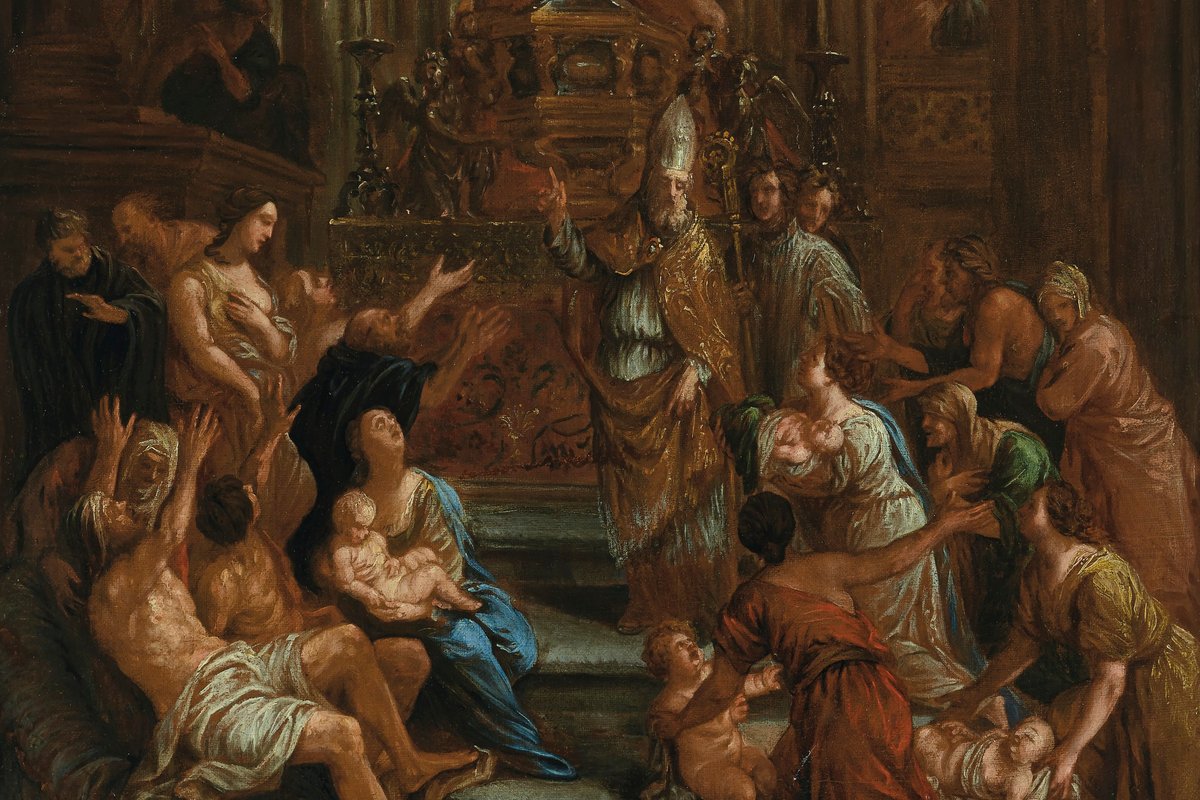
Anicet Charles Gabriel Lemonnier, Saint Charles Borromeo Bringing the Assistance of Religion to the Plague Victims of Milan, c. 1784–85, National Galleries of Scotland — public domain.
Closing the Council of Trent
Rather than simply enjoying the privileges of his office, Borromeo went to work inside the machinery of the Church's response to the Protestant Reformation. The Council of Trent — the Church's marathon, on-and-off effort across nearly two decades to define doctrine and reform its own practices — had stalled more than once before Borromeo became closely involved in its final sessions in the early 1560s, helping keep the fractious council moving toward a close in 1563. Afterward, he was part of the team entrusted with translating the council's decisions into something a parish priest could actually use: the Roman Catechism, published in 1566, which distilled Trent's teaching into a single, practical reference that shaped Catholic religious instruction for centuries. Borromeo was ordained a priest and consecrated a bishop only after this work was already underway — an unusual order of operations for a man history now remembers first as a bishop.
Reforming a diocese from the inside
Once he took up residence in Milan as its actual working archbishop — rather than an absentee cardinal administering from Rome, which had become common practice — Borromeo took charge of the same storied see once shepherded, more than a thousand years earlier, by Saint Ambrose, and threw himself into a program of reform that touched nearly everything: he held provincial councils and diocesan synods, founded seminaries to properly train priests, established schools of Christian doctrine for children, and insisted on regular visitations of parishes to check that clergy were actually doing their jobs. Some of this made him enemies. A disgruntled member of a religious order once even fired a shot at him during prayer, which Borromeo survived apparently without serious injury — a detail that, true or exaggerated in the telling, reflects just how disruptive his reforms were to a clergy that had grown comfortable with laxity.
Walking into the plague
Borromeo's defining moment, though, came in 1576, when plague broke out in Milan and quickly turned into one of the worst outbreaks the city had seen in generations — later chroniclers named it the "Plague of San Carlo" after him. As wealthier residents and even some clergy left the city for safer ground, Borromeo did not. He organized relief for the sick and dying, arranged for food and medical care to reach quarantined households, and went in person into the infected districts rather than directing everything from a safe distance. It's the kind of leadership that's easy to praise in the abstract and genuinely rare to see practiced at personal risk — a cardinal-archbishop with every means available to protect himself instead choosing to walk toward the danger.
The confessional box and other quiet inventions
Borromeo's reforms weren't limited to grand gestures like confronting plague or closing a council; some of his most lasting influence shows up in small, practical fixtures of ordinary parish life that Catholics still encounter today. He is generally credited with popularizing the enclosed wooden confessional box, with its screen separating priest and penitent — a design meant to protect the privacy and propriety of confession at a time when the sacrament was too often heard in the open, exposed to bystanders. He also promoted the Forty Hours' Devotion, a period of continuous Eucharistic adoration, as a regular parish practice across his archdiocese, and pushed hard for seminaries that trained priests in a structured, supervised setting rather than leaving their formation to chance or family connections. None of these innovations made for dramatic storytelling, but together they reshaped how ordinary Catholics experienced the sacraments for centuries after his death.
A bishop who practiced what he preached
Borromeo's own words survive from an address he gave near the end of his life, at the last diocesan synod he attended, later preserved in the official Acta Ecclesiae Mediolanensis (Acts of the Church of Milan). Speaking to his priests about the example clergy set, he told them plainly: "Be sure that you first preach by the way you live. If you do not, people will notice that you say one thing, but live otherwise, and your words will bring only cynical laughter and a derisive shake of the head." Read against the backdrop of 1576, it reads less like a rhetorical flourish and more like a description of the standard he'd already held himself to.
Borromeo died on November 3 or 4, 1584, in Milan, worn down by years of punishing work. Pope Paul V canonized him in 1610, less than twenty-six years later — a remarkably fast turnaround by the standards of the era — and his feast is kept on November 4. He's remembered today as patron of bishops, cardinals, seminarians, and catechists, titles that trace directly back to the three fronts of his own life: governing the Church, forming its priests, and teaching its doctrine to ordinary believers.
Trivia
Who was Saint Charles Borromeo?
What did Charles Borromeo actually do during the Milan plague?
What was Charles Borromeo's role at the Council of Trent?
When was Charles Borromeo canonized and when is his feast day?
What is Charles Borromeo the patron saint of?
Related Reading