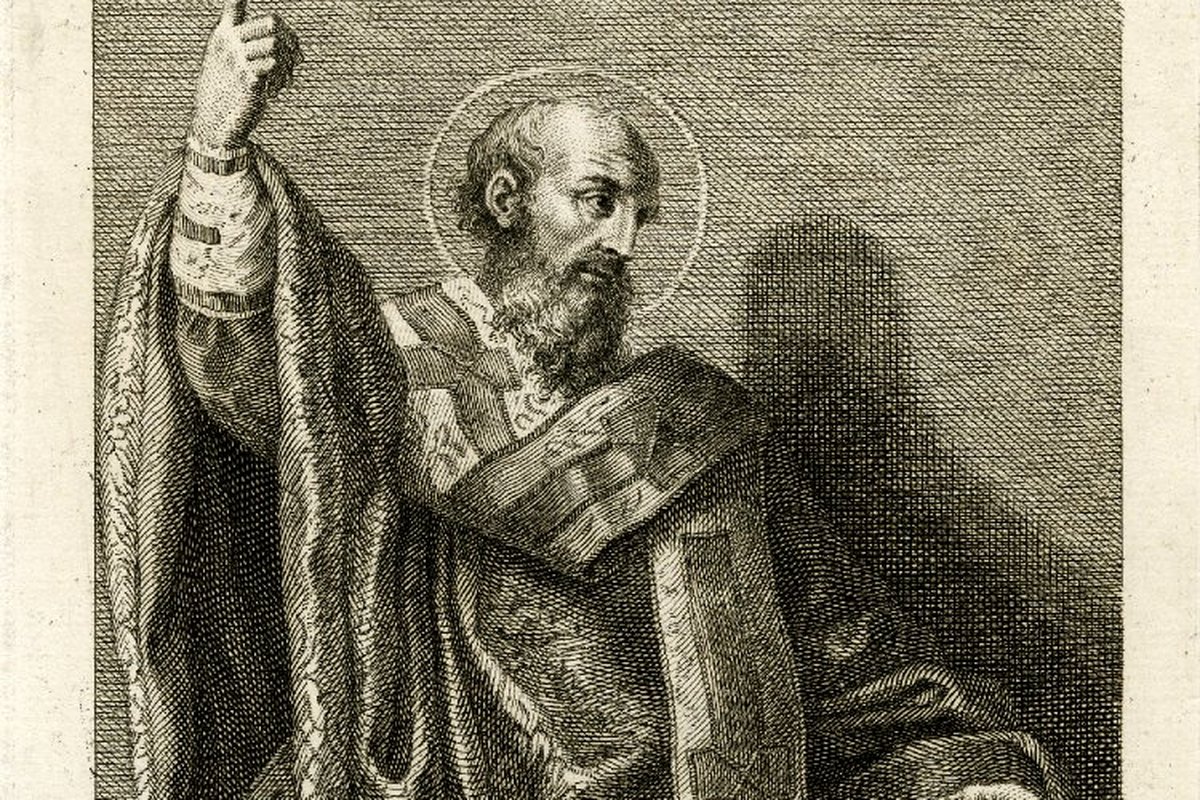
Saint Ambrose of Milan

From provincial governor to reluctant bishop
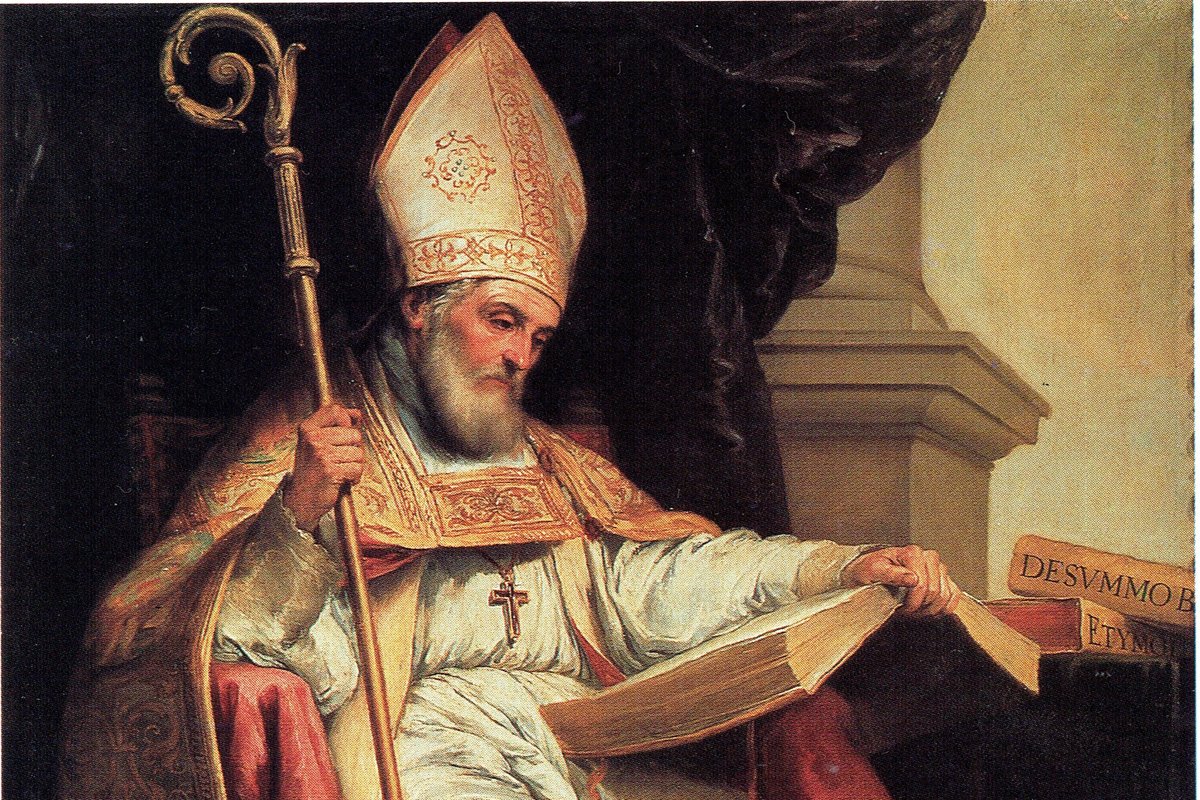
Ambrose was born around 340, most likely in Trier, where his father served as praetorian prefect of Roman Gaul. Trained as a lawyer, he rose to become consular governor of Liguria and Aemilia, based in Milan, by about 370. When the city's bishop, an Arian named Auxentius, died in 374, the election to replace him threatened to split Milan between Arians — who denied that Christ was fully divine — and Nicene Christians who held the orthodox position. Ambrose, still governor and not yet even baptized, went into the church himself to keep the peace. According to his biographer Paulinus, a child's voice in the crowd suddenly cried out "Ambrose, bishop!," and the acclamation spread before Ambrose — who tried to protest, and even attempted to flee the city — could stop it. He was baptized on November 30 and consecrated bishop just a week later, on December 7, 374, having passed through baptism and every clerical order in a matter of days.
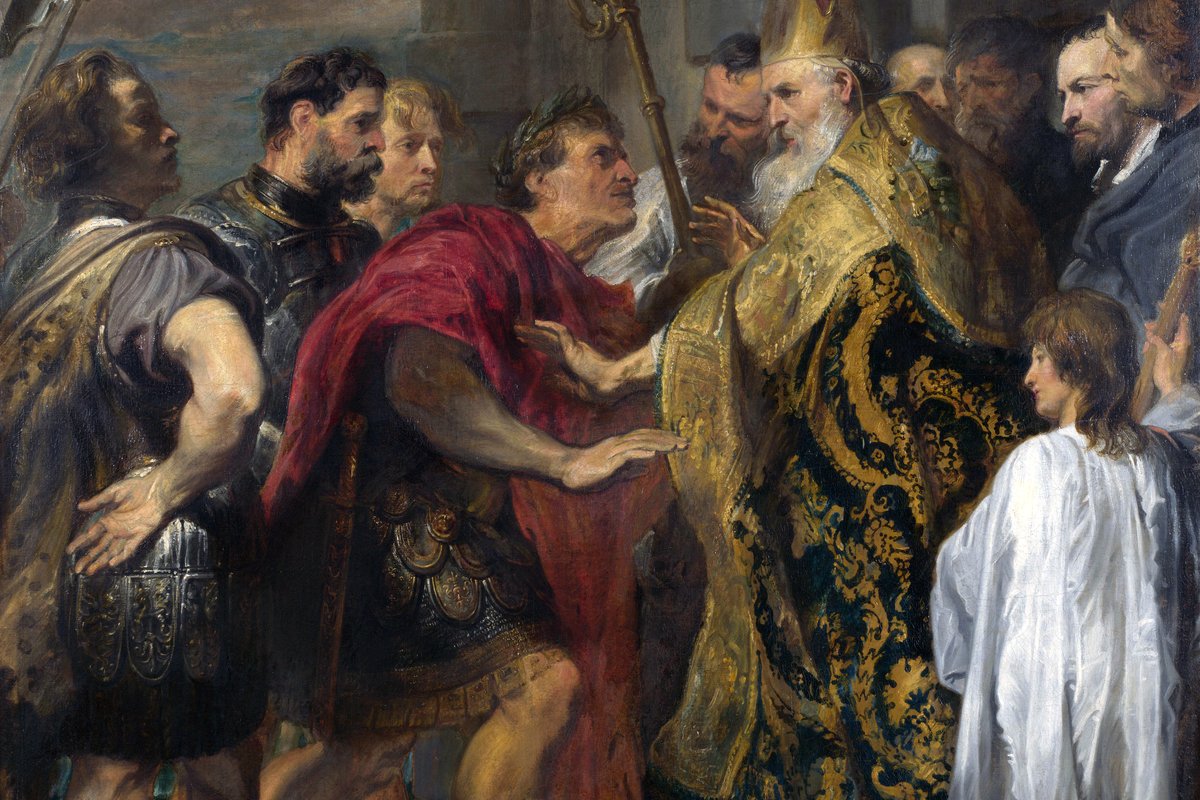
Anthony van Dyck, Saint Ambrose Barring Theodosius from Milan Cathedral, c. 1619–1620, National Gallery, London — public domain.
The professor who came to listen
Among the people who later heard Ambrose preach in Milan was a young rhetoric professor named Augustine, drawn in by the bishop's allegorical way of reading Scripture and, at the same time, worn down by the years of prayer his mother Monica had already invested in his conversion. Augustine had arrived in Milan already skeptical of the more literal readings of the Old Testament he'd been taught as a boy, and what struck him first about Ambrose wasn't any single argument but the discovery that a serious, respected intellectual could read Scripture allegorically — finding deeper spiritual meaning beneath a text's plain surface — without abandoning either reason or faith. That single realization, Augustine later wrote, did more to reopen Christianity to him than years of prior debate had managed. Ambrose baptized Augustine at the Easter Vigil, on the night of April 24–25, 387, along with Augustine's son Adeodatus and his friend Alypius — an episode Augustine himself recounts in Book IX of his Confessions. It's a rare case of one Doctor of the Church directly forming another.
A bishop who told an emperor no
Ambrose's most consequential confrontation, though, was with an emperor. In 390, after the lynching of a Roman garrison commander in Thessalonica, Theodosius I ordered a reprisal massacre in the city — later church historians such as Sozomen and Theodoret put the toll at several thousand, though no contemporary source survives, and modern historians treat some of the vivid details, including the picture of Ambrose personally blocking the cathedral doors, as later embellishment of a real and simpler fact: Ambrose wrote privately to Theodosius refusing him Communion until he showed genuine repentance. Theodosius accepted the correction, appearing in church without his imperial regalia for roughly eight months of public penance before Ambrose readmitted him to Communion on Christmas Day, 390 — a bishop holding a Roman emperor to account, and an emperor who let him.
Hymns, chant, and four Doctors of the Church
Ambrose is also credited with bringing antiphonal, responsive hymn-singing into Western worship, following Eastern practice; Milan still calls its distinct liturgical chant and rite "Ambrosian" today. He introduced the practice partly as a pastoral response to a real crisis: when the imperial court, still sympathetic to Arianism, tried to seize one of Milan's basilicas for Arian use, Ambrose and his congregation occupied the building for days, and he reportedly kept their spirits up and their unity intact by teaching them to sing psalms antiphonally, in alternating groups — turning a tense standoff into one of the roots of Western liturgical music.
He's venerated as patron of beekeepers — legend holds a swarm of bees settled harmlessly on his face as an infant, an omen later read as foretelling his gift for preaching — as well as of learning and of Milan itself. Alongside Augustine, Jerome, and Gregory the Great, he is counted among the four original Doctors of the Western Church, a grouping already common among medieval scholastics before Pope Boniface VIII formalized it in a 1298 decree. His feast day, December 7, marks the anniversary of that rapid, unplanned consecration in 374.
Words that outlived the empire
Ambrose's own writing survives in enough volume to check what's genuinely his against what's merely attached to his name. In On the Duties of the Clergy, he writes plainly: "A wise man, intending to speak, first carefully considers what he is to say, and to whom he is to say it; also where and at what time" — practical advice from a man who'd spent his career choosing words carefully in front of emperors. The much-quoted proverb "When in Rome, do as the Romans do" is often traced to him, but the actual record is a step removed: in a letter to a correspondent named Januarius, Augustine recounts Ambrose settling Monica's confusion over Milan's different fasting customs with advice in his own words — "observe the custom prevailing in whatever Church you come to, if you desire neither to give offense by your conduct, nor to find cause of offense in another's." The tidy modern proverb is a much later distillation of that longer, wiser sentence.
Trivia
Who was Saint Ambrose of Milan?
How did a Roman governor become a bishop while not even baptized?
What happened between Ambrose and Emperor Theodosius?
Did Ambrose really say "When in Rome, do as the Romans do"?
Why is Ambrose the patron saint of beekeepers?
Related Reading