Saint Charles Lwanga

Pages in a royal court
Charles Lwanga was born around 1860 in the Buddu region of Buganda, an East African kingdom in what is now Uganda, at a time when Catholic and Anglican missionaries were both actively working to establish Christianity in the kingdom, alongside an already-present Muslim influence at court. French Catholic missionaries known as the White Fathers had arrived in Buganda only a few years earlier, in 1879, and their teaching found a receptive audience among the young men attached to the royal household — a group with enough education and standing at court to grasp the new religion's ideas quickly, but young enough to embrace them with real conviction.
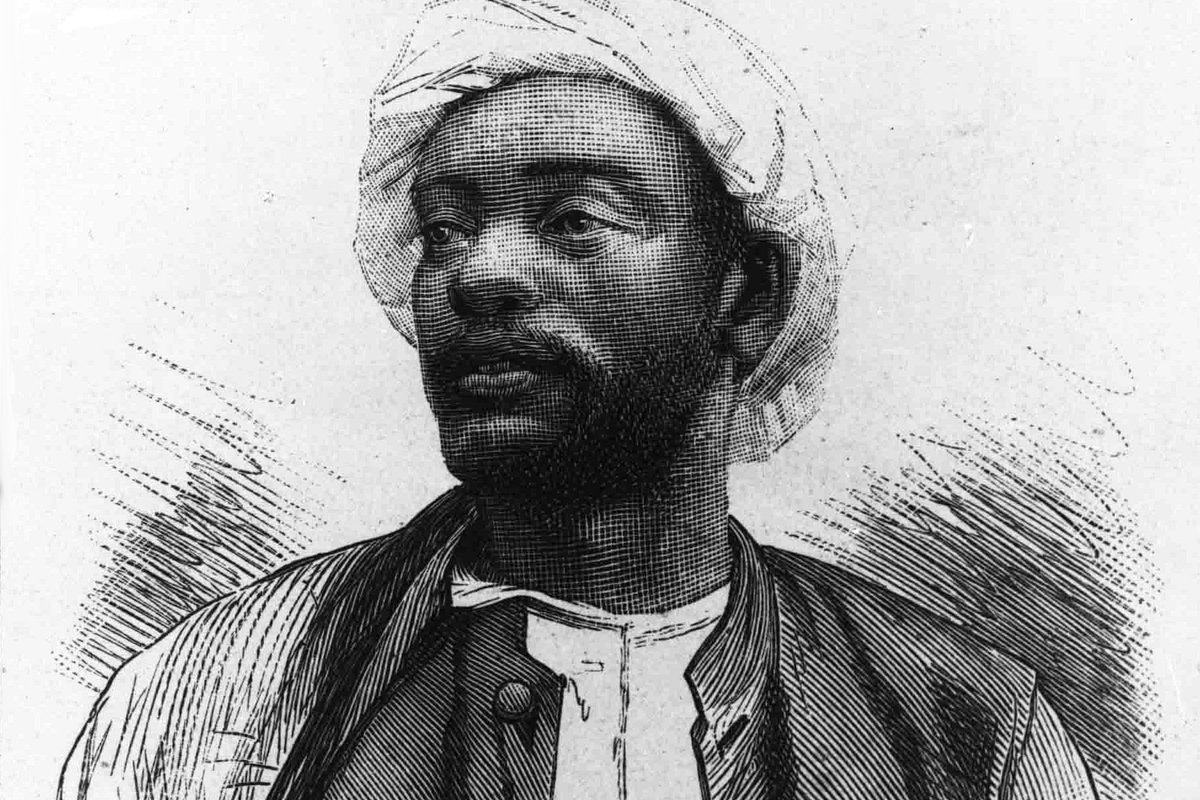
Deutsche Kolonialgesellschaft, König Mwanga von Uganda (portrait engraving, late 19th century), Koloniales Bildarchiv, Universitätsbibliothek Frankfurt am Main — public domain. (No public-domain portrait of Charles Lwanga himself survives; this image depicts King Mwanga II, whose court order led to Lwanga's execution.)
Lwanga served in the royal household of King Mwanga II as one of the pages — young men attending to the king's personal service, a position that combined domestic duties with genuine influence, since pages spent long hours in close proximity to the king himself. He rose to become the head of the pages, responsible in practice for the younger boys serving alongside him, a role that placed him in direct oversight of their training, discipline, and daily welfare. He converted to Catholicism as this missionary presence took hold among the young men of the court, receiving instruction from the White Fathers and becoming part of a small but growing community of Christian converts inside Mwanga's own household — a community that included pages loyal to both the Catholic and Anglican missions, alongside a smaller number who had adopted Islam under earlier influence from Arab traders active in the region.
A king's demands, and a page's resistance
Part of the documented historical record around the Uganda Martyrs, presented here plainly rather than as sensational detail, is that King Mwanga II made sexual demands on the young pages serving him, and that several of the converts, Lwanga among them, resisted those demands on the strength of their new Christian faith. As head of the pages, Lwanga is remembered specifically for shielding the younger boys under his authority from the king's advances, adding a layer of personal protection to his role that went beyond ordinary household duties. This resistance, combined with the pages' broader refusal to abandon Christianity despite Mwanga's hostility toward the new religion's growing hold over his court, set the two sides on a collision course that came to a head in 1885 and 1886.
Fire at Namugongo
Mwanga's anger at the Christian converts in his court escalated into open persecution, sharpened further by his suspicion that the new religion was undermining his personal authority and aligning his own pages with foreign missionaries rather than with him. Matters came to a head after Lwanga, on the night the king's anger first boiled over, secretly baptized several of the younger pages who had not yet formally entered the Church, aware of the danger but unwilling to leave them unprepared. The next day, Mwanga demanded that the Christian pages renounce their faith; when they refused, he ordered a mass arrest.
On June 3, 1886, Charles Lwanga and a group of his companions were marched roughly ten miles to Namugongo, wrapped in reed mats, and burned alive. According to the accounts that survive, Lwanga and the others faced their execution with notable composure, a detail that became central to how they were remembered afterward — some reportedly encouraged each other and even their executioners as the fire was lit. Their deaths on that single day at Namugongo became the defining episode of a broader wave of persecution against Christian converts in Buganda that stretched from 1885 into 1887, claiming dozens of young lives across both the Catholic and Anglican communities at Mwanga's court, including a page named Joseph Mukasa, Lwanga's own predecessor as head of the pages, who had been executed months earlier for openly rebuking the king over his treatment of the young men in his household.
Part of a wider group of martyrs
Charles Lwanga is the best-known individual figure among a larger group collectively remembered as the Uganda Martyrs — 22 Catholic converts, along with a separate group of Anglican converts, executed by King Mwanga II's order over roughly two years. Pope Benedict XV beatified the Catholic martyrs in 1920, and Pope Paul VI canonized all 22 together on October 18, 1964, formally recognizing them as saints of the universal Church. Lwanga's role as the pages' protector and their acknowledged leader in the faith gave him a particular prominence within that group that has persisted in how the story is told and remembered ever since.
Uganda's Martyrs' Day
The site of the executions at Namugongo has become one of Africa's most significant Catholic pilgrimage destinations, anchored today by the Basilica of the Uganda Martyrs, a circular church built in the shape of an African hut and dedicated in 1975, a decade after Pope Paul VI's canonization of the group. June 3 is observed in Uganda as Martyrs' Day, a national public holiday that draws enormous numbers of pilgrims to Namugongo each year, including many who walk on foot from other parts of the country in the days leading up to the feast, turning the anniversary into one of the largest annual gatherings of Catholics anywhere on the African continent. That scale makes Charles Lwanga and his companions one of the most visibly and continuously venerated groups of modern-era martyrs anywhere in the world Church.
Pope Paul VI, on the occasion of their canonization, pointed to the Uganda Martyrs as proof that the age of Christian martyrdom hadn't ended in the ancient world, and their story has since become a touchstone for the wider growth of Catholicism across sub-Saharan Africa in the twentieth century. He is honored today as a patron of African Catholic youth and converts, and specifically of torture victims — a patronage that speaks directly and without euphemism to exactly what he suffered rather than to any softened or symbolic version of his death.
Trivia
Who was Saint Charles Lwanga?
Why did King Mwanga II have Charles Lwanga and his companions executed?
How did Charles Lwanga die?
Who are the Uganda Martyrs, and how does Charles Lwanga relate to them?
What is Saint Charles Lwanga the patron saint of, and when is his feast?
You May Also Like
Related Reading