Saint Columban

Leaving Ireland for good
Columban was born around 543 in Leinster, Ireland, and trained as a monk under Saint Comgall at the great monastery of Bangor, on the northeast coast. Sometime in his forties, he did something that had a name in early Irish monastic culture but no real equivalent elsewhere in Christian Europe at the time: he became a peregrinus, a monk who left his homeland permanently as an act of self-exile undertaken for Christ's sake, with no plan or expectation of ever returning. Around 590, Columban set out for the European continent with twelve companions, landing in Merovingian Gaul — the Frankish kingdom that covered most of what is now France — at a moment when the local Church was, by most accounts, in a fairly relaxed and worldly state.
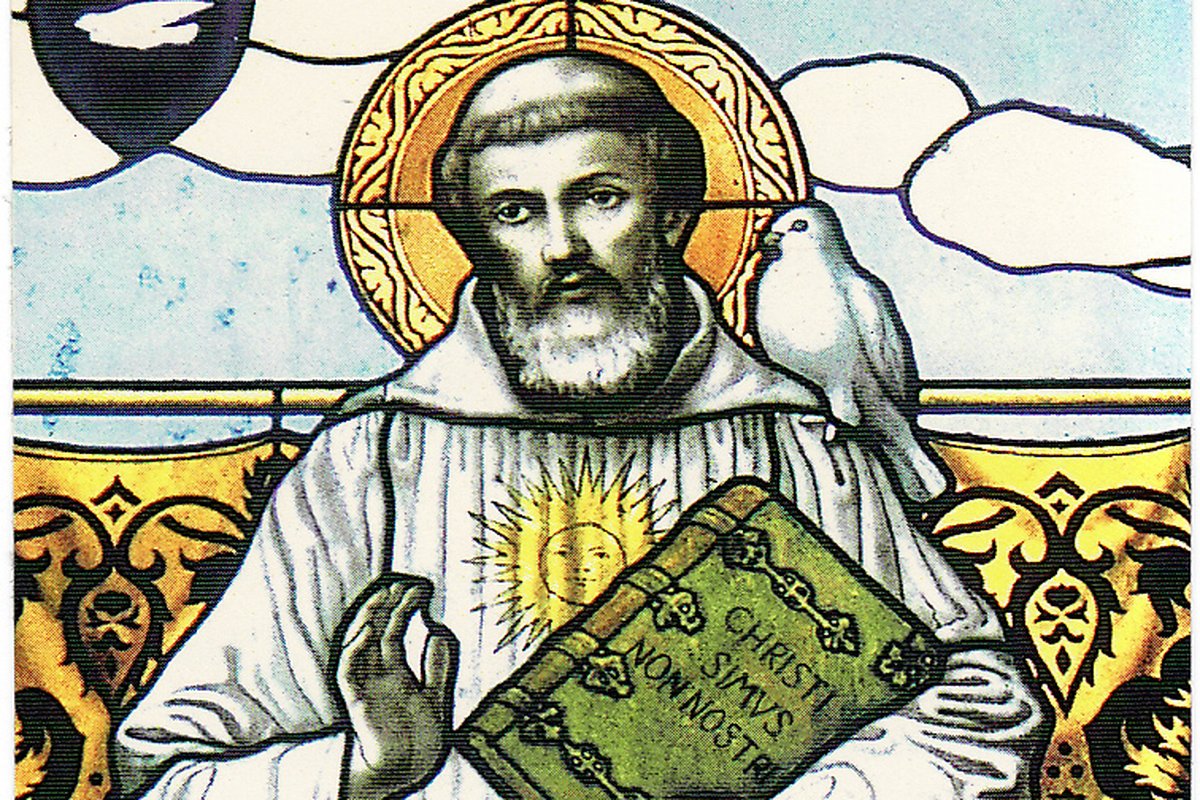
Unidentified 19th-century stained-glass artist, window depicting Saint Columban, Abbey of Bobbio, Italy — public domain.
A chain of monasteries in Gaul
Columban and his companions settled first in the Vosges Mountains, where the Frankish king Childebert II granted them land to build a monastery at Annegray. As more recruits arrived, Columban founded two more nearby houses, Luxeuil and Fontaine, with Luxeuil becoming the largest and most influential of the three. He governed all three communities under a Rule of his own composition — the Regula Monachorum, a real and still-surviving text that lays out a monastic discipline notably stricter than the Rule of Saint Benedict that would eventually eclipse it across Western Europe. Luxeuil, in particular, became a training ground for a generation of monk-bishops who went on to found further monasteries of their own, spreading Columban's influence well beyond anything he oversaw personally.
A blunt word for a king
Columban's standing at Luxeuil did not survive his willingness to say uncomfortable things to powerful people. King Theuderic II of Burgundy, whose territory included Luxeuil, was living with several concubines rather than a lawful wife, and Columban condemned the arrangement to his face — then refused, when asked, to bless Theuderic's sons by those concubines, on the grounds that children born outside a legitimate marriage had no claim to succeed him. Theuderic's grandmother, Queen Brunhilda, who held real power at court and had her own reasons to resent Columban's interference, backed the king's fury. Around 610, Columban was forcibly removed from Luxeuil and marched, under guard, back toward the coast for deportation to Ireland — a plan that fell apart when the ship meant to carry him ran aground, leaving him free to continue his mission on the continent instead.
Defending Ireland's Easter to the popes
Even before the break with Theuderic, Columban had picked another fight — this one with the wider Church hierarchy, over the date of Easter. Ireland calculated the date using an older method than the one used in Rome and across most of the continent, and continental bishops pressed Columban to fall in line. Rather than simply comply or simply refuse, he wrote directly to more than one reigning pope, defending the Irish practice with a confidence that reads, even now, as remarkably undeferential for a monk addressing the bishop of Rome. These letters survive as genuine primary sources, not later legend, and they show a monk who took obedience to the Church seriously without treating every point of local practice as beyond argument.
Bobbio and a library that outlasted an empire
After leaving Frankish territory, Columban made his way south into Lombard Italy, where King Agilulf granted him land at Bobbio, in the Apennine foothills, to found one final monastery in 614. Columban died there on November 23, 615, having spent barely a year as its abbot. Bobbio went on to become one of medieval Europe's most important centers of manuscript preservation, its library eventually holding a collection of classical and early Christian texts significant enough that scholars still study what survived there today. Between Annegray, Luxeuil, Fontaine, and Bobbio, Columban left behind not a single institution but a network — one that continued producing monks, bishops, and manuscripts for centuries after his death.
The Regula and a harsher path to holiness
Columban's monastic Rule, the Regula Monachorum, is worth pausing on because it reveals something about how differently sixth-century Irish monasticism approached discipline compared to what would later become standard on the continent. Where the Rule of Saint Benedict, written around the same era in Italy, is famous for its moderation — a "little rule for beginners," as Benedict himself called it — Columban's Rule imposed a noticeably harsher regime of fasting, silence, and corporal penance for infractions as small as coughing during psalms or speaking without permission at meals. It reflected a specifically Irish monastic culture that treated bodily austerity as a primary path to spiritual discipline, an emphasis some later medieval writers found so demanding that Benedict's gentler Rule gradually displaced it at monastery after monastery, including eventually at Luxeuil itself.
Companions who carried the mission further
Columban rarely traveled or worked alone, and several of the monks who accompanied him from Ireland or joined him along the way became significant founders in their own right. Saint Gall, one of his original companions, stayed behind in the region of Lake Constance when Columban continued on to Italy, and the hermitage Gall founded there eventually grew into the Abbey of St. Gall in modern Switzerland — one of the most important monastic libraries in the medieval world, still standing today. It's a pattern that repeats throughout the early Irish missionary movement: a single peregrinus setting out with a handful of companions could, within a generation or two, seed an entire network of institutions across a continent that had never asked for them but badly needed the stability, literacy, and continuity monasteries provided in the post-Roman world.
A patron for travelers, old and new
Columban's feast is kept on November 23. Alongside Saint Benedict, he is informally honored as a patron of a unified Christian Europe, a fitting tribute to a monk whose life's work was carried out almost entirely outside his own country. In a much lighter and distinctly modern twist, he has also picked up an informal following as a patron of motorcyclists — a 20th-century designation with obvious roots in the fact that hardly any saint in the calendar covered more unplanned ground, on foot, than Columban did.
Trivia
Who was Saint Columban?
Why was Columban expelled from the monastery he founded at Luxeuil?
What is a 'peregrinus,' and was Columban one?
Did Columban really argue with the pope about Easter?
What is Saint Columban the patron saint of?
You May Also Like
Related Reading