Saint Gall

One of the twelve who left Ireland
Gall was born in Ireland around 550 and became one of twelve monks who joined Columban's mission to the European continent — a group of Irish peregrini, monks who left their homeland permanently as a deliberate act of exile undertaken for Christ, with no plan of returning. This practice, sometimes called "white martyrdom" because it involved no bloodshed but demanded the same total surrender of self as dying for the faith, sent waves of Irish monks across the Continent in the sixth and seventh centuries. Columban, the leader of Gall's mission and the most famous of these wandering monks, went on to found monasteries across Gaul and Italy, a story told in Saint Columban's article.
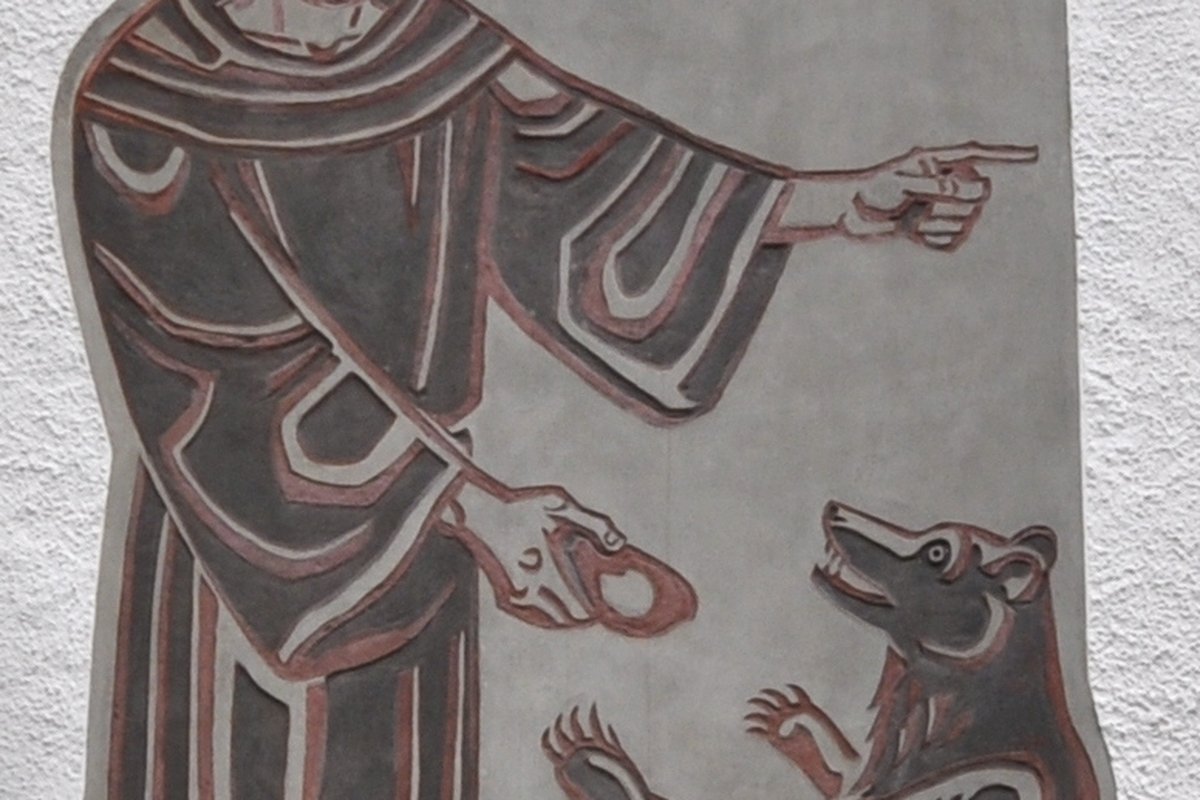
Andreas Praefcke, photograph of a relief mural depicting Saint Gallus and the bear, St. Gallen, Switzerland, 2013 — public domain (released by the photographer).
The group crossed into Merovingian Gaul together and later moved into the region around Lake Constance, in what is now northeastern Switzerland, preaching among the Alemanni, a Germanic people who had not yet been converted to Christianity in any settled way. Gall is remembered as fluent enough in the local language to preach directly to them himself, a detail that set him apart even within Columban's own circle of companions. Some accounts credit him with actually destroying pagan idols in the region, a common enough motif in missionary hagiography that reflects the real friction between the new faith and older customs.
Left behind by a lake
When local hostility and political pressure eventually forced Columban to leave the Lake Constance region for Italy around 612, Gall did not go with him. The traditional account holds that he was too sick to travel, and stayed behind rather than continue on to what would become Columban's final monastery at Bobbio. Some later sources add a more personal note of tension to the parting: they say Columban, displeased that Gall would not follow, forbade him from celebrating Mass for as long as Columban himself remained alive, and that Gall honored this out of obedience until word of Columban's death reached him years later.
Whatever the precise reason for the separation, Gall settled into a hermit's life in the forest near the lake, living alone in a hut by the Steinach stream and drawing a small community of disciples to him over the years that followed. He never held any formal office in the Church and, according to tradition, twice declined the offer of a bishopric — once for the nearby see of Konstanz and once, some accounts add, for an abbacy back in the region Columban had left — preferring the hermitage he had built to any position of authority. That refusal became almost as much a part of his reputation as the bear story: a monk who had crossed a continent for the sake of solitude and had no intention of trading it for a miter.
A bear, a fire, and a fair amount of legend
The best-known story about Gall involves a bear. According to the traditional account — pious legend rather than documented history, and worth naming as such — Gall was warming himself by a fire in the forest when a bear charged out of the trees toward him. Instead of fleeing, Gall rebuked the animal, and it stopped short; he then offered it bread, and the bear, in gratitude, brought him firewood for his fire. It's the kind of story that circulated widely about desert and forest hermits across the early medieval Church, and it isn't treated as verified history even by sympathetic modern accounts. Stories of saints befriending or taming wild animals appear again and again in this period — Saint Jerome and his lion, various desert fathers and their obliging beasts — and they typically carry the same message: a holy person living in right relationship with God is restored, in some small way, to the peace between man and creation that existed before the Fall.
But whatever its origins, the bear story took firm enough hold in local memory that the animal became a lasting emblem of the community that grew up around Gall's hermitage. It still appears on the coat of arms of the city of St. Gallen today, walking upright on its hind legs exactly as the old story describes, and for centuries live bears were kept in a pit near the abbey precincts as a living reminder of the legend — a practice that has long since ended, but that shows how completely the story became part of civic identity rather than staying a pious footnote confined to hagiography.
From a hermit's hut to a monastery
Gall died around 646, having spent decades as a hermit rather than the founder of any formal institution. It was his followers, not Gall himself, who built a monastery on the site of his hermitage after his death, and the community that grew up there took his name: the Abbey of St. Gallen. The monastery did not reach its full importance immediately — it took roughly a century, under the Carolingian rulers of the eighth and ninth centuries, for the abbey to grow into the major center of learning it became. Over those following centuries, it turned into one of the most significant hubs of manuscript copying, teaching, and monastic scholarship anywhere in early medieval Europe, at a time when relatively few institutions on the continent were doing that work at all.
A library that survived the centuries
The Abbey Library of St. Gallen still exists today, and it remains one of the most important surviving collections of medieval manuscripts in the world — recognized as a UNESCO World Heritage Site, and open, in part, to visitors who can walk through the same ornate Baroque hall that has held these books since the eighteenth century. Its shelves hold roughly 2,100 manuscripts, some dating back to the eighth century, including the famous Plan of Saint Gall, a ninth-century architectural drawing of an idealized monastery that is the oldest surviving architectural plan from the medieval West. It's a rare case among early medieval monastic foundations: not a ruin, not a story preserved only in later chronicles, but a working library that has held onto its own history in physical form since long before anyone thought to write it down as legend.
A name that became a city
Few saints have left as literal a mark on a map as Gall did. The hermitage he built by the Steinach stream slowly gathered the monastery, then a town, then an entire Swiss canton around it, and all three still carry his name today: the city of St. Gallen and the canton of the same name sit exactly where his hut once stood. Visitors to the old town can still see his story retold in stone — the relief carving of Gall and the bear pictured at the top of this article is one of many such depictions scattered through the city, a reminder of how thoroughly local identity and the hermit's legend became intertwined over fourteen centuries.
Gall's feast is kept on October 16. He is honored today as the patron of the Swiss city and canton that carry his name, and, through the old folk tradition tied to his years in the forest, as a patron of birds as well.
Trivia
Who was Saint Gall?
Why did Gall separate from Columban?
What is the story of Saint Gall and the bear?
What did Gall's hermitage become?
What is Saint Gall the patron saint of, and when is his feast?
You May Also Like
Related Reading