Saint Cyril of Alexandria

A patriarch's nephew becomes a patriarch
Cyril was born around 376, probably in or near Alexandria, Egypt's great intellectual capital, and grew up in the household of his uncle Theophilus, the city's patriarch. Theophilus made sure his nephew received a thorough education in Scripture and the writings of earlier Church Fathers, and Cyril also spent time among the monks of the Egyptian desert, absorbing the ascetic discipline that shaped so many of Alexandria's clergy in this period. When Theophilus died in 412, Cyril succeeded him after a contested election, inheriting a see that functioned as much as a political power base as a religious one — Alexandria's patriarch commanded enormous wealth, a private force of monks who acted something like a personal militia, and an influence that regularly collided with the city's Roman prefect.
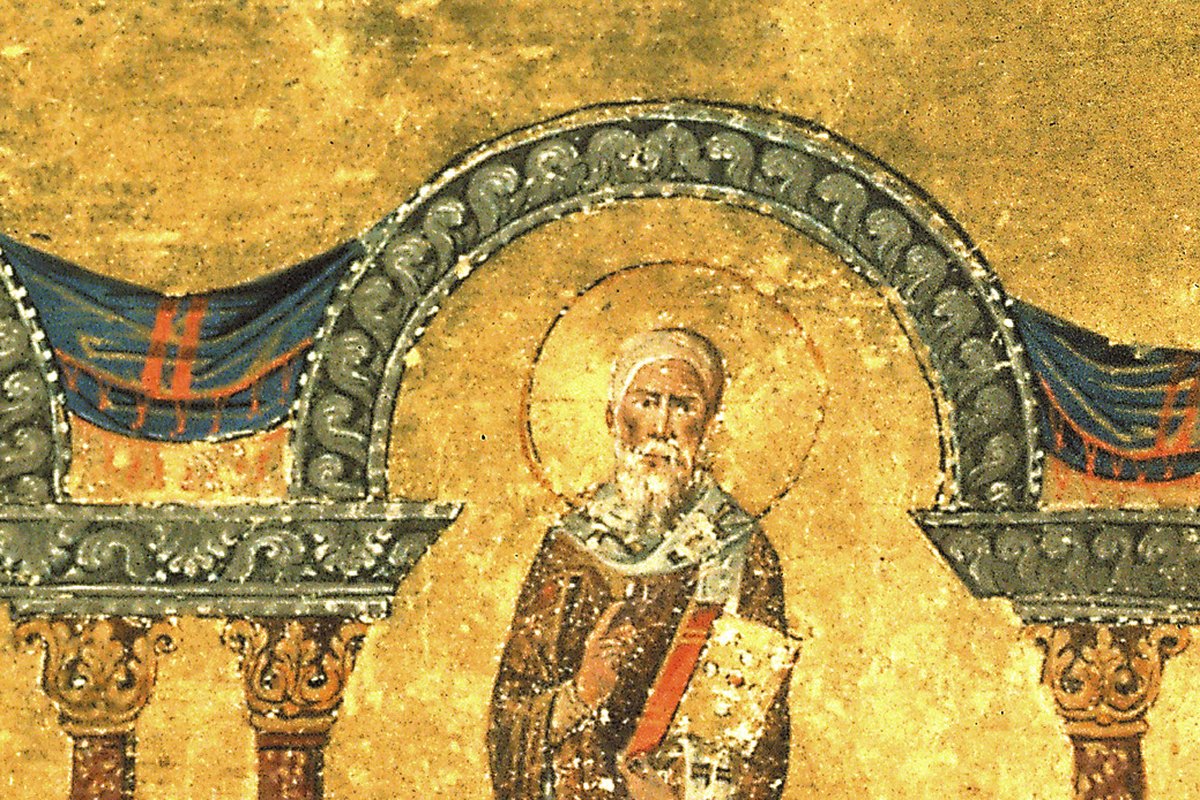
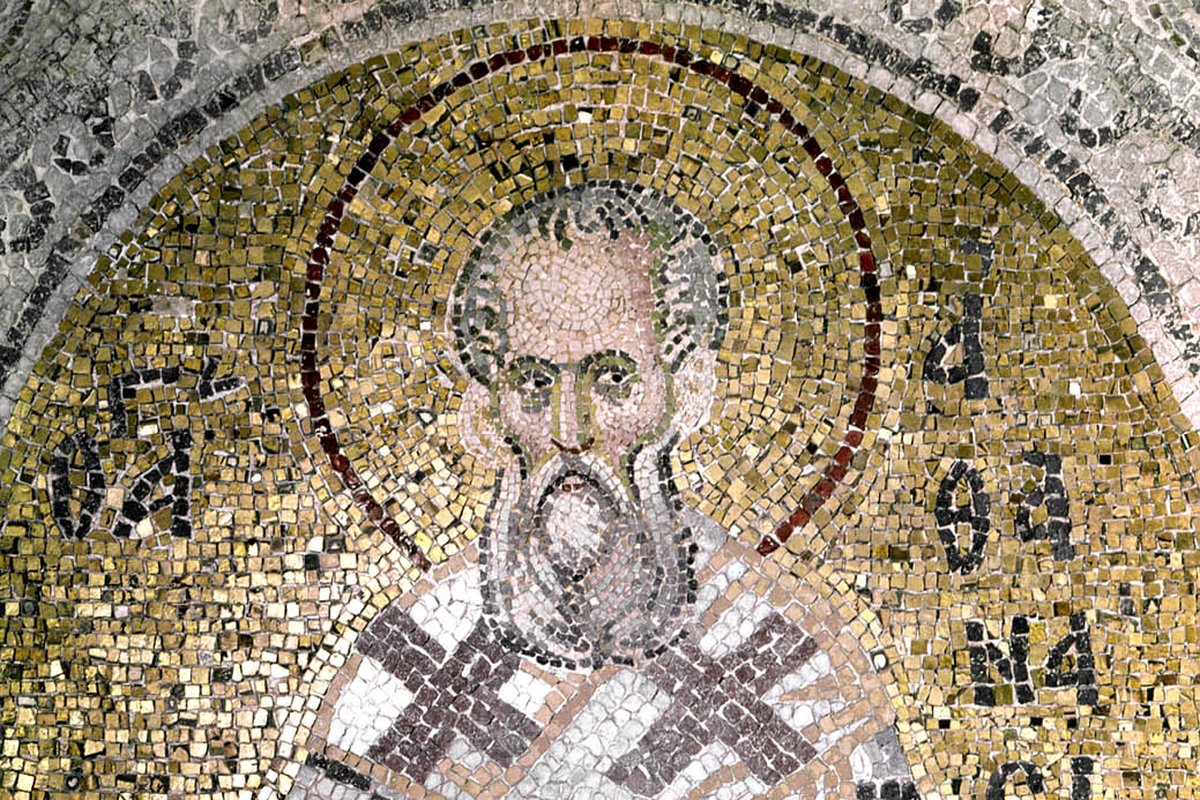
Byzantine manuscript illuminators, Athanasius and Cyril of Alexandria, Menologion of Basil II, c. 985, Vatican Library (Vat. gr. 1613) — public domain.
A hard chapter historians don't skip
That collision turned violent more than once in Cyril's early years as patriarch. His tenure saw the expulsion of Alexandria's Jewish community after a period of communal rioting, and in 415 a mob linked to Cyril's supporters murdered Hypatia, a respected pagan philosopher and mathematician, dragging her from her carriage in broad daylight. No surviving ancient source shows Cyril ordering the killing, and historians still argue over exactly how directly responsible he was — but it happened amid genuine tension between his office and Alexandria's governor, tension Cyril was actively part of, and no honest account of his life leaves it out.
The council that didn't wait
Cyril's lasting reputation rests on a theological fight several years later. Nestorius, the newly installed bishop of Constantinople, was teaching that Mary shouldn't be called Theotokos ("God-bearer") but only Christotokos, "mother of Christ" — a distinction Cyril read as dividing Jesus into two loosely joined persons, one divine and one human, instead of a single undivided Christ. Cyril wrote to Nestorius directly, warning him in his Second Letter that he had "greatly scandalized the whole Church, and cast among the people the leaven of a strange and new heresy." That letter, along with a follow-up in which Cyril set out twelve formal anathemas (condemned propositions) against Nestorius's teaching, circulated widely among bishops well before the council convened, meaning much of the theological groundwork for Ephesus had already been laid in writing before anyone even reached the city. When the dispute reached an ecumenical council at Ephesus in June 431, Cyril — presiding as Pope Celestine I's representative — opened proceedings on June 22 without waiting for the delegation of bishops loyal to Nestorius, who were still delayed on the road. The bishops present condemned and deposed Nestorius within that single day. When the missing delegation, led by John of Antioch, finally arrived, they were furious enough to convene their own rival council condemning Cyril right back — a messy, overlapping double verdict that took two more years of negotiation to settle into the Formula of Reunion of 433.
A theologian, not just a politician
It would be a mistake to remember Cyril only for the political maneuvering at Ephesus. He was, by the standard of his era, an unusually careful and prolific theological writer, producing commentaries on the Gospel of John and the Pentateuch, treatises on the Trinity, and a long series of letters that circulated widely among bishops across the Mediterranean world. His central theological insight — that the divine and human in Christ are united in a single person without either nature being diminished or absorbed by the other — became known in later theology as the "hypostatic union," a term Cyril himself didn't use but whose substance he articulated as clearly as anyone before the Council of Chalcedon formalized the vocabulary. His writing style was famously combative; he rarely pulled punches with theological opponents, a trait that won him devoted allies and lasting enemies in roughly equal measure.
Doctor of the Incarnation
The Council of Ephesus's ruling held, and it did more than settle one bishop's career: it affirmed Theotokos as correct doctrine and set down the principle — refined further at the Council of Chalcedon twenty years later — that Christ is one person holding two complete natures, divine and human, without division or confusion between them. That principle remains part of the Catholic Church's core Christology today, and the title Theotokos is still used of Mary in both Catholic and Orthodox devotion, a direct legacy of the fight Cyril led at Ephesus. Cyril's feast falls on June 27, and in 1882 Pope Leo XIII named him a Doctor of the Church, honoring him specifically as the theologian whose combative, closely argued letters protected the doctrine of the Incarnation at a moment when it could easily have split apart into rival churches. His legacy sits alongside other early defenders of Trinitarian and Christological orthodoxy covered elsewhere on this blog, including Saint Hilary of Poitiers in the West and Saint John Damascene writing several centuries later in the East — each confronting a different challenge to the same core conviction that Christ is truly God and truly man.
Trivia
Who was Saint Cyril of Alexandria?
What happened at the Council of Ephesus in 431?
Why is Cyril called the 'Doctor of the Incarnation'?
What is Cyril's connection to the killing of the philosopher Hypatia?
Why was Nestorius's teaching considered a heresy?
You May Also Like
Related Reading