Saint Athanasius of Alexandria

A deacon at the Council of Nicaea
Athanasius was born around 296 in Alexandria, then one of the largest and most intellectually significant cities in the Roman world, and grew up within the orbit of its bishop, Alexander. He was still only a deacon — not yet a bishop himself — when he accompanied Alexander to the Council of Nicaea in 325, the landmark gathering of bishops that condemned the teaching of an Alexandrian priest named Arius. Arius held that the Son was a created being, distinct from and lesser than God the Father — a position that, if accepted, would have redefined the basic Christian understanding of who Christ was. Nicaea rejected Arius's teaching and affirmed instead that the Son is "of one substance" (homoousios) with the Father, fully and equally divine. Athanasius, present for that decision as a young churchman still early in his career, would spend the rest of his life defending it — long after most of the bishops who'd voted for it had died, wavered, or been replaced.
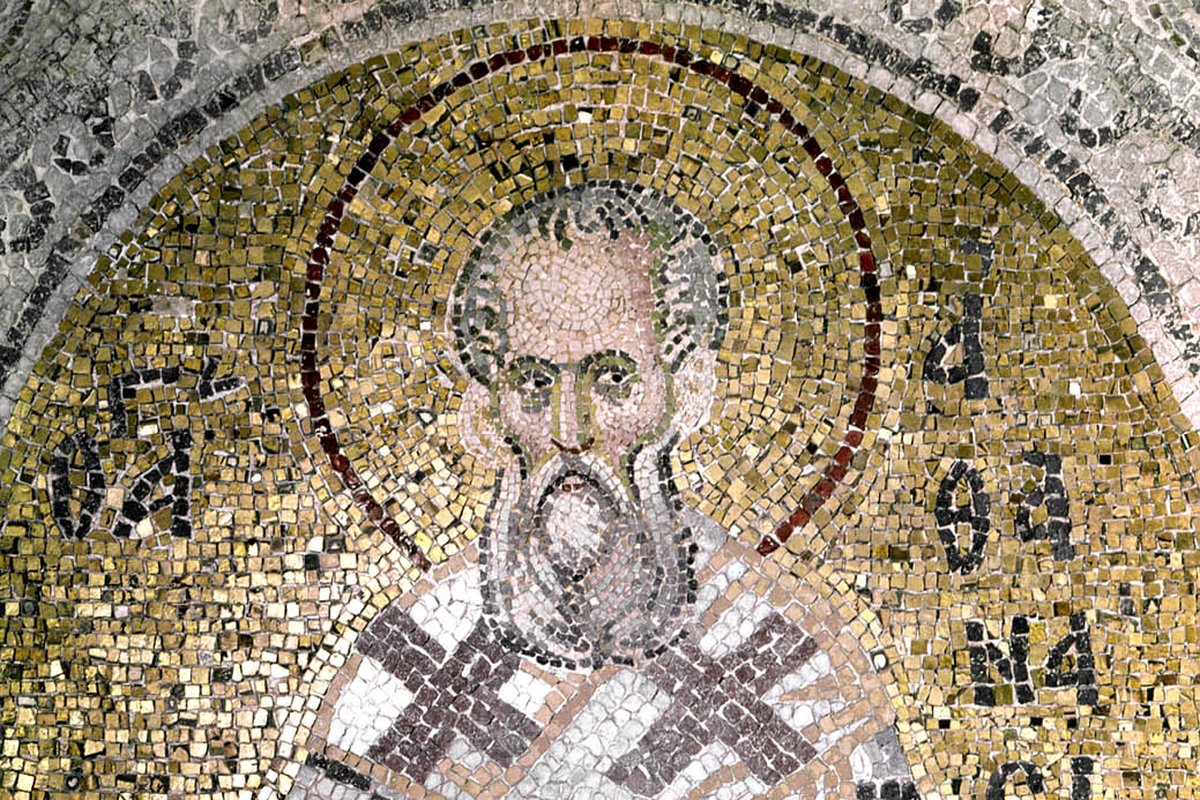
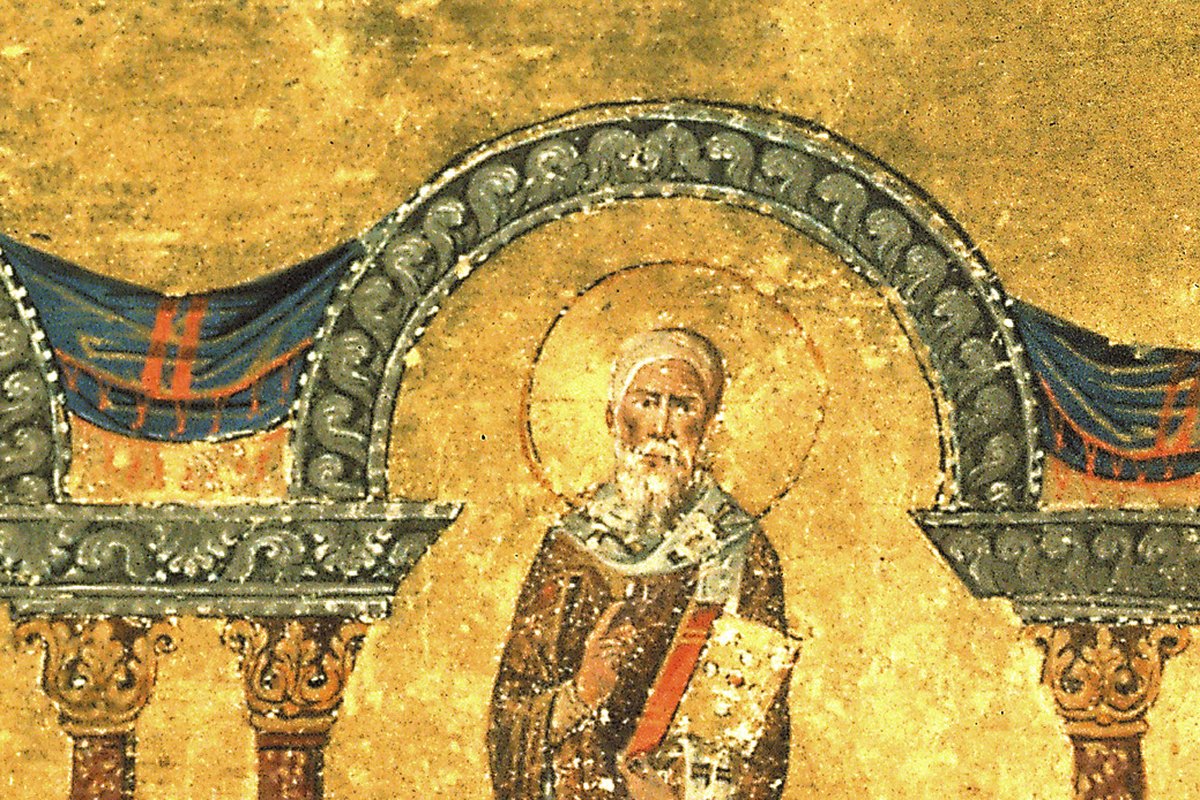
Byzantine mosaic of Saint Athanasius, Pammakaristos Church (Fethiye Camii), Istanbul, late 13th–early 14th century; photographed by the Byzantine Institute, Dumbarton Oaks — public domain (CC0).
The dispute wasn't an abstract argument over technical vocabulary, even though it can look that way from a distance. Arius taught that "there was a time when the Son was not" — that the Son was a creature, brought into being by the Father rather than existing eternally alongside him. Athanasius saw immediately what that implied: if Christ was merely a very exalted creature, then he couldn't fully unite humanity to God, and the entire Christian claim that salvation comes through Christ would rest on shaky ground. That conviction — that getting Christ's identity wrong put salvation itself at risk — is why Athanasius refused every compromise offered to him for the rest of his life, even when compromise would have ended his exile and restored his comfort.
Bishop of Alexandria, five times exiled
Athanasius succeeded Alexander as Patriarch of Alexandria in 328, becoming the 20th bishop of that see, and immediately stepped into a decades-long fight that Nicaea's decision hadn't actually settled. Arianism didn't disappear after being condemned; it retained powerful supporters, including at various points emperors themselves, who preferred a version of Christianity that didn't force the same uncompromising choice Athanasius insisted on. Over the course of his episcopate, Athanasius was driven out of Alexandria five separate times by four different emperors — Constantine I, Constantius II, Julian, and Valens — spending roughly a third of his nearly 46 years as bishop in exile, hiding among monks in the Egyptian desert or fleeing to distant corners of the empire. Each time, once the political winds shifted, he returned to his diocese and picked up the same fight in the same place, without ever conceding the point that had gotten him banished.
His longest stretch away from Alexandria, during the reign of Constantius II, sent him deep into the Egyptian desert among the monks who had fled ordinary society to live in prayer and manual labor. That exile turned out to be more than just hiding; it forged a lasting bond between Athanasius and the emerging monastic movement, one he later gave lasting shape to in writing. He also used his years away from the capital productively rather than passively, drafting letters and theological treatises that circulated even while he himself couldn't safely show his face in Alexandria — a bishop governing his diocese, in effect, by correspondence smuggled past imperial officials who wanted him silenced entirely.
The bishop later called "against the world"
That pattern of exile and return, held together by a refusal to bend, eventually earned Athanasius a Latin epithet from later generations: Athanasius contra mundum — "Athanasius against the world." It's important to be clear that this is a title history gave him after the fact, not a line Athanasius himself is recorded saying; it captures how isolated his position sometimes looked, particularly during stretches when Arian-leaning bishops controlled major sees and imperial favor ran against him, and he seemed to be nearly the last major churchman still insisting on the Nicene position. Time proved him right: the Nicene understanding of Christ's full divinity that Athanasius refused to abandon became, and remains, the mainstream Christian position, reaffirmed at the Council of Constantinople in 381, eight years after his death.
The letter that named the New Testament
Among Athanasius's writings sits one document whose influence reaches well beyond the Arian controversy that consumed most of his career. Each year, as bishop of Alexandria, he wrote a Festal Letter announcing the date of Easter to the churches of Egypt — a routine administrative duty. In his Festal Letter for the year 367, however, Athanasius did something no surviving Christian document had done before: he listed all 27 books of the New Testament, in the exact grouping still used today, and called them alone the authentic, canonical Scriptures of the faith. It's the earliest surviving list that matches the New Testament canon precisely as Christians now receive it — a quiet, almost incidental legacy from a bishop whose public reputation rests mostly on louder battles.
A Doctor of the Church
Athanasius died in Alexandria in 373, having outlasted every emperor who ever exiled him. His writing — including a landmark biography of Saint Anthony of Egypt that helped spread the ideals of Christian monasticism across the Mediterranean world, and a body of theological work defending Nicene doctrine — secured his reputation long after his death. In 1568, Pope Pius V formally named him a Doctor of the Church, placing him alongside Saint Basil the Great, Gregory Nazianzen, and Saint John Chrysostom as one of the four great Doctors of the Eastern Church. His feast is kept on May 2, and he's venerated today as patron of theologians — recognition for a churchman whose defining trait wasn't brilliance alone, but the refusal to trade a hard theological truth for an easier, quieter life. Readers interested in the wider Arian controversy and the century of theological argument it set off may also want to read about Saint Basil the Great, who took up essentially the same fight a generation later, this time over the divinity of the Holy Spirit rather than the Son.
Trivia
Who was Saint Athanasius of Alexandria?
Why was Athanasius exiled so many times?
What does 'Athanasius contra mundum' mean?
Is Athanasius a Doctor of the Church?
What is Saint Athanasius the patron saint of?
You May Also Like
Related Reading