Saint Isidore of Seville

A see inherited from his own brother
Isidore was born around 560 in Cartagena, on Spain's southeastern coast, into a family that produced an unusual number of bishops and saints: his older brother Leander became Archbishop of Seville, his sister Florentina and younger brother Fulgentius are both venerated as saints in their own right, and Isidore himself was raised and educated largely under Leander's care after their parents died. Leander had a reputation, by Isidore's own later account, as a demanding teacher, and Isidore's education under him took place against the backdrop of a genuinely turbulent Spain: the Visigothic kingdom that ruled the peninsula had only recently abandoned Arianism, the heresy denying Christ's full divinity, for orthodox Nicene Christianity, a religious realignment Leander himself had helped bring about at the Third Council of Toledo in 589.
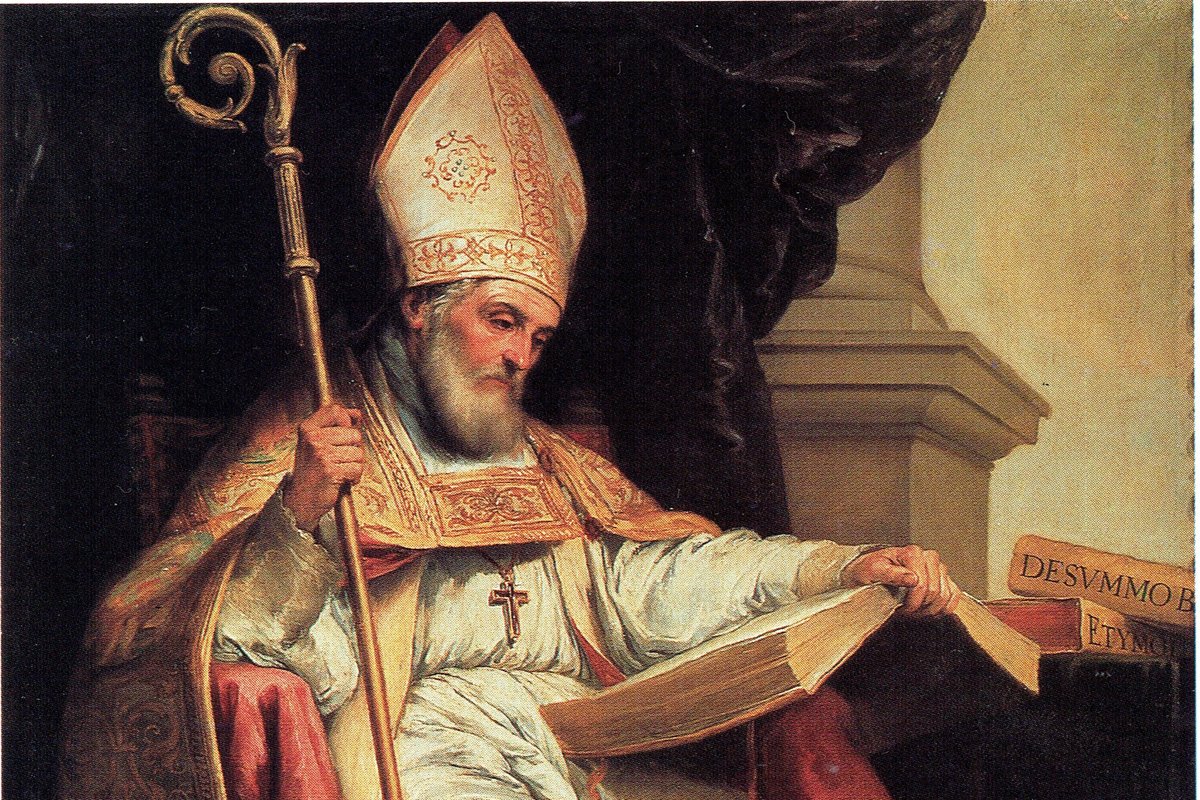
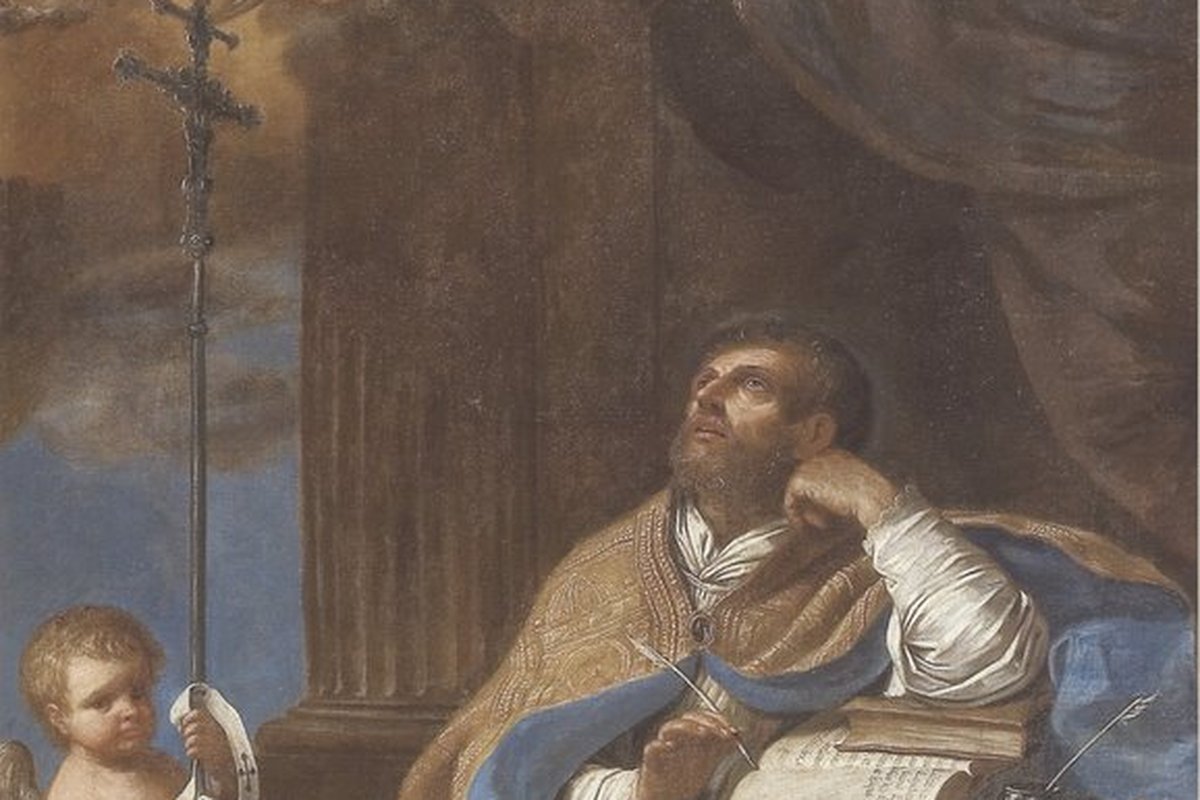
Bartolomé Esteban Murillo, Saint Isidore of Seville, 1655, Sacristía Mayor, Seville Cathedral — public domain.
When Leander died around the year 600, Isidore succeeded him as Archbishop of Seville, a post he held for more than three decades, presiding over Spanish church councils and pushing for a unified system of clergy education across the country's cathedral schools. He presided most notably over the Fourth Council of Toledo in 633, which issued sweeping decrees on liturgy, clergy discipline, and education, including a requirement that every cathedral maintain a school for training future clergy — an early and influential push toward standardized, formal education within the Spanish Church.
Twenty books, one encyclopedia
Isidore's defining work, finished near the end of his life, is the Etymologiae — sometimes called the Origines — a sprawling twenty-book encyclopedia that organizes an enormous range of subjects, from grammar and medicine to law, theology, zoology, geography, and the design of buildings and ships. Its organizing principle is etymology: Isidore works outward from the origin of each subject's key words, on the theory that a word's history reveals something true about the thing itself. Much of the material is drawn and condensed from earlier classical and Christian authors rather than original research, but the scale of the compilation was, for its time, without real precedent — an attempt to gather essentially all available learning into a single reference a reader could actually hold.
Modern readers who dip into the Etymologiae often come away struck by how much of it reads as charmingly, confidently wrong by today's scientific standards — Isidore repeats ancient claims that barnacle geese hatch from driftwood, or that salamanders can survive fire unharmed, treating inherited classical lore with the same confidence he brings to sound Christian doctrine. That's not a flaw specific to Isidore so much as a feature of pre-modern encyclopedism generally: his goal was to preserve and organize the accumulated learning available to him, not to independently test it, and by that standard the book succeeded on an enormous scale. His nephew and student, also confusingly named Isidore in some later sources though more commonly Braulio, Bishop of Zaragoza, was responsible for organizing and circulating the finished work after Isidore's own death, since the encyclopedia was still not fully polished when he died.
An unofficial patron for a very different age
That same impulse — organizing scattered knowledge into one accessible place — is exactly why Isidore's name resurfaced in the 1990s among Catholic internet users looking for a patron saint of their own. The comparison isn't a stretch: an encyclopedia trying to hold all human knowledge in one place has an obvious echo in what the internet promises to do today. It's worth being precise about the Church's actual role here, though: in 1999, the Vatican's Pontifical Council for Social Communications recommended Isidore as a fitting patron for internet users and computer programmers, but no pope has ever issued a formal, final decree naming him so. His patronage of the internet remains popular and widely repeated, not an official Church teaching.
Doctor of the Church
Isidore was canonized in 1598, and Pope Innocent XIII declared him a Doctor of the Church in 1722, a title recognizing not just the Etymologiae but Isidore's broader role holding classical learning together in Spain during a genuinely precarious period, after Rome's collapse in the west had put centuries of ancient knowledge at real risk of disappearing outright. His feast is kept on April 4, the anniversary of his death in 636.
Isidore's other writings extended well beyond the Etymologiae: he wrote a history of the Goths, Vandals, and Suebi who had settled on the Iberian peninsula, a treatise on Church offices, and a shorter handbook of scientific and cosmological knowledge called De Natura Rerum ("On the Nature of Things"), composed at the request of a Visigothic king. Taken together, his body of work made him, by a wide margin, the most prolific Latin author of Visigothic Spain, and one of the last figures in Western Europe writing with anything resembling the range and ambition of the late Roman encyclopedic tradition before the intellectual contraction of the following centuries set in.
Why his work still gets read
The Etymologiae survives today in hundreds of medieval manuscript copies, making it one of the most widely circulated reference texts of the entire Middle Ages. For many later medieval readers, Isidore's encyclopedia was effectively the only channel through which fragments of otherwise-lost classical texts and ideas reached them at all — a seventh-century bishop, working from a cathedral library in Spain, quietly keeping pieces of the ancient world in circulation long after the empire that produced them had fallen.
Readers interested in other early Church figures who devoted themselves to preserving and organizing knowledge for future generations, rather than to original theological speculation, may also want to read about Saint Cyril of Jerusalem, whose catechetical lectures performed a comparable service on a smaller, more pastoral scale a couple of centuries earlier. Isidore's own project was, by contrast, encyclopedic in the most literal sense — an attempt, however imperfect by later standards, to hold the entire inherited memory of the ancient and Christian worlds together in one set of books, at a moment when a great deal of it was genuinely at risk of being lost for good.
Trivia
Who was Saint Isidore of Seville?
What is the Etymologiae?
Is Isidore of Seville officially the patron saint of the internet?
Why is Isidore of Seville a Doctor of the Church?
Why does Isidore's encyclopedia still matter to historians?
You May Also Like
Related Reading