Saint Dunstan of Canterbury

A craftsman before he was an archbishop
Dunstan was born around 924 near Glastonbury, into a family with connections to the West Saxon royal court, and he spent part of his youth being educated by Irish monks who had settled near the old abbey there — a detail that helps explain both his early exposure to serious scholarship and his lifelong attachment to Glastonbury itself. Long before he held any major church office, he had a genuine reputation as a skilled craftsman — working metal, casting bells, illuminating manuscripts by hand, and even playing the harp well enough that later stories credited him with near-magical musical ability. That real, documented talent is worth holding onto, because it's almost certainly what gave later storytellers their raw material: a monk who could actually work a forge was an easy figure to cast as the hero of a blacksmith's duel with the Devil himself.
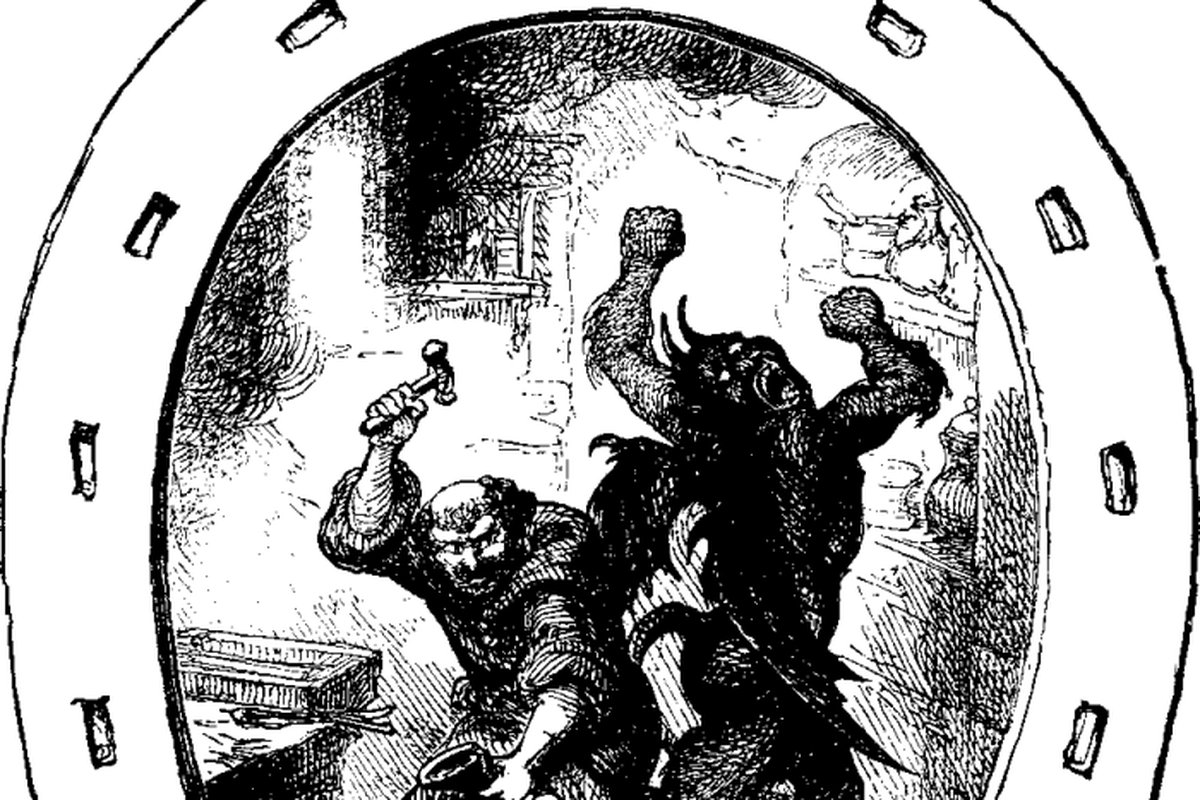
George Cruikshank, Dunstan and the Devil, 1871, illustration — public domain.
Dunstan's early career was not a smooth, uninterrupted rise. He served for a time at the court of King Æthelstan, but jealous rivals accused him of practicing sorcery — a charge that stemmed, ironically, from the same scholarly and artistic interests that made him valuable to the court — and he was driven out in disgrace. He nearly abandoned any thought of a public life afterward, but a bout of serious illness convinced him to commit fully to monastic life instead, and he returned to Glastonbury to begin the work that would define him. Dunstan became Abbot of Glastonbury and used the position to begin restoring a monastery that, like most of England's religious houses at the time, had fallen into disrepair after generations of Viking raids and general neglect.
Exile, and a king's summons
Dunstan's reforming instincts made him plenty of enemies among nobles who preferred the looser standards of the existing religious houses, and under King Eadwig he was banished from England entirely after a dispute that, according to tradition, began when Dunstan publicly rebuked the young king for leaving his own coronation feast to keep company with a noblewoman rather than attending to his royal duties. Dunstan spent his exile in Flanders, at the abbey of Blandinium, where he had his first close look at Benedictine monastic reform already underway on the Continent — an experience that shaped the reforms he would later bring to England. When Eadwig's brother Edgar came to the throne, Dunstan was recalled, restored to favor, and rapidly promoted through a series of bishoprics before his eventual appointment as Archbishop of Canterbury in 959.
Rebuilding English monastic life
Dunstan's real achievement had nothing to do with tongs or temptation. In 959, he became Archbishop of Canterbury, and from that position he led one of the most significant reforms in the history of the English Church, working alongside two other reforming bishops, Æthelwold and Oswald of Worcester. Their combined effort culminated around 973 in the Regularis Concordia — the first unified rule for monastic life applied across the whole of England, replacing the patchwork of inconsistent local customs that had governed individual monasteries up to that point. It was a genuinely difficult administrative and spiritual undertaking, coordinating reform across an entire kingdom's worth of religious houses, and its effects on English monasticism outlasted Dunstan by centuries.
An early kind of canonization
Dunstan died in Canterbury on May 19, 988, and the recognition of his sanctity followed the informal pattern typical of the period rather than any process resembling the Church's later formal canonization. In 1029, the Synod of Winchester formally ordered that his feast be kept as a solemn observance throughout England — a striking, quasi-official step that predates the developed Roman canonization procedure by centuries and reflects just how significant his reform work was already understood to be within a generation of his death. For roughly two centuries after his death, Dunstan was the most widely venerated native saint in England, and Canterbury Cathedral held his relics as one of its principal treasures — a status that only shifted centuries later, after the murder of Saint Thomas Becket at the same cathedral drew pilgrims toward a newer, more dramatic martyr's cult.
The legend, and why it stuck
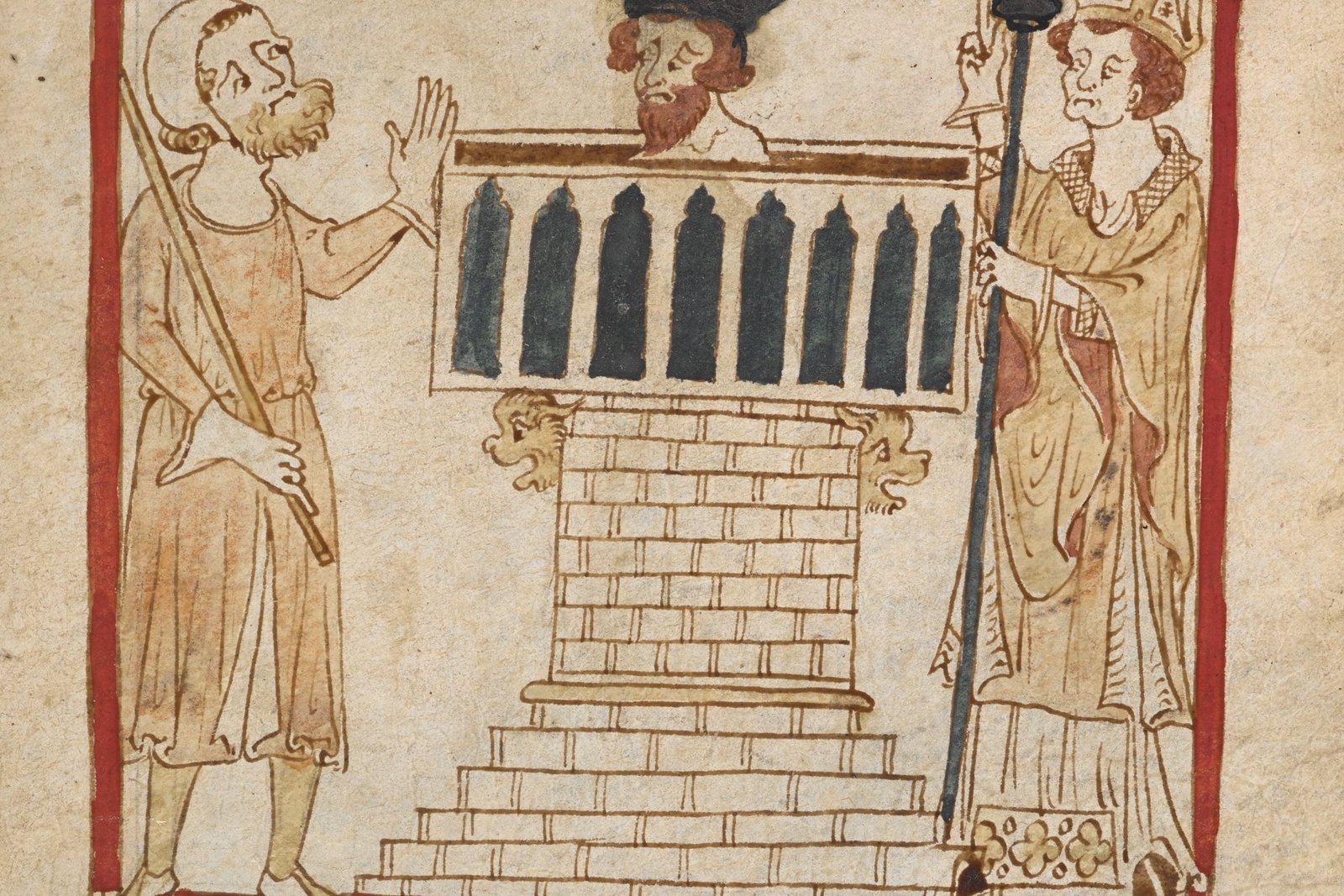
No account of Dunstan is complete without addressing the story most people have actually heard: the Devil, tempted to distract him, supposedly approached Dunstan at his forge in disguise, and Dunstan responded by seizing the Devil's nose with a pair of red-hot tongs and refusing to release him until he fled. It's important to be direct about what this is: a popular legend that surfaces only in later medieval tradition, not a contemporary record of Dunstan's actual life, and it should be read as folklore rather than documented history. What the legend does reflect accurately, though, is Dunstan's genuine skill as a metalworker — and that connection is exactly why metalworkers and locksmiths came to popularly regard him as a kind of patron, an informal, traditional association rather than one ever confirmed by formal papal decree. His feast is kept on May 19, and his more durable legacy, the Regularis Concordia, remains the far less flashy but far better-attested achievement of his life.
Trivia
Who was Saint Dunstan of Canterbury?
Is the story of Dunstan and the Devil's nose true?
What was the Regularis Concordia?
How was Saint Dunstan recognized as a saint?
Is Saint Dunstan really the patron saint of metalworkers?
You May Also Like
Related Reading