Saint Oswald of Worcester

One of three men who rebuilt English monasticism
Oswald was born around 925 or 926 into a family of Danish descent already well established in the English Church — his uncle, Oda, was Archbishop of Canterbury, which gave the young Oswald an early and direct path into ecclesiastical life. He was ordained a priest fairly young but, notably, chose to leave England for a time to study at the monastery of Fleury in France, a community famous across Western Europe for its strict observance of the Rule of Saint Benedict. That decision mattered: Oswald returned to England having actually lived inside the kind of disciplined monastic community he would later spend his career trying to recreate at home, rather than simply having read about it.
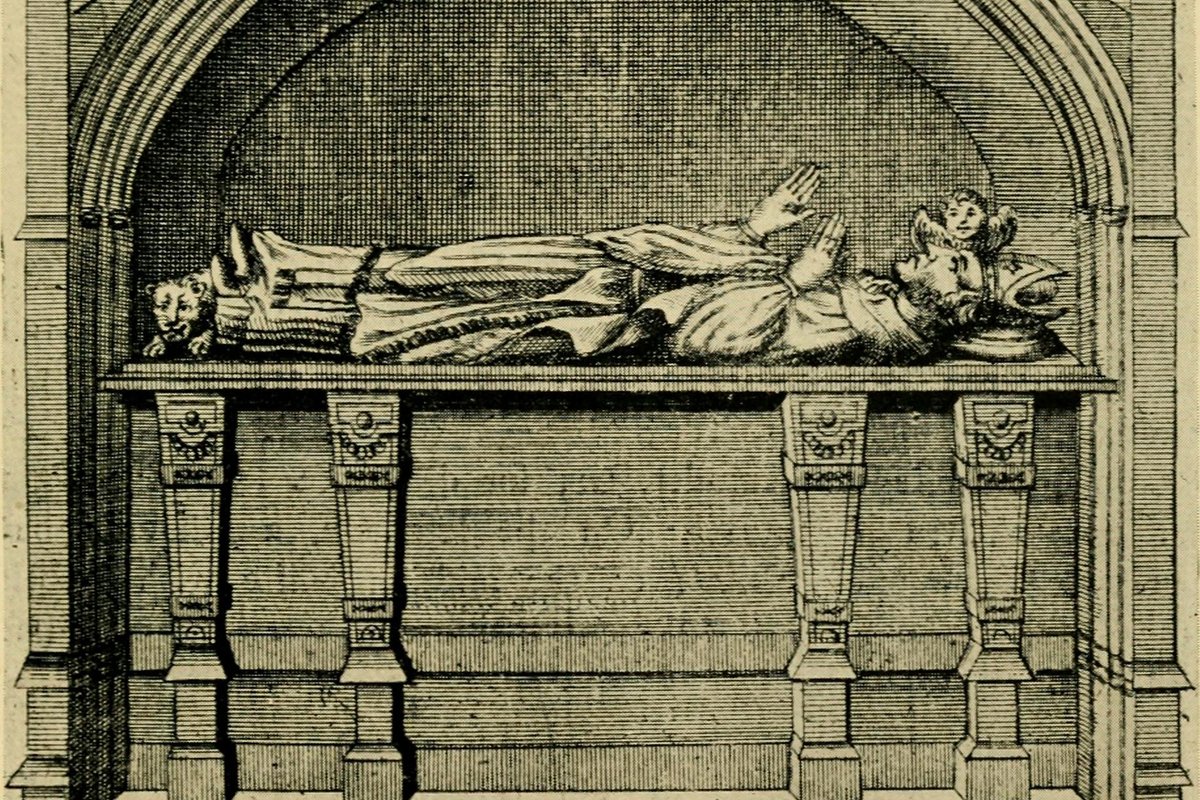
J. Mynde, engraving of the tomb of Saint Oswald, from "The Saints and Missionaries of the Anglo-Saxon Era," 1897 — public domain.
He came back to a Church that had inherited a genuine crisis: generations of Viking raids and general neglect had left much of English monastic life in ruins, with religious houses scattered, inconsistent, and often barely functioning, their lands seized or their communities scattered by generations of conflict. He became Bishop of Worcester in 961 and, unusually, went on to hold the archbishopric of York simultaneously — an arrangement that gave him influence across a wide swath of England at once. Working alongside two other reforming churchmen, Dunstan of Canterbury and Æthelwold of Winchester, Oswald became one of the three architects of the 10th-century monastic reform movement, a coordinated effort to bring England's religious houses back under a shared, disciplined standard of practice. He personally founded Ramsey Abbey and reformed several other monasteries, applying the same patient, practical rebuilding that defined the movement as a whole.
A partnership among reformers
What set this reform apart from smaller, local efforts was its scale and coordination. Dunstan, Æthelwold, and Oswald didn't simply reform their own individual sees — they worked in concert, with the backing of King Edgar, whose reign gave the reformers the political stability and royal patronage that earlier, more piecemeal efforts had lacked. Their combined effort eventually produced the Regularis Concordia, the first unified rule for monastic life applied across the whole of England, drawing together customs from continental houses like Fleury with existing English practice into a single standard that monasteries throughout the kingdom were expected to follow. Before this, English monasteries had often drifted toward looser, more locally improvised routines; the Concordia replaced that patchwork with something far closer to a shared, enforceable discipline.
Oswald's specific contribution, founding Ramsey and personally overseeing its growth into a serious center of monastic life, gave the reform one of its most durable institutional footholds — Ramsey went on to become an important center of learning in its own right, producing scholars and manuscripts for generations after its founder's death. It's a less dramatic legacy than any single miracle story, but it's the kind of patient, structural work that actually outlasts a single generation — English monasticism carried the marks of this reform for centuries afterward, right up until the far more sweeping disruption of the monasteries under Henry VIII, more than five hundred years later.
A bishop who preferred persuasion to compulsion
Oswald's approach to reform set him apart in one important respect from some of his fellow reformers: rather than simply expelling secular clergy (priests living without formal monastic vows) from Worcester's churches and replacing them by decree, he tended to build new monastic communities alongside the existing arrangements and let the reformed model gradually prove its own worth, winning over resistant clergy through patience rather than confrontation. It made his reform slower in places, but also less prone to the resentment and backlash that more forceful methods sometimes provoked elsewhere in England during the same period.
What Byrhtferth's biography preserves
Much of what's known about Oswald's life, including the detail of his death at the feet of the poor, comes down through a biography written by Byrhtferth, a monk of Ramsey Abbey working within a generation or so of Oswald's own lifetime — close enough to living memory that historians generally treat the outline of his account as reliable, even while recognizing the devotional shaping typical of the genre. Byrhtferth's Life of Saint Oswald is also valued by historians for reasons well beyond Oswald himself: it's one of the relatively few surviving windows into the daily texture of English monastic reform as it was actually experienced on the ground, describing the practical work of rebuilding a monastery's discipline, its property, and its community life rather than only the miracles later readers might have expected from a saint's biography. That relatively grounded, practical quality is part of why Oswald's story reads less like legend and more like documented institutional history compared to many of his contemporaries.
A death that matched the life
Oswald kept a private Lenten practice for years: kneeling down and washing the feet of the poor with his own hands, a small, deliberately humble act repeated season after season without fanfare. On February 29, 992, he performed the ritual as he always had — and the moment it was finished, he collapsed and died at the feet of the very people he had just knelt before. It's a genuinely touching detail, and unlike much of what survives from this period, it's well documented rather than legendary embellishment added centuries later. His feast is kept on February 28. Like Dunstan, Oswald's recognition as a saint followed the informal pattern typical of the era — an ancient, pre-formal cultus rather than a process resembling the Church's later canonization procedures — and no established patronage or Doctor of the Church title ever attached to his name. What he left behind instead was Ramsey Abbey, a share in the Regularis Concordia, and a death that quietly confirmed everything his life had already shown.
Trivia
Who was Saint Oswald of Worcester?
How did Saint Oswald die?
What did Saint Oswald accomplish for English monasticism?
Was Saint Oswald really a bishop and an archbishop at the same time?
Is Saint Oswald of Worcester the patron of anything?
You May Also Like

Related Reading