Saint Martin of Tours

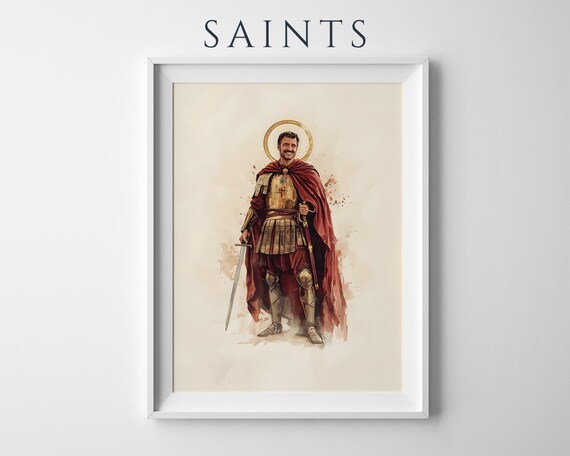
A soldier, not yet a believer
Martin's most famous moment happens before he was even baptized. Born around 316 in Pannonia (in what is now Hungary) and raised in Pavia, Italy, he served in the Roman cavalry in Gaul, stationed around 334 near modern Amiens. Still only a catechumen — someone receiving instruction in the faith but not yet formally baptized — Martin encountered a beggar at the city gates, inadequately dressed against the cold, with nothing else around to help him.
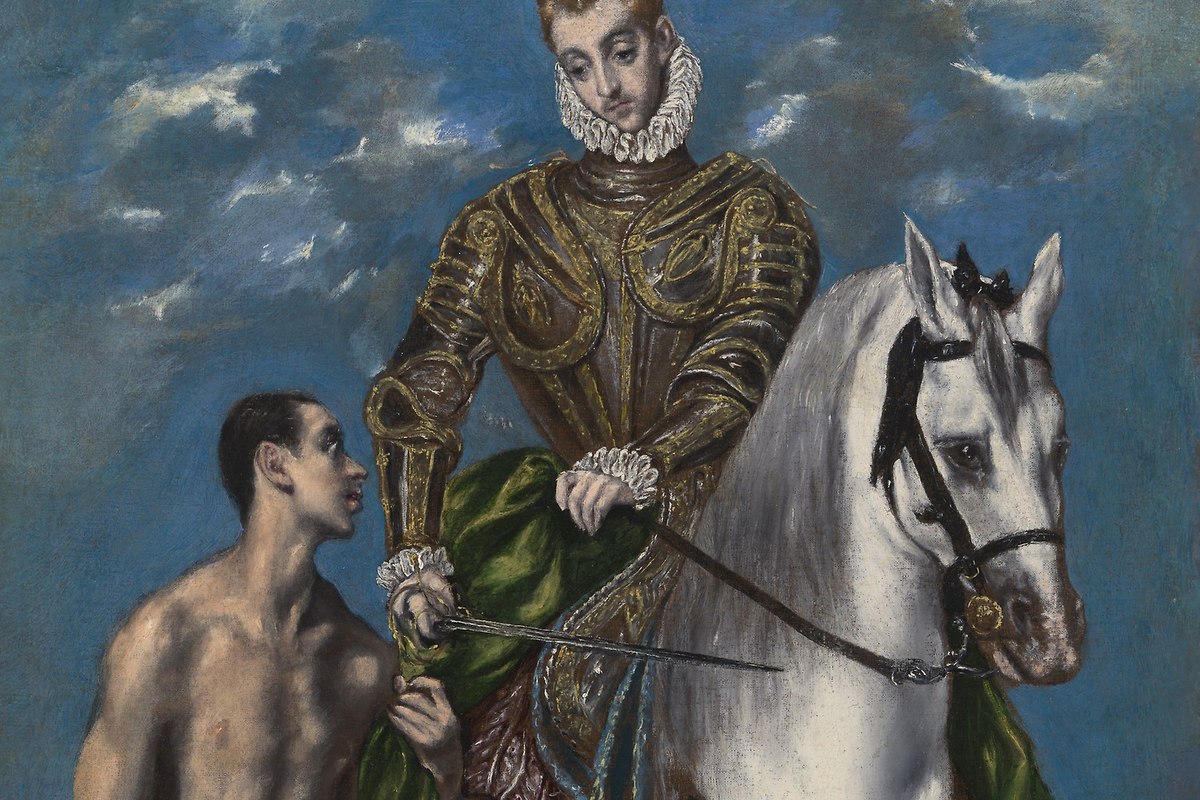
El Greco and workshop, "Saint Martin and the Beggar," c. 1597-1600 — public domain.
Martin's own background made his choice of career less a matter of personal ambition than family expectation. His father was a Roman military officer, and Roman law of the period required the sons of veterans to serve as well; Martin, according to his earliest biographer Sulpicius Severus, had wanted to become a hermit-monk from childhood but was enrolled in the cavalry against his wishes at around age fifteen. That tension — a soldier's uniform worn by someone whose real inclination ran toward prayer and solitude — helps explain why he carried himself, even before his conversion, as more generous and less combative than most of his fellow soldiers; ancient accounts describe him giving away much of his pay and possessions to the poor well before the night at Amiens made the pattern unforgettable.
An impulsive act with nothing held back for himself
Martin had no money to give. What he had was his military cloak, and without hesitation he cut it in half with his sword, keeping one piece for himself and handing the other directly to the freezing man. It's a strikingly literal act of charity — not a donation arranged at a distance, but an immediate, physical division of something Martin needed himself, given on the spot to a stranger he had no other way to help.
A dream that confirmed who he had really clothed
That night, Martin dreamed of Jesus wearing the exact half-cloak he had given away, and heard him say to the surrounding angels, "Martin, who is still but a catechumen, clothed me with this robe." The vision reframed the entire encounter: the beggar at the gate, in the logic of the dream, had been Christ himself, meaning Martin's unthinking generosity toward a stranger turned out to have been directed, all along, at someone else entirely.
From the army to the birth of Western monasticism
Not long after, Martin sought release from military service, reportedly telling the emperor Julian the Apostate, "I am Christ's soldier: I am not allowed to fight." He left the army before 361 and became a disciple of Hilary of Poitiers, a bishop already known for his defense of orthodox Christian teaching against the Arian heresy — the belief, condemned at the Council of Nicaea, that Christ was a created being rather than fully divine. Under Hilary's guidance, Martin founded the first monastery in Gaul at Ligugé, gathering a small community of men devoted to prayer, manual work, and simplicity, modeled loosely on the desert monasticism already taking shape in Egypt.
Reluctant bishop, tireless missionary
Martin's reputation for holiness eventually made him too well known to remain hidden away in a monastery. In 371, the people of Tours are said to have tricked him into coming to the city — luring him in under the pretense of visiting a sick relative — so they could acclaim him as their new bishop, a role Martin, by most accounts, never actually wanted. He accepted, but continued living something close to a monk's life even as bishop, founding the community of Marmoutier just outside Tours as a place he could retreat to for prayer between his pastoral duties. As bishop, Martin also became known for actively working to convert the still-largely-pagan countryside of rural Gaul, personally overseeing the destruction of pagan shrines and the founding of parish churches in their place — an aggressive missionary style not without controversy even among fellow bishops of his time, some of whom found his methods too confrontational.
Feast day traditions and a lasting patronage
Martin died in 397, and his feast day, November 11, grew into one of the most widely celebrated saints' days in medieval and early modern Europe — known in various countries as Martinmas, a traditional marker for the end of the agricultural year, the slaughtering of livestock ahead of winter, and, in later centuries, a day associated with feasting on goose. France in particular came to regard him as a kind of national patron, and Tours became a major pilgrimage destination built around his tomb, ranking for a time among the most visited shrines in Western Christendom, alongside sites tied to figures like Saint Francis of Assisi in Italy. Today Martin is honored as a patron of soldiers, of the poor, and of France itself — a fitting range of patronages for a man whose defining moment came from splitting, quite literally, what little he had between his own needs and someone else's, a legacy that traces back to a single impulsive, unthinking act of charity toward a stranger at a city gate.
Trivia
What is the famous story of Martin's cloak?
What did Martin dream about that same night?
Why did Martin leave the Roman army?
What is Martin's connection to Western monasticism?
Related Reading