Saint Edmund the King

A teenage king facing a war he couldn't win
Edmund became king of East Anglia — one of the patchwork of Anglo-Saxon kingdoms that made up England before unification — around the year 855, when he was roughly fifteen years old. For over a decade he ruled what was, by the standards of the time, a functioning and settled kingdom. That changed with the arrival of the Great Heathen Army, a large coalition of Viking forces that spent the 860s conquering one Anglo-Saxon kingdom after another. By 869, East Anglia's turn had come, and Edmund, still a young man, was captured by the invading force with no realistic path to holding his kingdom by force of arms.
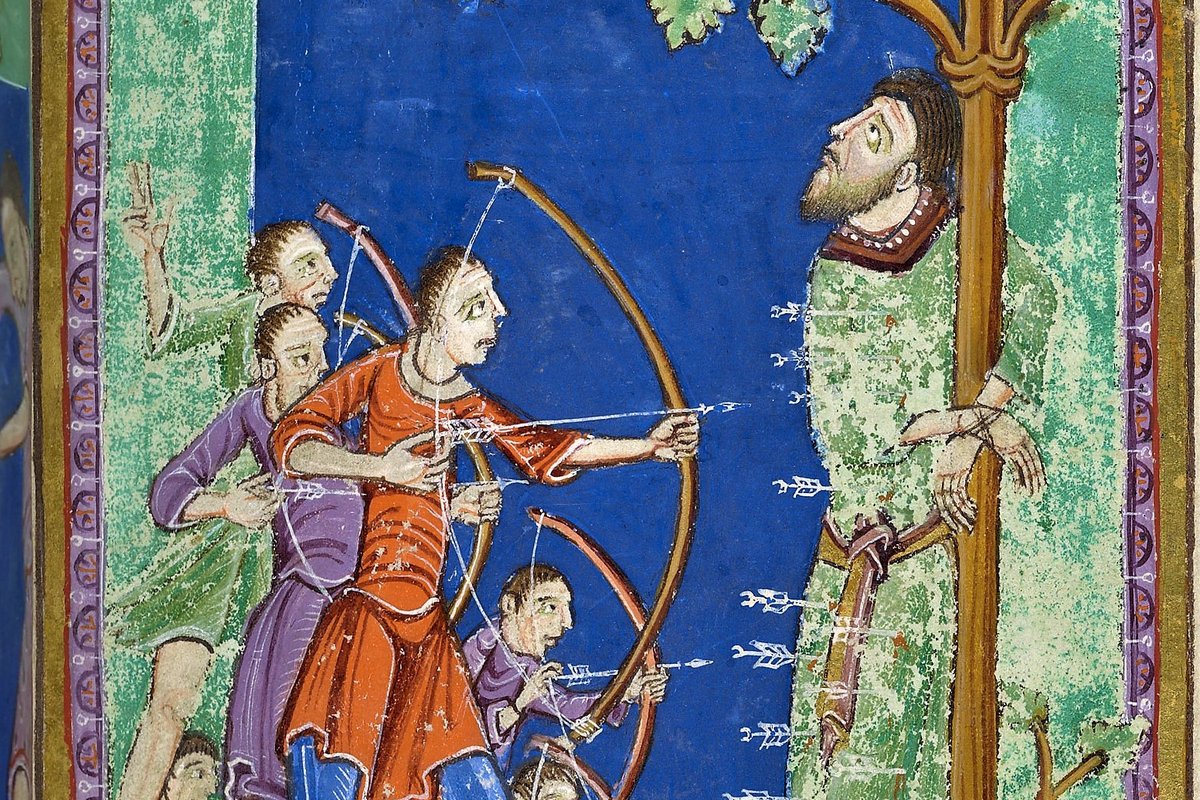
Alexis Master, martyrdom of St Edmund by archers, from a Life and Miracles of St Edmund manuscript, Pierpont Morgan Library MS M. 736, c. 1130 — public domain.
What the earliest sources actually say
Here's where honesty about the sources matters. The near-contemporary Anglo-Saxon Chronicle — one of the most reliable records surviving from this period — states plainly that Edmund died fighting the Danes in 869, without dwelling on how. The vivid, specific martyrdom narrative that most people associate with Edmund today — his refusal to renounce Christianity or share power with the pagan invaders, his beating, his binding to a tree, his execution by arrows, his beheading — comes from a much later source: an account written by the monk Abbo of Fleury around 985, more than a hundred years after Edmund died. Abbo himself claimed to be relaying details passed down from Edmund's own former sword-bearer, but that's still a chain of oral memory spanning generations before it reached parchment. The core fact of Edmund's violent death at Danish hands is solid history. The dramatic texture around it — every arrow, every specific cruelty — belongs to a later hagiographic retelling, and it's worth holding those two layers apart rather than treating the whole account as a single, uniformly reliable record.
A body "like a hedgehog"
By Abbo's account, Edmund was captured, beaten, and tied to a tree, where the Danes used him for archery practice until his body was so thickly covered in arrows that the text compares him to the bristling spines of a hedgehog — a striking image Abbo had actually borrowed from an earlier account of the martyrdom of Saint Sebastian, rather than inventing fresh for Edmund. Only then was he beheaded, his head reportedly thrown into a thicket to prevent a proper burial — a detail medieval legend later built on with a story of the head calling out "Here, here, here!" to guide searchers, guarded by a wolf until it was found and reunited with his body. Whatever the precise historical accuracy of any single detail, the underlying claim — that Edmund was killed specifically for refusing to abandon his Christian kingship rather than simply dying in the chaos of battle — is what transformed a defeated Anglo-Saxon king into a venerated martyr almost immediately after his death, well before anyone wrote Abbo's account down.
A shrine that outgrew its abbey
Edmund's body, according to tradition, was first buried near where he fell, then moved within a few decades to a newly built wooden church at what was then called Beodricesworth — a settlement that grew, expanded, and was eventually renamed for its royal saint: Bury St Edmunds. The abbey built around his shrine became one of the wealthiest and most politically significant monasteries in medieval England, drawing pilgrims, royal visitors, and substantial endowments for centuries. King Cnut, a Danish ruler himself, ordered a stone church built over the shrine in the early eleventh century, and later kings of England, including several in the run-up to Magna Carta, are said to have visited the shrine to swear oaths or seek Edmund's intercession — a striking detail given that Edmund's own death had come at the hands of a Danish army. The abbey was eventually demolished during the Reformation dissolution of the monasteries in the 1530s, and Edmund's relics have never been definitively located since.
A cult that shaped an English town
Edmund's veneration spread quickly and lasted centuries: the town that grew up around his shrine still carries his name today, Bury St Edmunds, and for a time in the medieval period he was regarded as something close to a patron saint of England itself, before that role was eventually taken over by Saint George. His feast is kept on November 20, and — like most saints from this early medieval period, including figures such as Saint Edward the Martyr covered elsewhere on this blog — his sainthood predates the Church's later formalized canonization process entirely, resting instead on the strength of ancient and sustained popular devotion. He's remembered today as patron of kings, of protection against pandemics, and of torture victims — each patronage rooted directly in the story of a young ruler who, by every surviving account, chose death over surrendering either his faith or his people.
Trivia
Who was Saint Edmund the King?
How did Saint Edmund the King die?
Is the story of Edmund's martyrdom historically reliable?
What is Saint Edmund the King the patron of?
When is the feast of Saint Edmund the King?
You May Also Like
Related Reading