Saint Edward the Martyr

A boy-king caught in a succession dispute
Edward was the eldest son of King Edgar of England, born around 962, and his path to the throne was never entirely settled. Edgar had reigned over a kingdom that was, by the standards of the era, unusually stable and prosperous — a reign later remembered fondly enough that the disorder following his death stood out sharply by comparison. Edward's own mother's identity is uncertain in the surviving sources, and some chroniclers even questioned the legitimacy of his birth, a doubt that later partisans of his rival half-brother were happy to keep alive.
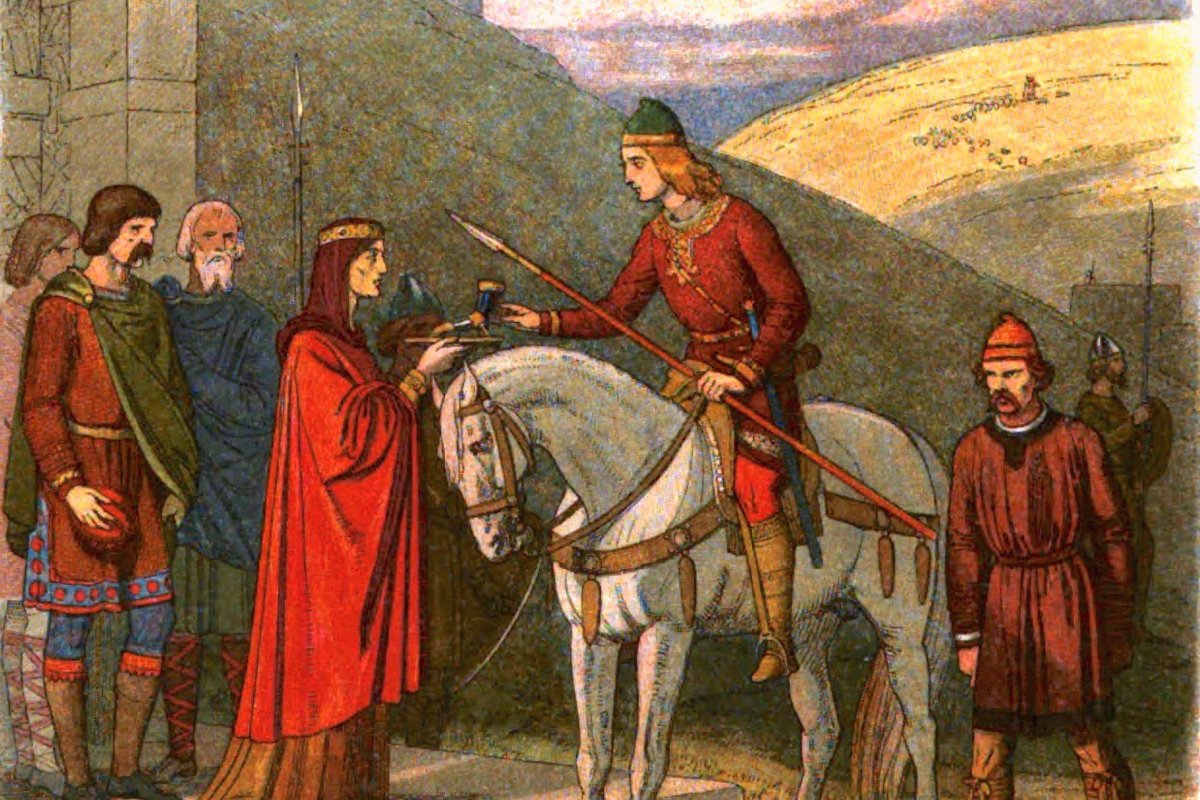
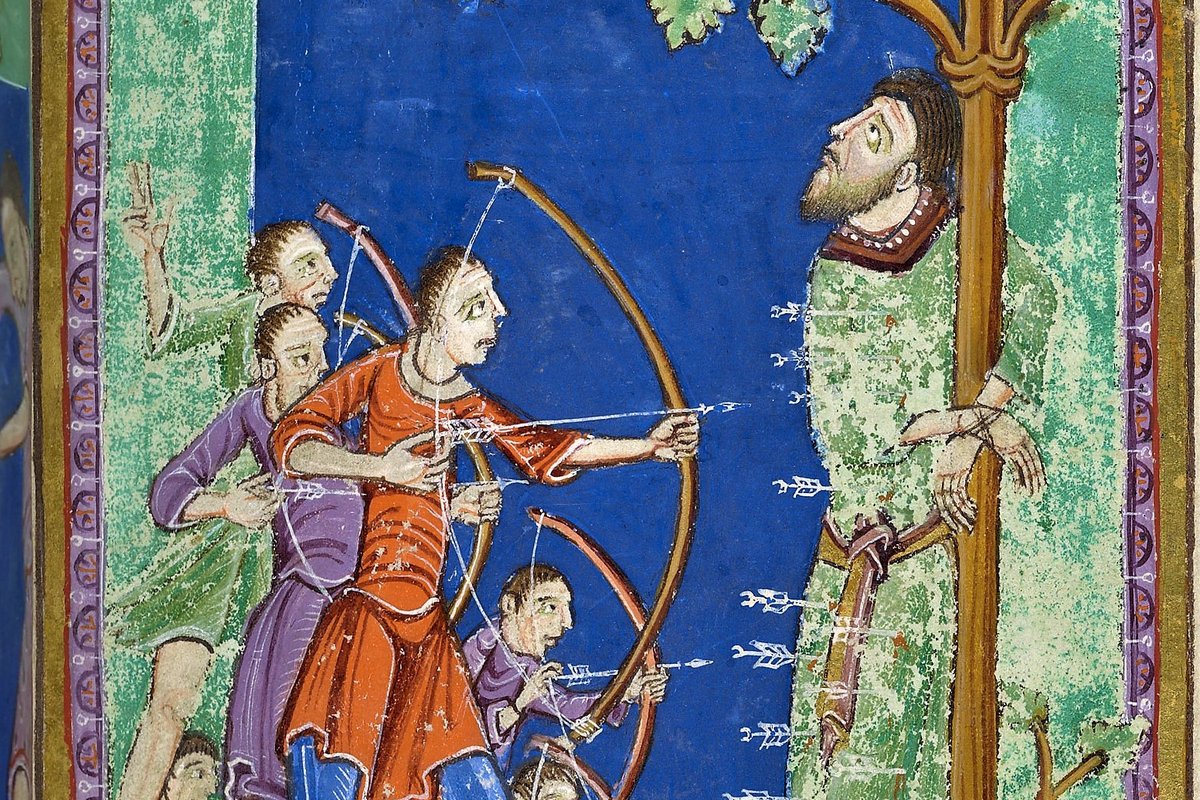
James William Edmund Doyle, Edward Murdered at Corfe, from "A Chronicle of England," 1864 — public domain.
When Edgar died in 975, Edward became king at roughly twelve or thirteen years old — but his claim was contested by supporters of his younger half-brother Æthelred, whose mother, Queen Ælfthryth, was Edgar's widow and had every reason to want her own son on the throne instead. The two rival factions split roughly along the lines of the Church's own internal politics of the day: a movement to reform English monasticism along stricter continental lines had gained enormous influence under Edgar, and Edward drew support from the reformers, while opponents of the reform tended to back Æthelred's faction instead, meaning the succession dispute was tangled up with a real, contemporary fight over the shape of English religious life. Edward's short reign, only about two and a half years, played out against that background of unresolved rivalry between two competing sets of noble supporters, each backing a different boy for the crown.
A cup offered at the castle gate
In March of 978, Edward rode to Corfe Castle in Dorset, where his half-brother Æthelred was staying with Ælfthryth. What exactly happened next isn't recorded in enough contemporary detail to reconstruct with confidence, but the broad shape of the event is not in serious dispute: Edward was murdered at or near the castle gate, stabbed while still mounted on his horse. Later medieval retellings dressed the scene with vivid, sympathetic detail — a welcoming cup offered at the gate, a knife hidden beneath a cloak — but it's worth being honest that these are later narrative flourishes layered onto a killing whose actual mechanics went largely unrecorded by anyone writing at the time.
What contemporary sources do agree on is that Edward's body was buried hastily and without royal ceremony at Wareham, not the kind of burial expected for an anointed king — itself a striking detail, since it suggests whoever controlled the immediate aftermath had reason to downplay rather than honor what had just happened. That treatment didn't last: within a year, reports of miracles associated with the site were already circulating, and the growing sense that a legitimate king had been wrongfully killed set in motion the process that would eventually lead to Edward's remains being moved to a far more honorable resting place.
A stepmother blamed generations later
Here's where the story gets genuinely uncertain, and it's worth resisting the temptation to flatten that uncertainty into a tidy villain. It was chroniclers writing after the Norman Conquest — more than a century after Edward's death — who firmly placed the blame on Queen Ælfthryth, casting her as the mastermind behind a murder designed to clear the throne for her own son. Modern historians are genuinely divided on how much of that accusation reflects real, remembered fact versus a politically convenient narrative that hardened over time, especially once Æthelred's own troubled reign gave later writers every incentive to trace his rule back to an original sin at Corfe Castle. The honest answer is that nobody alive today knows for certain who ordered Edward's death, or whether it was planned at all rather than a sudden, opportunistic act of violence.
Æthelred, who took the throne as a boy of about ten in the aftermath, went on to earn the nickname "the Unready" — a label that in Old English actually meant something closer to "poorly counseled" rather than literally unprepared — and his reign was later remembered as a disastrous period of renewed Viking invasion and internal instability. That reputation made it easy, and politically convenient, for chroniclers writing generations later to read his entire troubled rule as divine punishment flowing from the sin committed to put him on the throne in the first place, whether or not Æthelred himself, still a young child at the time, bore any actual responsibility for what happened at Corfe.
Sanctity through sacrilege, not persecution
What made Edward a saint in medieval eyes wasn't a refusal to renounce his faith, the way it was for a figure like Saint Edmund the King; it was the killing of a rightfully crowned, divinely anointed king, which the medieval Christian understanding of kingship treated as an act of sacrilege in its own right, regardless of the killer's actual motive. That category of martyrdom — sanctity attached to the wrongful killing of a legitimate ruler rather than to religious persecution in the strict sense — was not unique to Edward; a handful of other early medieval English and European kings received similar veneration after violent, politically motivated deaths, reflecting how seriously the era took the sacred character of anointed kingship itself.
Miracles were soon reported at his grave, his remains were formally translated to Shaftesbury Abbey in 979, and veneration spread quickly enough that Edward was recognized as a saint through medieval popular acclaim rather than any formal Vatican process — the same pathway that produced many early English royal martyrs. Shaftesbury Abbey became a significant pilgrimage site as a result, and Edward's cult continued there for centuries until the abbey, like so many English monastic institutions, was suppressed during the Reformation under Henry VIII; the exact present-day location of his remains has been a matter of some dispute in more recent history, with several 20th-century excavations and identifications generating ongoing debate. His feast is kept on March 18, and he's also honored as a saint within the Orthodox Church. No well-established individual patronage has survived attached to his name, but his story remains one of Anglo-Saxon England's most enduring unsolved mysteries, wrapped in eleven centuries of devotion.
Trivia
Who was Saint Edward the Martyr?
How did Saint Edward the Martyr die?
Is it historically certain that Queen Ælfthryth ordered Edward's murder?
Why was Edward venerated as a saint if his murder wasn't a religious persecution?
Was Saint Edward the Martyr formally canonized by the Vatican?
You May Also Like
Related Reading