Saint Fulgentius of Ruspe

A career abandoned for the monastery
Before he was ever a bishop, Fulgentius had a promising career laid out for him in Roman civil administration. Born around 462 or 467 in Telepte, North Africa, to a family of some means, he was educated thoroughly in Latin and Greek and, still a young man, was appointed procurator — a senior tax-collecting official — in the province of Byzacena, a position of real responsibility and a natural stepping stone toward a career in Vandal-controlled North African government. He gave it up. According to his earliest biographer, reading a homily of Saint Augustine on the Psalms convinced him to abandon public life entirely, and he entered monastic life under an abbot named Faustus, a fellow North African who had himself been driven from his own monastery by Vandal persecution. Fulgentius's early monastic years were marked by the same instability affecting the wider Nicene community: he was forced to move between several monasteries as Arian authorities harassed and displaced Catholic religious communities, and he even attempted, unsuccessfully, to travel to Egypt to live among the desert monks there, turning back partway after learning the Egyptian church of his day had fallen into schism.
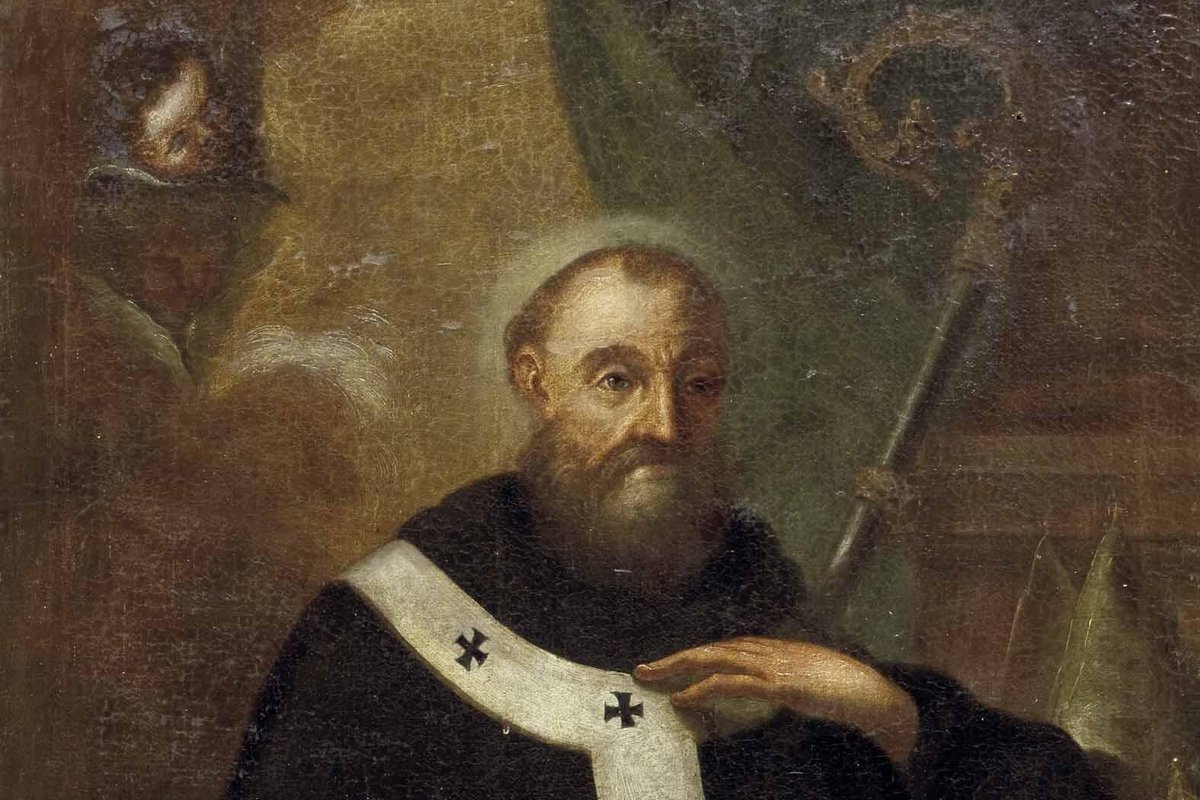
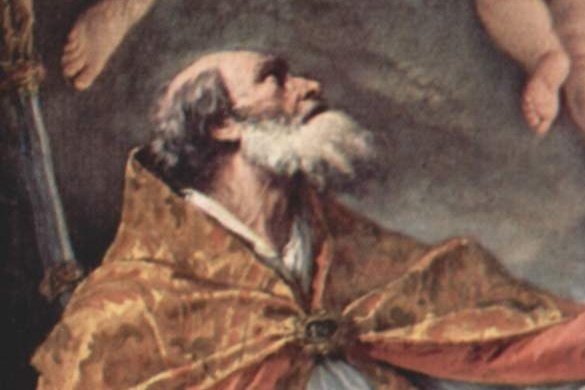
Anonymous, S. Fulgentius Episcopus Rufpensis, 17th century, oil on canvas — public domain.
A bishop made spokesman by exile
Fulgentius became Bishop of Ruspe around 507 or 508, in the Roman province of Byzacena, at a time when the region's Vandal rulers were committed Arians — adherents of a theology that denied the full, equal divinity of Christ with the Father, and openly hostile to the Nicene bishops who upheld it. Almost immediately after his consecration, the Arian king Thrasamund moved against that opposition directly, exiling around sixty orthodox bishops to Sardinia. Fulgentius was among them, and it was in exile, rather than in his own diocese, that he did some of his most consequential work: organizing the displaced community and effectively speaking for it, turning a punitive banishment into a functioning center of resistance to Arian theology.
Thrasamund, despite his own Arian convictions, seems to have taken a genuine interest in Fulgentius's abilities as a debater. He twice summoned Fulgentius back to the Vandal capital at Carthage to argue theology directly with him and his court theologians, and on each occasion, after Fulgentius held his ground, the king sent him back into exile rather than risk the Nicene bishop's continued presence and influence in the capital. It was during one of these periods back in Carthage that Fulgentius composed some of his most important written responses to Arian objections, arguing them out point by point in a form other exiled bishops could use in their own preaching.
The Pocket Augustine
What Fulgentius is remembered for beyond the exile itself is the sheer consistency of his theological writing, most of it composed in direct defense of Nicene orthodoxy against Arian arguments. He drew so heavily and so faithfully on the thought of Saint Augustine of Hippo that later writers gave him a nickname that stuck: "the Pocket Augustine," a tribute to how closely his own arguments tracked Augustine's a century after Augustine's death. It's a smaller, quieter kind of legacy than a dramatic martyrdom, but it mattered in the moment — a coherent, well-argued Nicene voice, sustained in writing, at a time when Arian rulers controlled the ground under his own diocese.
His best-known surviving work, De Fide ad Petrum ("On the Faith, to Peter"), was written as a plain instructional summary of orthodox Christian belief for a layman named Peter who was heading into exile himself and wanted a reliable guide to what the Church actually taught — a sign of how urgently ordinary Catholics under Vandal rule needed clear, accessible teaching rather than dense academic argument. He also wrote at length against Fabianus, an Arian writer whose objections Fulgentius answered systematically, and he continued Augustine's particular emphasis on grace — the conviction that human salvation depends fundamentally on God's freely given help rather than on human effort alone — carrying that argument forward into a new generation after Augustine's death in 430 had left the debate without its most forceful defender.
Return, restoration, and a quiet end
The exile in Sardinia lasted, with the interruptions in Carthage, roughly a decade. When Thrasamund died in 523, his successor Hilderic reversed the Vandal kingdom's policy of persecution and allowed the exiled Nicene bishops to return home, and Fulgentius went back to Ruspe to resume his duties as bishop. He spent his final years there much as he had lived earlier in his monastic life: austere, given to long hours of prayer, and, by the account of his biographer, continuing to teach and write even as his health declined. He founded a monastery at Ruspe as well, drawing on the same monastic discipline he had first encountered as a young man giving up his career in tax administration, and he is remembered as having tried, even as a busy diocesan bishop, to keep some part of the contemplative life he'd originally sought out for himself.
A thin record, honestly told
Fulgentius died on January 1, 533, in Ruspe, and was venerated as a saint through the same ancient, informal recognition typical of his era, well before the Church developed its later formal canonization process. He was never given the title of Doctor of the Church, and no established patronage has ever attached itself to his name. Beyond the Sardinian exile and his body of theological writing, the surviving record of his life is genuinely thin — which is worth saying plainly rather than padding out. His feast is kept on January 1, and what endures of his legacy is less a story than a body of argument: sixty exiled bishops who kept functioning as a community, and one theologian among them who kept Augustine's defense of grace alive in writing while the ground under Nicene Christianity in North Africa kept shifting.
Trivia
Who was Saint Fulgentius of Ruspe?
Why was Fulgentius exiled to Sardinia?
Why was Fulgentius nicknamed 'the Pocket Augustine'?
When is the feast of Saint Fulgentius of Ruspe?
You May Also Like
Related Reading