Saint Isaac Jogues

From Orléans to New France
Isaac Jogues was born on January 10, 1607, in Orléans, France, into a prosperous merchant family, and showed enough academic promise as a young man that his Jesuit teachers expected he would end up teaching literature rather than living in a bark longhouse on the edge of the known world. He entered the Society of Jesus at seventeen, was ordained a priest in 1636, and sailed for New France — French colonial Canada — that same year, arriving at a mission effort that was still young, difficult, and dangerous by any measure.
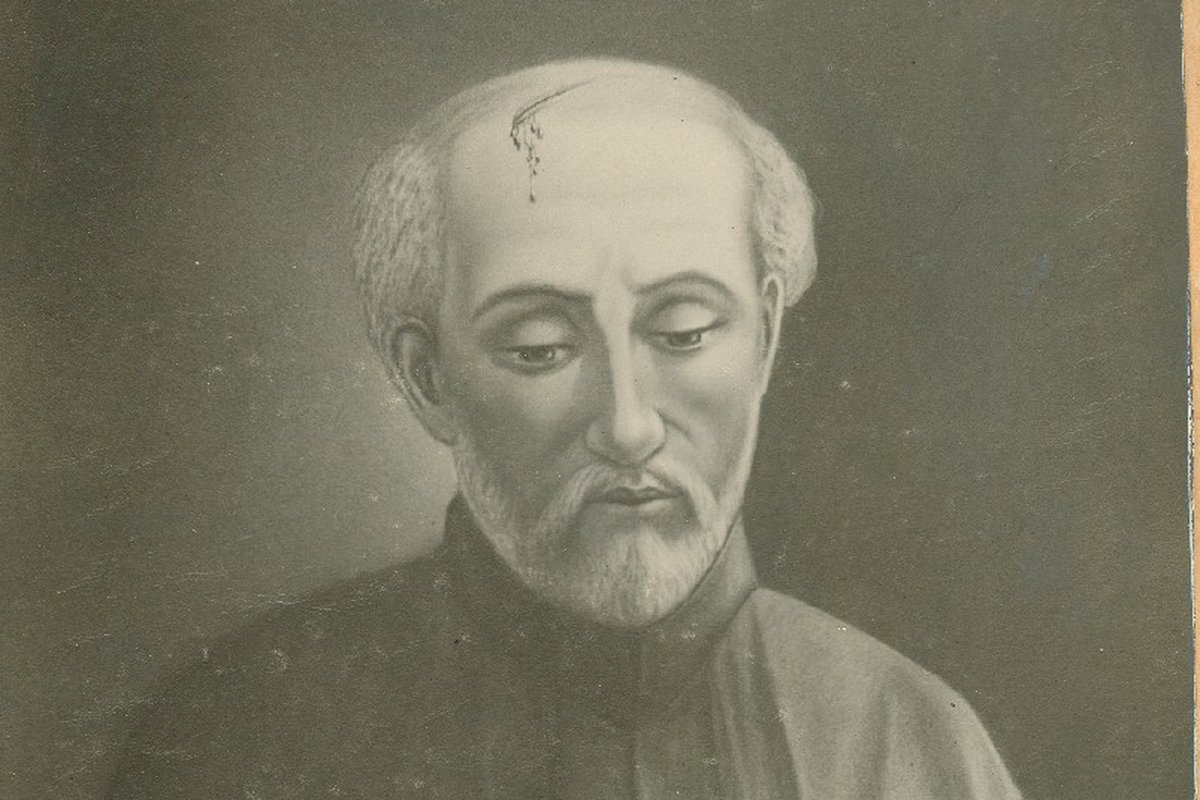
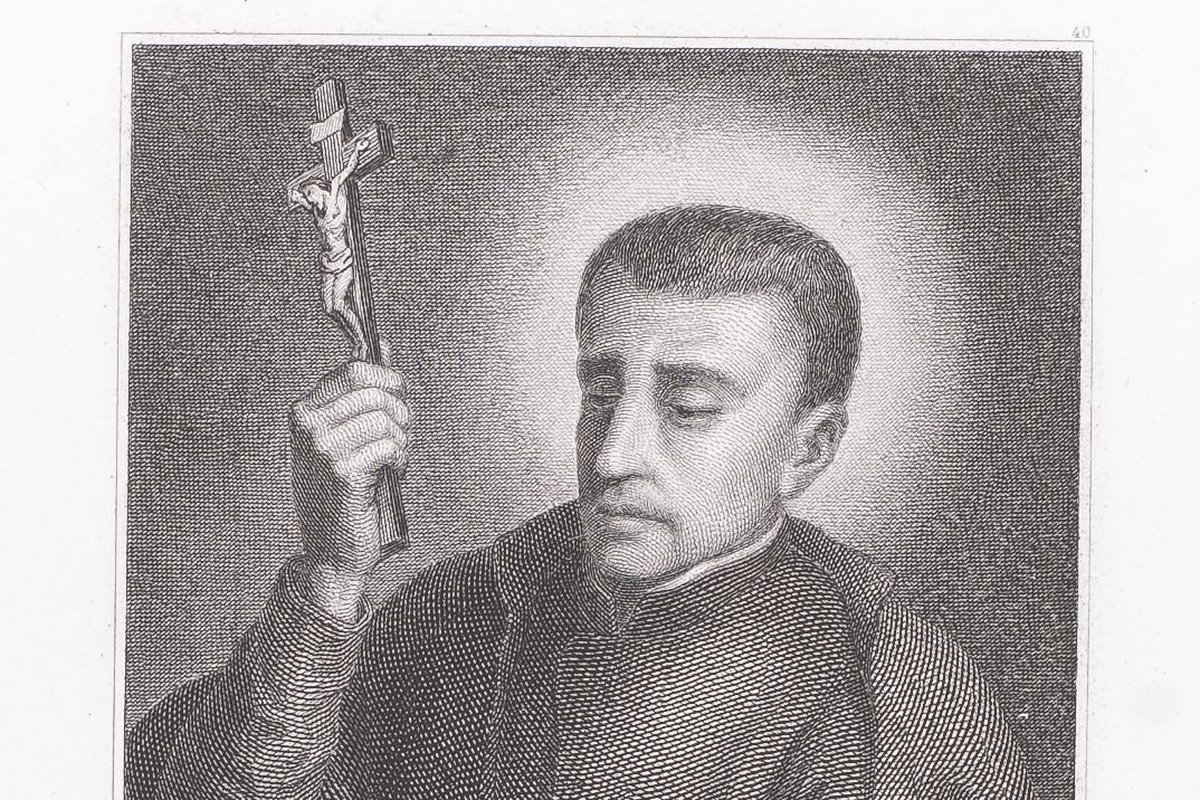
I. Jogues, 19th-century devotional portrait of Saint Isaac Jogues, Archives of Montreal, artist unknown — public domain.
Jesuit missionaries had been working for several years by then to evangelize among the Huron and other Indigenous nations, learning their languages and living for extended periods within their communities rather than staying at a distance in French settlements. This approach demanded real linguistic skill and physical endurance: missionaries traveled by canoe along the Great Lakes waterways, wintered in Huron villages, and depended entirely on their hosts for food and safety. Jogues proved capable at exactly that kind of demanding, embedded missionary life, mastering Huron well enough to preach in it directly and spending years living among Huron communities before the event that would come to define the rest of his life.
By 1641, Jogues had traveled as far west as Sault Ste. Marie, at the outlet of Lake Superior, making him among the first Europeans on record to reach that far into the interior of North America — a genuine achievement of exploration undertaken purely as a byproduct of missionary travel. The Huron missions he served depended on a supply line running back to Quebec, and it was on one of these resupply trips that his 1642 capture took place.
Captured, tortured, mutilated
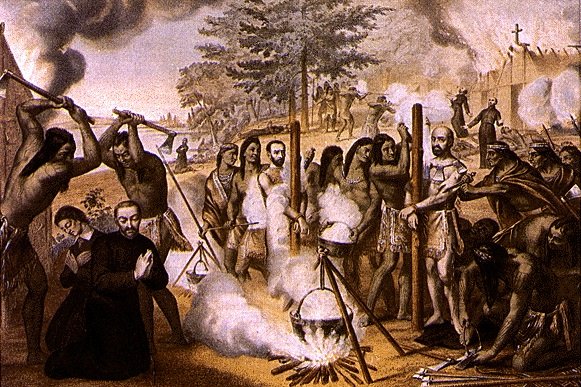
In 1642, while traveling with a group that included Huron converts and French colonists, Jogues was captured by a Mohawk raiding party — the Mohawk being one of the nations of the Iroquois Confederacy, then in conflict with the Huron and their French allies over trade routes and territory. What followed was close to a year of captivity marked by repeated, deliberate torture, much of it inflicted during a brutal gauntlet-style welcome to Mohawk villages along the way, a customary ordeal for captives that Jogues endured multiple times as he was moved between settlements. Among the injuries inflicted on him, several of his fingers were cut or chewed off, including both thumbs — a mutilation that, whether or not his captors intended it this precisely, carried an unmistakable symbolic weight for a Catholic priest, since it left him physically unable to hold the Host the way the Mass required.
Jogues was not tortured alone. A young lay volunteer traveling with him, René Goupil, was killed by his Mohawk captors within weeks of their capture for making the sign of the cross over a child, becoming, in the Church's later reckoning, the first of the eight North American Martyrs to die. Jogues himself was effectively enslaved for the remainder of his roughly year-long captivity, put to hard labor and kept alive more as an object of ongoing cruelty than as a prisoner with any recognized status, before Dutch colonists in the region, sympathetic to his situation, helped arrange his escape and passage back to Europe in 1643.
A pope's answer to a mutilated priest
Jogues returned to France in 1644 a minor sensation — a priest who had survived Mohawk captivity and come back missing most of his fingers. Queen Anne of Austria reportedly asked to meet him and kissed his ruined hands out of reverence, a gesture that spread his story quickly through the French court. Under the Church's canon law at the time, a priest with that degree of hand injury was technically barred from celebrating Mass, since the rubrics assumed the ability to hold the Host properly between thumb and forefinger.
Jogues's case was brought to Pope Urban VIII, who granted him a personal dispensation to celebrate Mass despite his injuries. The pope is widely remembered as having explained the decision along the lines that it would be shameful for a martyr of Christ to be kept from drinking the Blood of Christ — the exact wording varies somewhat across the sources that record it, but the substance of the ruling is well attested: Jogues was permitted to say Mass, mutilated hands and all, a public acknowledgment that his wounds were themselves a form of witness.
Choosing to go back
What happened next is the part of Jogues's story that tends to stop people short. Rather than settling into a safer assignment in France, he asked his superiors for permission to return to the missions in North America, and by 1644 he was back in Canada. His first task there was itself a striking piece of diplomacy: in 1646 he traveled to Ossernenon, the same Mohawk settlement where he had once been a captive, as part of a peace delegation between the French and the Mohawk, and the mission he helped negotiate that year was informally called "the Mission of the Martyrs," a name that turned out to be more prophetic than anyone involved could have known.
Later that same year he made his way back to the Mohawk communities a second time, now specifically to establish a permanent mission among the very people who had tortured him. It wasn't a naive decision — Jogues understood exactly what kind of risk he was walking back into, and he wrote to friends beforehand in terms that show he expected he might not return. He went anyway, continuing missionary work among a people who had already come close to killing him once.
Blamed for a famine, killed with a tomahawk
The return mission didn't last. When a run of crop failures and an outbreak of illness struck the Mohawk community not long after his arrival, some among them blamed sorcery, pointing specifically to a locked box of ritual objects Jogues had left behind on an earlier visit, which rumor transformed into a source of the community's misfortune. Suspicion settled on Jogues and the mission's presence, and on October 18, 1646, he was struck with a tomahawk and killed at Ossernenon, a Mohawk settlement near what is now Auriesville, New York; a companion, Jean de Lalande, was killed the following day trying to recover his body.
He was canonized in 1930 by Pope Pius XI together with seven other Jesuit missionaries and lay volunteers killed in the same mission field, collectively remembered as the North American Martyrs. His feast is kept on October 19 in the United States and September 26 in Canada, and he is honored, alongside his companion martyrs, as a patron of Canada. Auriesville itself later became a place of pilgrimage, and it was also, decades after Jogues's death, near the birthplace of Saint Kateri Tekakwitha, a Mohawk woman who would become the first Native American canonized a saint — a quiet but real continuity between the mission field where Jogues died and the faith that, against every expectation raised by his death, eventually took root there. The written record of Jogues's life comes largely from the Jesuit Relations, detailed contemporary reports Jesuit missionaries sent back to their superiors in France, meaning his story, unlike so many ancient martyrdoms, rests on solid documentary ground rather than on legend assembled generations later.
Trivia
Who was Saint Isaac Jogues?
What happened to Isaac Jogues when he was captured?
Why did the pope give Isaac Jogues special permission to celebrate Mass?
Why did Isaac Jogues return to the mission after escaping?
How did Saint Isaac Jogues die?
You May Also Like
Related Reading