Saint Ivo of Kermartin

From law student to ecclesiastical judge
Ivo Hélory was born on October 17, 1253, near Tréguier in Brittany, in what is now northwestern France, to a family of the minor nobility. Brittany at the time was a semi-independent duchy on the far western edge of the French-speaking world, culturally distinct and Celtic in its roots, with its own language still spoken in daily life alongside French and Latin. That regional identity mattered to Ivo throughout his life; he never left Brittany for long, and the people he later represented in court were, almost without exception, his own Breton neighbors.
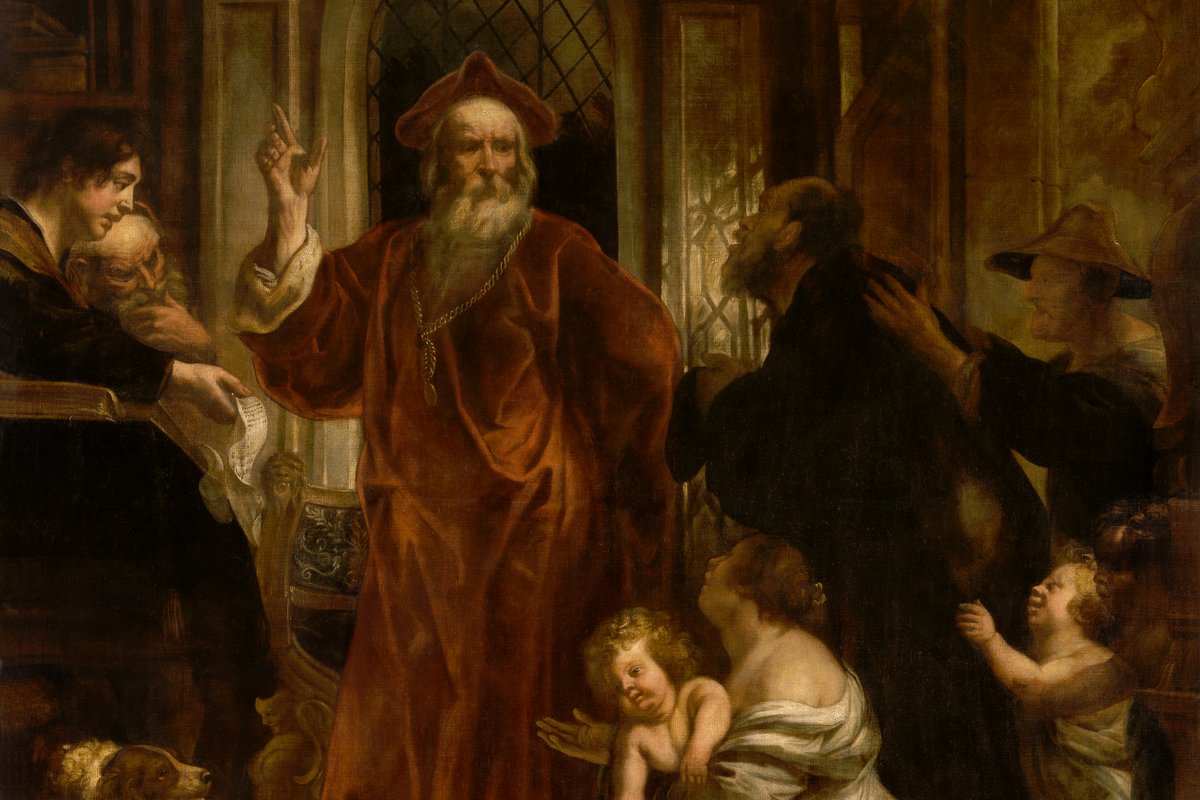
Jacob Jordaens, Saint Ivo of Kermartin, c. 1645, Royal Museum of Fine Arts Antwerp — public domain.
He studied law at the University of Paris, one of medieval Europe's great centers of learning, working through both civil and canon law — the Church's own body of legal doctrine and procedure — at a school whose student body in that same general period reportedly included figures who would themselves loom large in later history, among them the philosopher Duns Scotus and the natural scientist Roger Bacon. Legal training of this kind was unusually rigorous and lengthy even by medieval standards, requiring years of study in Latin argumentation, Roman legal precedent, and the tangled, still-developing body of canon law that governed everything from marriage disputes to property claims involving the Church. Ivo also studied theology alongside law, a combination that shaped how he would later practice: he treated legal disputes as moral questions as much as procedural ones.
After completing his studies, Ivo returned to Brittany and was appointed "official," an ecclesiastical judge, for the Bishop of Tréguier — a role that put his legal training directly to work settling disputes brought before the Church courts, which in that era handled a far broader range of cases than a modern reader might expect, including matters of inheritance, contracts, and moral conduct that today would fall to secular courts entirely. He later served in the same capacity for the neighboring diocese of Rennes, building a reputation across the region before he was ever ordained a priest.
The lawyer who worked for free
Ivo was later ordained a priest and took charge of parishes in Brittany, but he never set his legal training aside. Instead, he became known specifically for representing poor litigants — people who could never otherwise have afforded legal counsel — in court, without charging them for it. He earned a reputation as a scrupulously honest judge and advocate in an era when both professions were popularly, and often fairly, associated with corruption and delay; he was known to work quickly on cases, to reconcile disputing parties out of court whenever possible rather than letting cases drag on, and to treat rich and poor litigants with the same seriousness.
Contemporary accounts describe him keeping an open house for beggars and travelers, personally caring for the sick, and giving away money and food almost as fast as he received it — behavior consistent enough that it became part of the testimony later gathered for his canonization. He was also, by several accounts, a gifted and plain- spoken preacher, unusual for a man so deeply trained in the technical language of law; he seems to have made a deliberate effort to explain himself in terms ordinary parishioners could follow, the same instinct that made him effective defending peasants in court rather than only arguing points of law before other lawyers.
Canonized in a single generation
Ivo died on May 19, 1303, and his cause for canonization moved unusually fast by medieval standards: Pope Clement VI declared him a saint in 1347, less than half a century after his death, on the strength of extensive eyewitness testimony collected about his life and his free legal work for the poor — testimony far more detailed and closer to living memory than the process behind many earlier medieval canonizations. That speed and documentation is part of why his sainthood carries a distinct kind of credibility: Ivo's case for canonization rested less on distant legend than on people who had actually appeared before him in court and could describe firsthand what kind of judge he had been.
The only lawyer-saint
Today Ivo is remembered as the only judge or advocate from his era, or arguably from any era, that the Catholic Church has ever formally canonized — a genuinely distinctive claim among the thousands of saints on the Church's calendar. He is venerated as patron of lawyers, of Brittany, and of abandoned children, and his feast is kept on May 19. A Latin rhyme that circulated after his death captures how unusual his reputation was even in his own time: "Sanctus Ivo erat Brito, Advocatus et non latro, Res miranda populo" — "St. Yves was a Breton, a lawyer but not a thief, a marvel to the people." It reads almost like a joke at the legal profession's expense, and it likely was one, but it also reflects just how remarkable people found it that a lawyer could become a saint.
Pardon of the Poor
Tréguier still holds an annual pilgrimage in Ivo's honor each May, known as the "Pardon of the Poor," drawing lawyers, judges, and ordinary pilgrims from across Brittany and beyond to his tomb in Tréguier's cathedral. Legal associations in France and other countries mark his feast day with special Masses for the profession, a tradition that has spread as far as law schools and bar associations outside Europe. He is sometimes shown in art holding a scroll or book of law alongside a purse or coins, a visual shorthand for a man who held wealth in his hands only long enough to give it away.
His story also resonates with readers of other saints connected to justice and mercy, such as Saint Peter Canisius, another scholar who put his training to work defending ordinary believers, or the broader tradition of saints who chose service over status. Ivo's case remains, centuries later, a reminder that the Church has always been willing to recognize sanctity in unglamorous, technical professions — provided it's paired with genuine mercy toward the people that profession is meant to serve.
Trivia
Who was Saint Ivo of Kermartin?
Why is Saint Ivo important to lawyers specifically?
Where did Ivo of Kermartin study?
When was Saint Ivo canonized?
What is the Latin rhyme associated with Saint Ivo?
You May Also Like
Related Reading