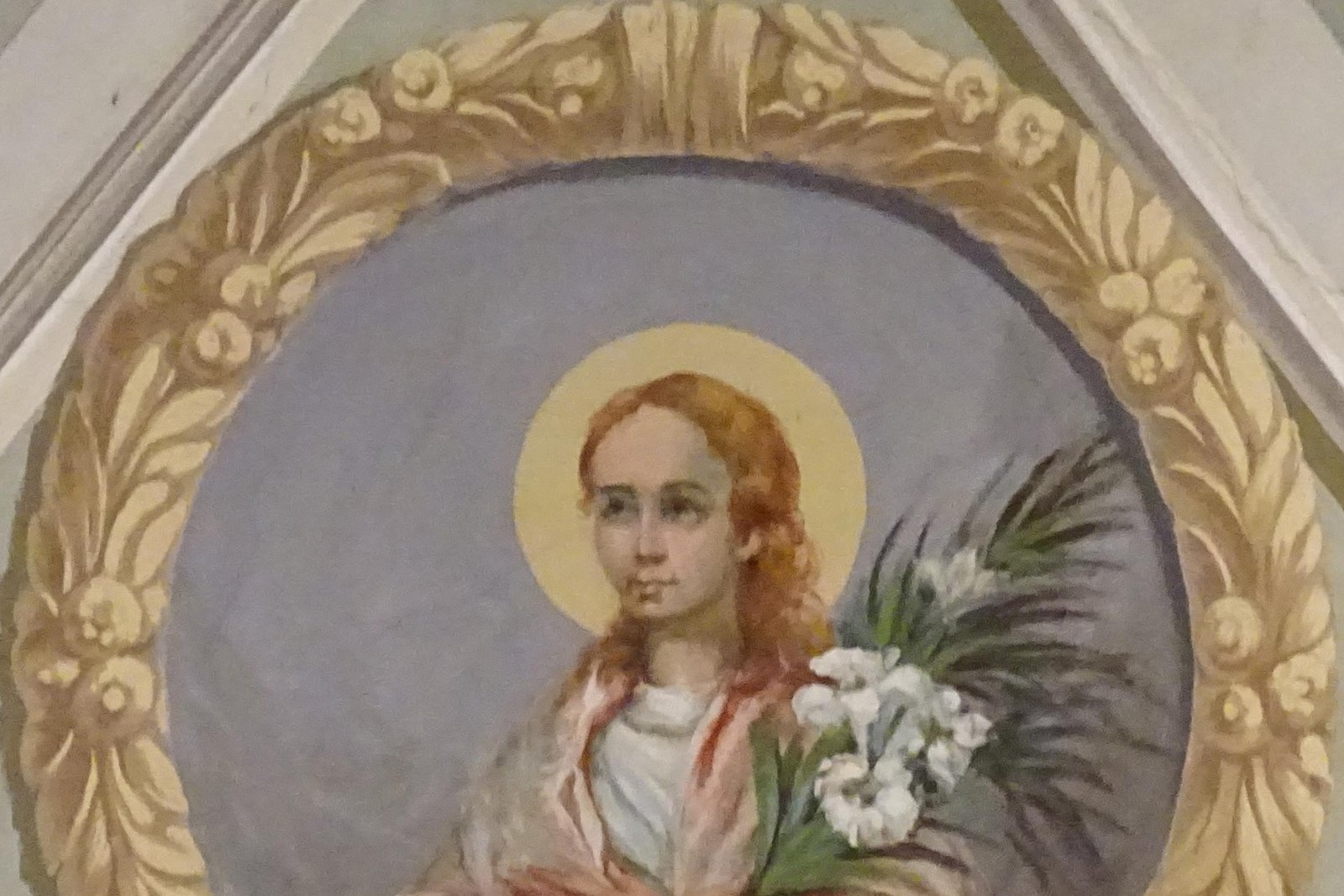
Saint Januarius

A bishop martyred under Diocletian
What's known about Januarius's life is comparatively brief. He served as bishop of Benevento, a city in the Roman province of Campania in southern Italy, during the reign of Emperor Diocletian — a period that produced one of the most severe and systematic persecutions of Christians in the empire's history, with imperial edicts ordering the destruction of churches and scriptures and demanding that Christians sacrifice to the Roman gods or face imprisonment and death. By tradition, Januarius traveled to visit and encourage Christians already imprisoned for their faith near Pozzuoli, close to Naples, and was himself arrested for that act of solidarity and condemned to death around 305 AD.

Louis Finson, "San Gennaro" (Saint Januarius), circa 1610–1612, Palmer Museum of Art — public domain.
The legendary account of his execution includes a detail common to many martyrdom stories of the period: that he was first thrown to bears or lions in an arena, which reportedly refused to harm him, before the authorities resorted to beheading him instead. Companions said to have been martyred alongside him, including a deacon and several laypeople, are also honored in the traditional account of the event, though, as with Januarius himself, the specific narrative details rest on later tradition rather than contemporary documentation. The core fact of his martyrdom under Diocletian's persecution, however, is well established in the Church's memory of him, and his cult in the Naples region can be traced back with reasonable confidence to within a few generations of his death — an unusually early and stable devotional record for a martyr from this period.
What happened after death
Januarius is remembered today far less for the circumstances of his death than for what has reportedly happened to his relics ever since. Naples Cathedral holds a sealed glass vial said to contain his dried blood, collected, according to tradition, at the time of his martyrdom. Multiple times each year — most notably on his September 19 feast day, but also on other set occasions in the Neapolitan calendar — that vial is brought out in a public ceremony, and the dark, solid substance inside is reported to liquefy in front of the assembled crowd. This isn't a recent devotional invention: the liquefaction has been documented since at least the 14th century, making it one of the longest continuously observed religious phenomena in the Catholic world, and it still draws large crowds to Naples Cathedral every time it's scheduled to occur.
A phenomenon the Church has never dogmatically ruled on
It's worth being precise about how the Catholic Church actually treats this event, because popular retellings often overstate it in one direction or the other. The Church has never issued a formal doctrinal declaration pronouncing the liquefaction a certified miracle, the way it does with specific healings investigated for canonization causes. At the same time, the Church hasn't debunked or dismissed it either. It remains what it has been for centuries: a popular devotional phenomenon, documented and reported, that the Church allows to be venerated without requiring belief in it as an article of faith. Various scientific studies over the years have proposed natural explanations for how such a substance might behave under specific conditions, while other researchers have argued those explanations don't fully account for the observed pattern; the debate hasn't produced a universally accepted resolution, and the event continues largely as it always has — publicly, on schedule, watched by a cathedral full of people in a city that has built real civic identity around it.
A civic identity built around a relic
Naples has folded the blood ceremony deeply into its own sense of civic identity in a way few other cities have done with a patron saint's relic. Failures of the liquefaction to occur — rare, but documented across the centuries — have historically been read by Neapolitans as an unsettling omen, associated in popular memory with years of hardship or disaster for the city, a folk interpretation the Church itself has never endorsed as doctrine but has also never actively discouraged among the faithful. The event draws not only devout Catholics but journalists, scientists, and curious visitors from well beyond Italy each time it's scheduled, and the cathedral treasury housing the relic ranks, by some estimates, among the most valuable collections of devotional art and gold objects amassed for any single saint's cult anywhere in the Catholic world, built up through centuries of donations from a city that has never stopped investing in his memory.
Patron of Naples, and of blood donors
Januarius's feast is kept on September 19, and his patronage follows naturally from his story on two fronts. He is the principal patron saint of Naples itself, a city whose relationship with him goes well beyond the routine devotion many cities show their patron — the blood ceremony is a genuine cultural touchstone, watched and discussed even by Neapolitans who don't otherwise practice regularly. And because of the blood relic at the center of his cult, he has also become a patron of blood banks and blood donors, a modern patronage that grew directly and fittingly out of the very object his devotion has centered on for over six hundred years.
Trivia
Who was Saint Januarius?
What is the miracle of the blood of Saint Januarius?
Has the Church officially declared the liquefaction of Saint Januarius's blood a miracle?
What happens if the blood of Saint Januarius doesn't liquefy?
What is Saint Januarius the patron saint of?
You May Also Like

Related Reading