Saint Jean-Baptiste de La Salle

A canon who chose the classroom instead
Jean-Baptiste de La Salle was born in Reims, France, in 1651, into a family wealthy and well-connected enough to secure him a canonry at the city's cathedral — a comfortable, respected clerical position with a predictable future attached to it. He was ordained a priest in 1678 and earned a doctorate in theology not long after, credentials that would have let him pursue almost any career path the Church had to offer. Nothing about his background pointed toward founding schools for poor children. But involvement with a group of teachers working with the poor drew him steadily deeper into education. What began as occasional financial and organizational support for a struggling group of schoolmasters turned, almost against his own original intentions, into something far more demanding: he invited the teachers to live in his own family home so he could train and support them more closely, a decision that scandalized some of his more socially conscious relatives.
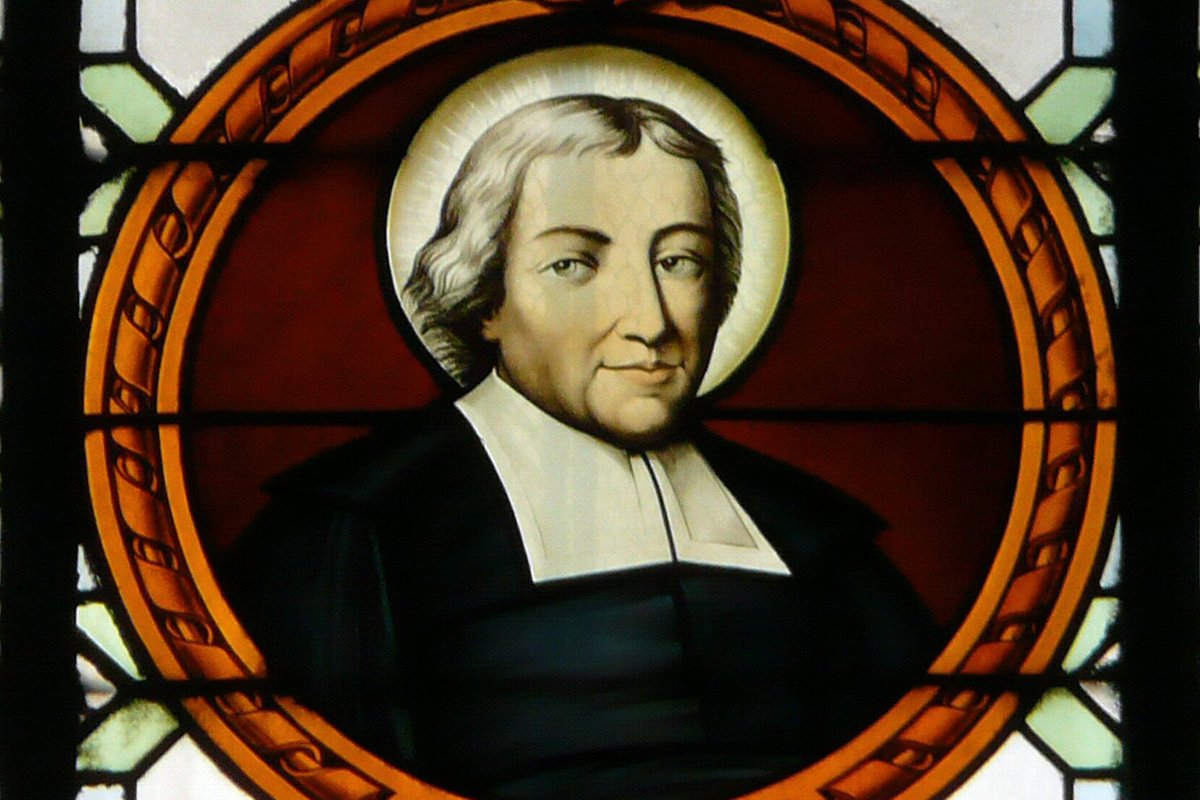
Stained-glass medallion of Saint Jean-Baptiste de La Salle, Church of Saint-Sulpice, Paris — public domain.
That closeness proved to be the turning point. Living alongside men who had none of his own advantages of birth or education gradually convinced La Salle that guiding the work from a comfortable distance wasn't enough, and he eventually renounced both his canonry and his family inheritance entirely — distributing the money to the poor during a famine rather than keeping it as security for the schools — choosing to live among the teachers he was training rather than direct their work from a comfortable distance.
The first teaching order with no priests in it
In 1680, that commitment took institutional shape: La Salle founded the Brothers of the Christian Schools, a religious congregation dedicated entirely to teaching. What made it structurally unusual for its era was that none of the Brothers were ordained priests — the first time a teaching congregation of men had been organized that way. It was a deliberate choice, keeping the community focused entirely on the classroom rather than on the sacramental duties that would come with ordination, and it let the congregation grow around a single, undivided purpose.
La Salle also insisted the Brothers train specifically for teaching rather than simply picking up the trade informally, and he opened what amounted to one of the first teacher-training colleges in Europe to make that possible. He put much of what he'd learned into a practical manual, The Conduct of the Christian Schools, laying out in detail everything from classroom management to lesson sequencing — a level of systematic attention to pedagogy that had few precedents at the time and that later educational reformers would draw on directly.
Teaching in French, and grouping students by ability
La Salle's methods were as significant as the institution he built to carry them out. Schooling in his era was conducted in Latin by default, which effectively locked out poor children who had no prior classical education — La Salle taught in French instead, making literacy and basic education genuinely accessible to students who would otherwise have had no path into a classroom at all. He also grouped students by ability rather than instructing them all together regardless of level, an organizational idea so basic to modern schooling that it's easy to forget it had to be invented by someone, at some point. Both innovations put La Salle's schools recognizably ahead of their time, and both practices became standard features of the classroom model that followed him.
Resistance, poverty, and a mission that kept going
None of this happened without opposition. La Salle's schools competed directly with independent, often poorly regulated schoolmasters who saw free education for the poor as a threat to their own livelihoods, and he faced repeated legal challenges and hostility from rival teaching guilds throughout his career. The Brothers themselves lived in real poverty by choice, surviving many lean years on very little, and La Salle weathered several serious personal crises within the young congregation, including periods when discouraged Brothers left the community and the whole enterprise seemed close to collapse. He held the schools together anyway, insisting that the mission mattered more than any individual setback — an insistence that, over the following decades, proved durable enough to outlive every one of those early crises.
A legacy formally recognized centuries later
La Salle died in Rouen in 1719, on Good Friday, a detail that struck his earliest biographers as fitting for a man who had given up wealth and status to spend his life in service of others' education. He was canonized in 1900, and half a century after that, in 1950, Pope Pius XII formally declared him the patron saint of teachers — a recognition that arrived, appropriately enough, only after generations of teachers had already put his methods into practice. His feast is kept on April 7.
Trivia
Why did Jean-Baptiste de La Salle give up his position and inheritance?
What did he actually found, and when?
What made his approach to teaching so different for its time?
When was he canonized, and when did he become patron of teachers?
How and when did Jean-Baptiste de La Salle die?
You May Also Like
Related Reading