Saint Justin Martyr

A philosopher who kept failing to find the answer
Justin was born around 100 AD in Flavia Neapolis, a Roman city in Samaria built near the site of modern Nablus, into a Greek-speaking pagan family. What set him apart from most converts to Christianity in his generation was the road he took to get there. By his own account, he studied under a series of teachers, working through the major philosophical schools of his day one after another — Stoicism, then the philosophy of Aristotle, then Pythagorean thought — each time hoping he'd found the discipline that could finally explain the nature of God and the soul, and each time coming away unsatisfied. He eventually settled with a Platonist teacher and felt, for a while, that he was close to real understanding. He wasn't finished looking.
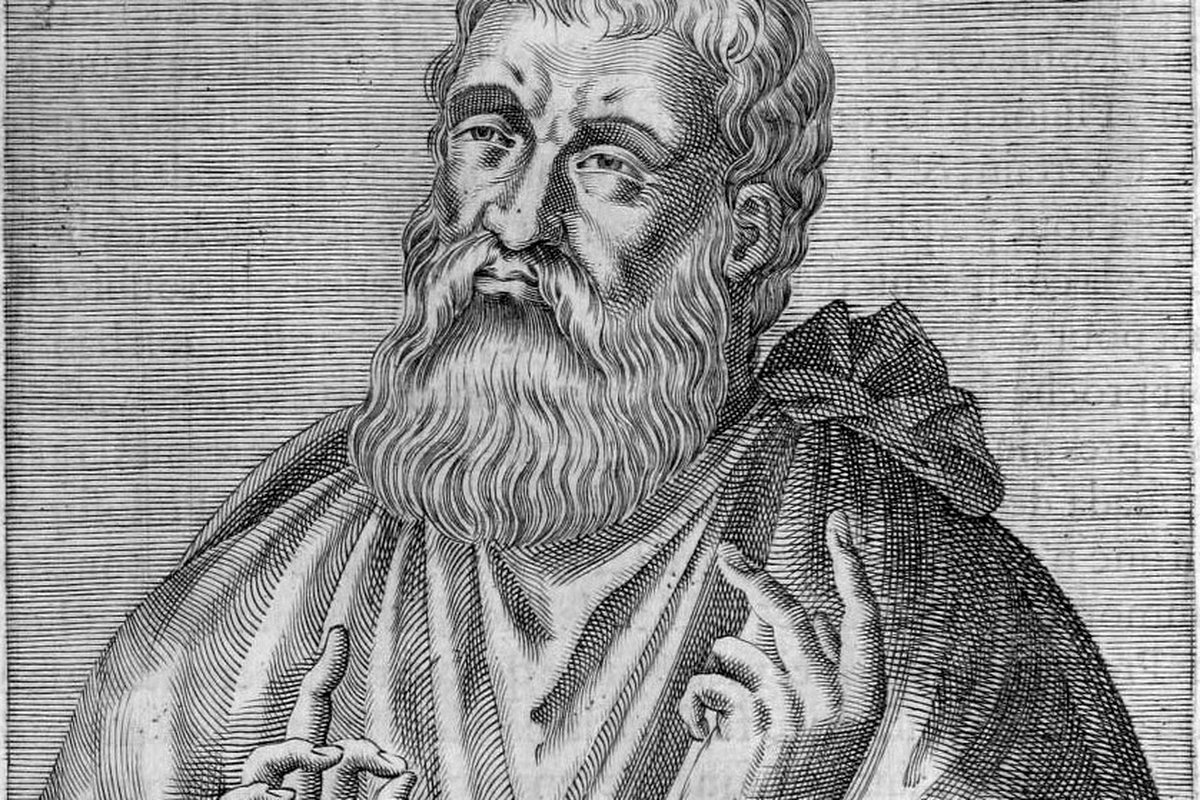
André Thevet, portrait of Justin Martyr, from "Les Vrais Pourtraits et Vies des Hommes Illustres," 1584 — public domain.
An old man on a beach
According to Justin's own telling in the Dialogue with Trypho, the turning point came during a walk along the seashore, where he fell into conversation with an elderly stranger. The old man challenged Justin's Platonism directly, then redirected him toward a source Justin hadn't seriously considered: the Hebrew prophets, whom the man described as older than the Greek philosophers and as men who had spoken not through pure reason alone but because they had actually seen the truth and been sent to announce it, with their words fulfilled in Christ. Justin described the encounter as lighting a fire in his soul. He didn't abandon philosophy — he became convinced that Christianity was the fulfillment of everything philosophy had been reaching for, and he kept wearing the philosopher's cloak, the standard dress of a professional teacher in the Greco-Roman world, for the rest of his life. He taught in Rome as a Christian philosopher, running what amounted to a school, presenting the faith to educated Romans not as a break with reason but as, in his own phrase, the true philosophy.
Defending the faith to emperors
Justin's surviving writings are among the most valuable Christian texts to come out of the 2nd century, both for their theology and for what they reveal about how outsiders viewed the early Church. His First Apology and Second Apology were addressed to Roman authorities, directly answering accusations commonly leveled at Christians — atheism, since they refused to worship the Roman gods; cannibalism and incest, garbled rumors likely sparked by outsiders misunderstanding the language of the Eucharist and the practice of calling fellow believers "brother" and "sister." In the First Apology, chapter 66, Justin gave one of the earliest outside descriptions of what Christians believed happened at the Eucharist, writing: "For not as common bread and common drink do we receive these; but in like manner as Jesus Christ our Saviour, having been made flesh by the Word of God, had both flesh and blood for our salvation, so likewise have we been taught that the food which is blessed by the prayer of His word... is the flesh and blood of that Jesus who was made flesh." His Dialogue with Trypho, meanwhile, records an extended argument with a Jewish interlocutor over how Hebrew prophecy pointed to Christ — whether or not the conversation happened exactly as written, it's a substantial and serious work of early Christian argument, not a quick pamphlet.
Arrest, trial, and a transcript that survived
Justin was eventually arrested in Rome along with six companions and brought before the prefect Rusticus. What happened next is unusually well documented for an event this old: the Acts of Justin, the surviving record of his trial, reads like an actual court transcript rather than the kind of embellished, miracle-filled hagiography common in later martyr accounts — scholars generally treat it as a genuine, sober record of the proceedings, not later legend. According to that record, Rusticus questioned Justin and his companions directly about their beliefs and ordered them to sacrifice to the Roman gods. They refused. All seven were beheaded. It's a death with none of the drama of some other early martyrdoms — no arena, no wild beasts, no miraculous survival of torture — just a straightforward, recorded refusal to renounce Christ, followed by execution.
Patron of philosophers and apologists
Justin's feast is kept on June 1, and his patronage — philosophers and apologists — follows directly and logically from his life's work. He's remembered less for a single dramatic miracle than for a body of writing that took Christianity seriously as an intellectual claim about reality and tried to defend it on those terms, to the same educated Roman audience that read Plato and the Stoics. That approach, treating faith and reason as partners rather than opponents, is exactly why the Church still looks to him as a model for anyone trying to explain and defend Christian belief through argument rather than assertion alone.
Trivia
Who was Saint Justin Martyr?
Why did Justin Martyr keep wearing a philosopher's cloak after becoming a Christian?
What did Justin Martyr write?
How did Saint Justin Martyr die?
What is Saint Justin Martyr the patron saint of?
You May Also Like
Related Reading