Saint Leopold Mandić

An unlikely figure for the confessional
He shares the century and the country of his ministry with another famous Italian confessor, Padre Pio, though the two friars never met; where Padre Pio's fame grew partly around dramatic, widely reported phenomena, Mandić's reputation rests entirely on the plain, repeated act of sitting and listening, day after day, for most of his adult life.
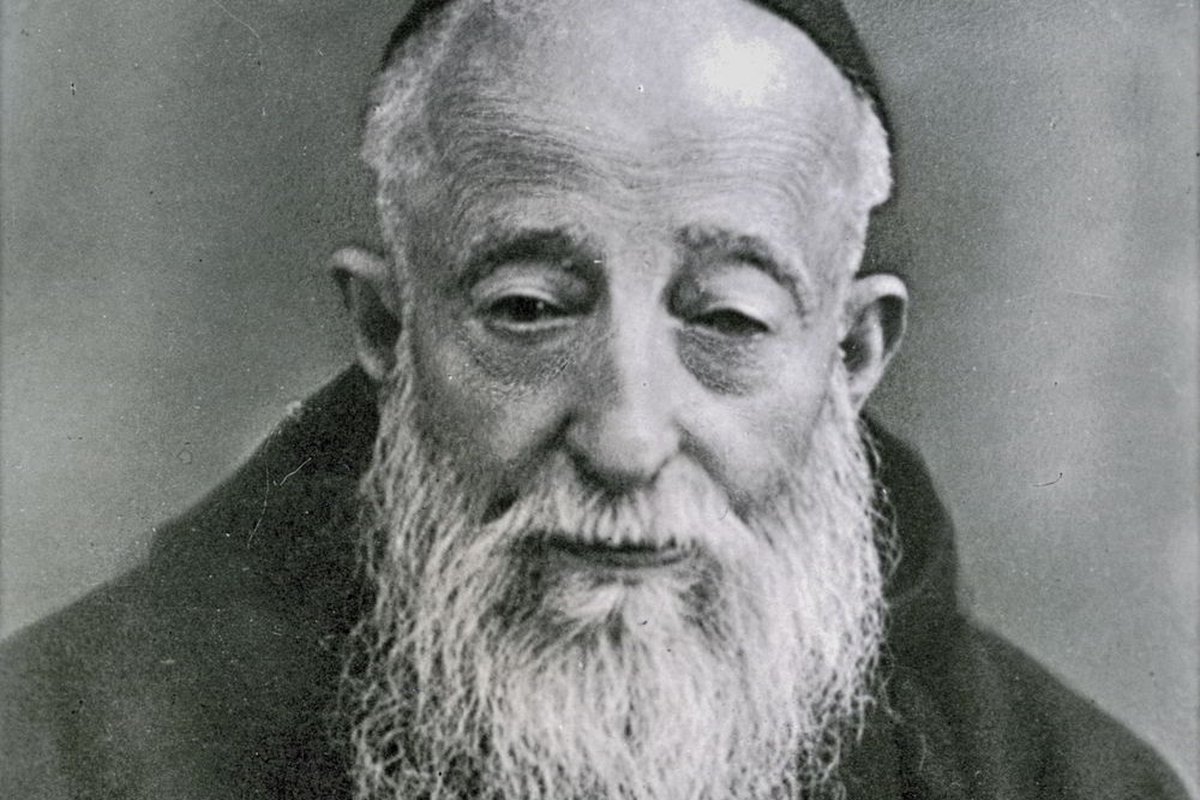
Photographic portrait of Leopold Mandić (1866-1942), before 1942 — public domain.
Leopold Mandić was born in 1866 in Herceg Novi, a coastal town in what's now Montenegro, and joined the Capuchin Franciscans as a young man. Physically, he was an unlikely fit for the kind of hands-on, door-to-door ministry many friars of his era pursued: small in stature, chronically frail, and afflicted with a stutter pronounced enough to affect his preaching. Rather than working around those limitations by avoiding public ministry, Mandić found the one form of priestly service where none of them mattered — sitting, largely silent and still, inside a confessional.
A dream of reunion he never got to pursue
Mandić entered religious life with a very different ambition than the one history remembers him for. Born in a region where Catholic and Orthodox Christians lived side by side, he grew up with a deep desire to work toward healing the centuries-old division between the Eastern Orthodox and Catholic Churches, and he hoped for years to be sent as a missionary to the Balkans or further east for exactly that purpose. His frail health and his stutter repeatedly worked against him — superiors judged him physically unsuited for demanding missionary travel and public preaching — and the assignment he'd hoped for never came. He accepted that disappointment as, in his own words, God's will working through his own limitations, and stayed instead in Italy, ministering in a way his body could sustain: seated, mostly silent, hearing one confession after another.
Twelve to fifteen hours a day, for decades
Mandić settled in Padua, Italy, and stayed there for virtually the entire remainder of his priestly life, and what he did there was remarkably narrow in focus and remarkable in scale at the same time. He heard confessions for as long as 12 to 15 hours a day, day after day, year after year, until the sheer accumulated weight of that single, repeated act became his defining legacy. Word of his availability and his manner with penitents spread well beyond Padua, and people traveled specifically to have him hear their confession rather than any other priest.
A reputation for mercy toward the anxious and despairing
Among penitents who struggled with scrupulosity — an excessive, anxious fixation on one's own sinfulness — or who arrived weighed down by despair, Mandić built a particular reputation for meeting that anxiety with reassurance rather than further scrutiny. Accounts of his ministry consistently describe him offering to take personal responsibility for penitents' sins himself, a gesture of radical mercy that became closely associated with his name, even if it's better understood as a well-attested characterization of his pastoral manner than a single verified verbatim quotation. That reputation is what eventually earned him the popular title "Apostle of Confession" — not a single dramatic act, but the accumulated evidence of decades spent making an anxiety-inducing sacrament feel survivable for thousands of ordinary people.
A war, an internment, and a small wooden confessional
Mandić's decades in Padua weren't entirely uneventful. During the First World War, Italian authorities interned him for over a year as an enemy national because of his Croatian origins, separating him from the friary and the penitents who depended on him — a disruption he accepted, by all accounts, without bitterness, and returned to the confessional the moment he was permitted to. The confessional itself became almost as famous as the man inside it: a small, plain wooden booth in the Capuchin friary of Padua that survived the Allied bombing that destroyed much of the rest of the building during the Second World War, an outcome many of the friary's own community read as a quiet sign in itself. That same booth still stands today, preserved as part of the shrine built around his tomb, and remains a stop for pilgrims visiting Padua.
Sainthood and an informal patronage
Mandić died in Padua in 1942 of esophageal cancer, an illness that had troubled him for years even as he continued his daily hours in the confessional almost until the end. He was beatified in 1976 and canonized in 1983 by Pope John Paul II, and his feast is now kept on May 12. Many Catholics today informally regard him as a kind of patron for confessors and for the sacrament of confession itself, though this reflects popular devotion built up around his story rather than a single formal, universal decree naming him patron of anything in particular — a fitting kind of recognition, in its way, for a man whose entire ministry was built on quiet, repeated, unglamorous faithfulness rather than any single dramatic moment.
Trivia
Who was Saint Leopold Mandić?
How did Leopold Mandić become known as the 'Apostle of Confession'?
What was Leopold Mandić's approach toward penitents who struggled with guilt or scrupulosity?
When was Leopold Mandić beatified and canonized?
What is Saint Leopold Mandić's feast day, and is he a patron saint?
You May Also Like
Related Reading