Saint Louis Bertrand

A Dominican vocation in Valencia
Louis Bertrand was born on January 1, 1526, in Valencia, Spain, into a family connected, at some distance, to the more famous Dominican Vincent Ferrer, a 14th-century preacher whose reputation for holiness the young Louis reportedly grew up hearing about. He entered the Dominican order in 1544 at nineteen, professing vows in a community that placed heavy emphasis on study and preaching, the twin pillars of Dominican life since the order's founding by Saint Dominic in the 13th century. Before his years abroad, Bertrand spent nearly two decades in fairly conventional roles within Spain — preaching, teaching, and serving as novice master, responsible for forming the newest members of the order — building a reputation as a serious, disciplined religious well before he ever considered a mission overseas. He was already in his mid-thirties, an experienced friar rather than a young idealist, when his superiors sent him to the Spanish colonial territory of New Granada, a region covering much of what is now Colombia and parts of the surrounding area.
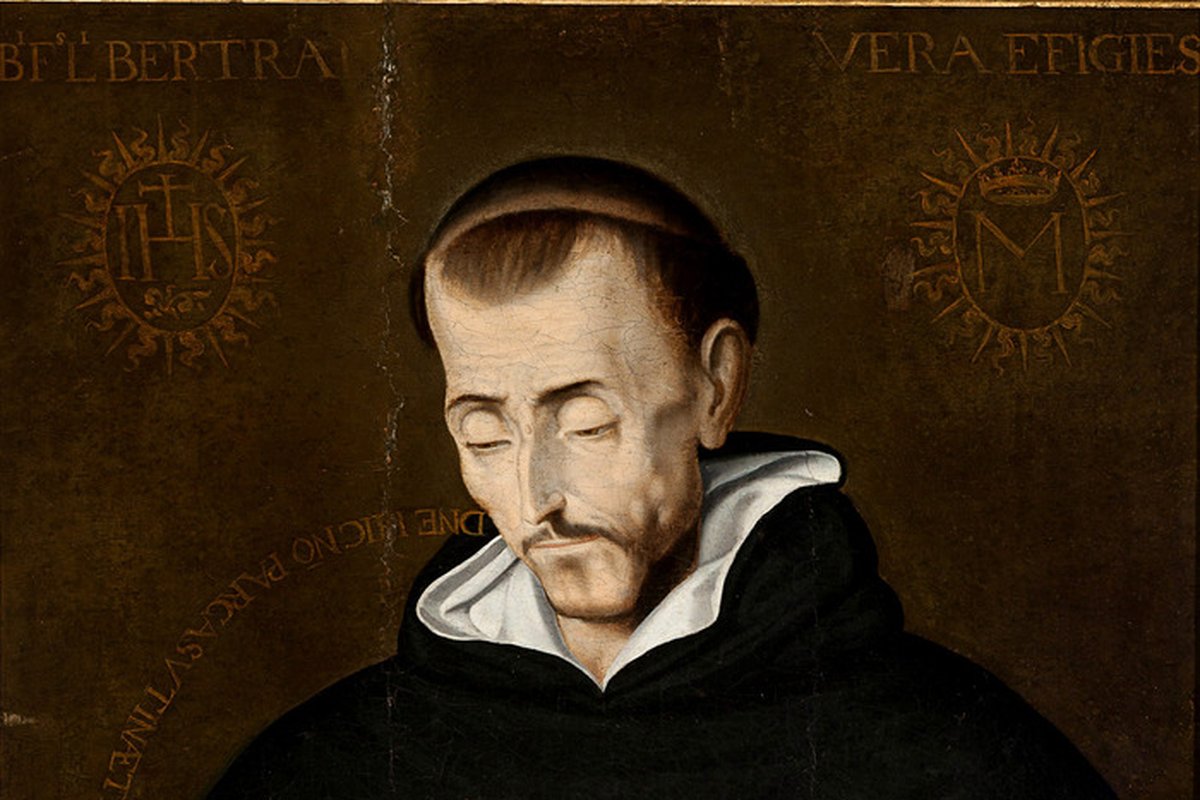
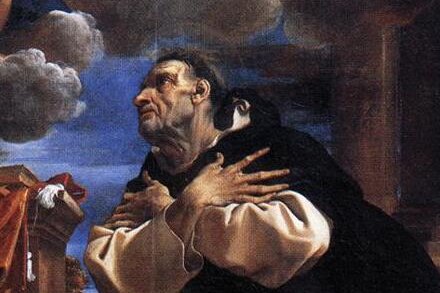
Juan Zariñena, Vera efigie del Venerable Luis Beltrán, c. 1581–82, Museo Ibercaja Camón Aznar, Zaragoza — public domain.
Seven years in New Granada
Bertrand arrived in South America in the early 1560s and spent roughly seven years there as a missionary, working directly among indigenous communities across present-day Colombia, Panama, and parts of the Caribbean coast, including stops on islands such as Santa Fe and Tubará. Tradition holds that he was given something close to a miraculous facility for being understood across language barriers he had not fully mastered — a "gift of tongues" story of the kind told about a number of missionary saints from this period, including, much earlier, the apostles at Pentecost — and one that should be read as pious tradition rather than a documented historical or linguistic claim. What is better attested, and doesn't depend on any miraculous account to hold up, is that Bertrand built a substantial record as a preacher and converted large numbers of people during his years in the field, moving from village to village on foot across difficult, often unmapped terrain, relying on local guides and whatever interpreters he could find along the way.
Speaking against colonial abuse
Bertrand's time in New Granada coincided with widespread and well-documented mistreatment of indigenous peoples by Spanish colonizers, and he became known specifically for opposing it — not as a marginal aside to his missionary work, but as a stance that shaped his reputation among both the people he served and the colonial authorities he was willing to criticize. This part of his story rests on firmer ground than the language legend: contemporaries and later biographers alike record him as a missionary who took the abuse of the people he was evangelizing seriously enough to speak against it directly, at a time when doing so carried real professional and personal risk within the colonial Church hierarchy.
Returning home, and staying there
In 1569, Bertrand returned to Spain and did not go back to South America. He spent the remaining twelve years of his life in considerably more conventional Dominican work — serving as a novice master and later a prior, shaping the formation of younger friars rather than continuing frontier missionary work. He died in Valencia, the city of his birth, on October 9, 1581.
The world Bertrand worked in
New Granada in the 1560s was still, in many respects, a raw and unstable colonial frontier — the Spanish conquest of the region had unfolded only decades earlier, and the encomienda system, under which colonizers were granted control over the labor of indigenous communities, was already producing the kind of documented abuses that would eventually draw sustained criticism from Church figures across Spanish America, most famously Bartolomé de las Casas a generation before Bertrand's own arrival. Bertrand worked in this same broad current of missionary reformers who saw evangelization and the defense of indigenous people's basic dignity as inseparable obligations, not as two separate projects. Colonial authorities did not always welcome that stance, and preaching against the abuses of the very system that funded and protected the missions took a particular kind of stubbornness that biographers consistently attribute to him.
Canonization and patronage
Pope Clement X canonized Louis Bertrand in 1671, nine decades after his death. He is venerated today as a patron of Colombia, honoring the years he spent evangelizing the territory that would become that country, and, more broadly, as a patron of missionaries. His feast is kept on October 9, the anniversary of his death in the city where his religious life had begun. He's remembered today less as a miracle-worker, despite the legends attached to his preaching, than as one of a line of 16th-century missionaries — a group that also includes figures like Saint Peter Claver, who continued similar work in the same region a generation later — whose commitment to the people they evangelized outlasted the more convenient parts of the colonial system they were officially serving.
Trivia
Who was Saint Louis Bertrand?
Is it true Louis Bertrand had a miraculous gift for languages?
Did Louis Bertrand actually oppose the mistreatment of Native peoples?
Why did Louis Bertrand return to Spain?
What is Saint Louis Bertrand the patron saint of, and when is his feast?
You May Also Like
Related Reading