Saint Damien of Molokai

Taking a brother's place
Damien of Molokai was born Joseph de Veuster on January 3, 1840, in Tremelo, Belgium. In 1858 he joined the Society of the Sacred Hearts of Jesus and Mary, taking the name Damien in honor of a 4th-century Christian martyr and physician. When his brother Father Pamphile, originally assigned to missionary work in Hawaii, fell ill, Damien took his place, arriving in Honolulu in 1864 and being ordained a priest there that same year.
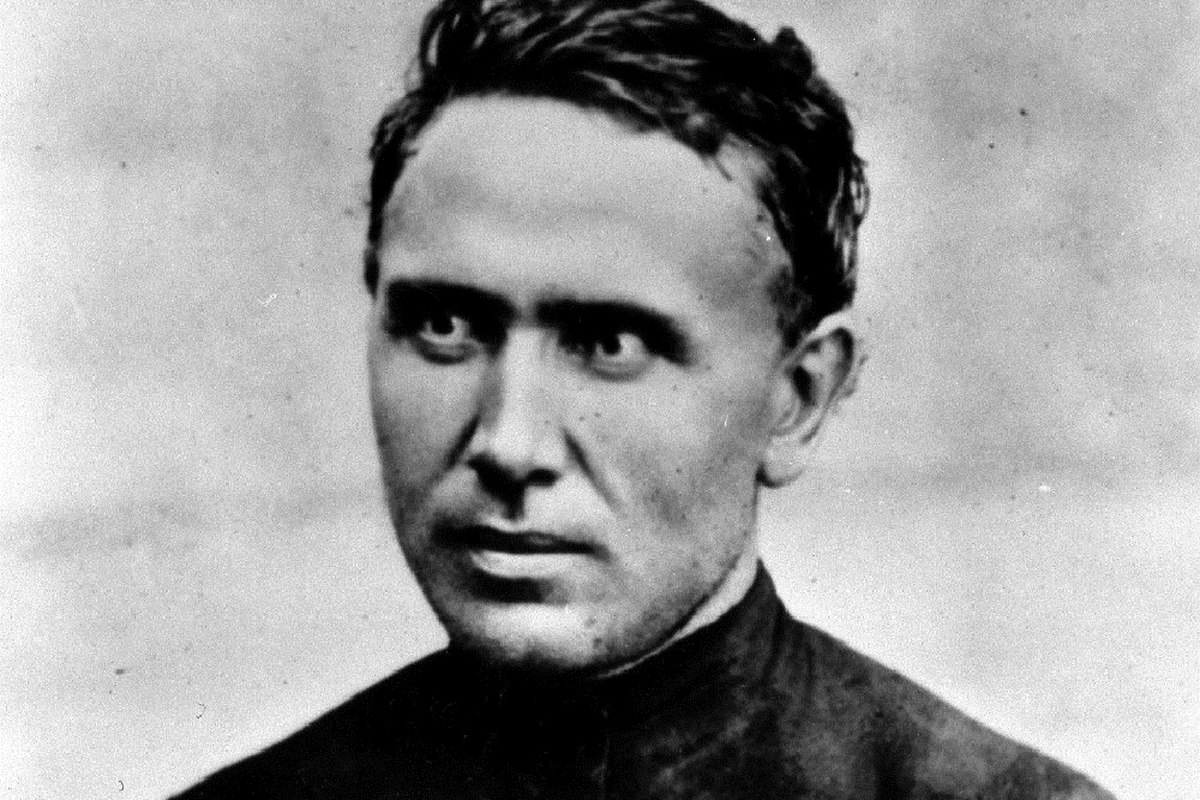
Photograph of Saint Damien of Molokai, 19th century, public domain.
Volunteering for a colony no one else wanted
Moved by the miserable conditions of people with leprosy whom the Hawaiian government had deported to Kalaupapa, on the island of Molokai, Damien volunteered to take charge of the settlement himself. Over sixteen years there, he improved the colony's water and food supplies and housing, and founded two orphanages — receiving help from other priests for only six of those sixteen years.
The disease he came to fight
In 1884, after two decades of close daily contact with people suffering from leprosy, Damien contracted the disease himself. He refused to leave the island for treatment elsewhere, choosing instead to remain among the community he had served for so long, and died of the disease in 1889 at the age of forty-nine.
Canonized after two verified miracles
Damien of Molokai was canonized in 2009, after the Church determined that two miraculous healings attributed to his intercession were authentic. His sixteen years on Molokai, and the disease that eventually took his life, remain the defining measure of a ministry built entirely on staying where he was needed most.
A farm boy who nearly missed his own ordination
Joseph de Veuster grew up on a farm in rural Belgium, one of seven children, and initially trained to take over the family grain business before deciding at nineteen to enter religious life, following an older brother and sister who had already become a priest and a nun. He was largely self-taught in Latin, cramming to catch up with seminarians who had studied it for years, and by his own account struggled academically compared to his more polished classmates. That background matters for understanding Kalaupapa: the man who eventually built roads, coffins, a water system, and two orphanages by hand was, from the start, someone who worked with his body as readily as with his mind.
Records show a settlement without law, water, or care
Before Damien's arrival, records from Hawaiian health officials and missionaries describe Kalaupapa less as a managed hospital colony than as an isolated dumping ground. People diagnosed with leprosy were shipped there by government order, sometimes literally thrown overboard near the shore to swim in, and left with minimal food, no reliable clean water, and no organized burial for the dead. Damien requested a transfer there in 1873, initially for a temporary assignment, and asked his bishop to let him stay permanently once he saw the conditions firsthand. He built a reservoir and pipes to bring fresh water into the settlement, organized farming, built several hundred coffins with his own hands over the years, and personally dug graves so the dead could be buried with dignity instead of left in mass, unmarked pits.
Tradition holds he learned of his own diagnosis in a striking way
Popular retellings often describe Damien realizing he had contracted leprosy when he accidentally scalded his foot with boiling water and felt no pain — a symptom of the nerve damage the disease causes. Multiple early biographers repeat some version of this story, though it should be read as reported personal testimony rather than a medically documented diagnostic moment; what is well documented is that Damien noticed the first physical symptoms around 1884 and disclosed his condition to his community soon after, continuing his work without interruption for another five years until his death in 1889.
Iconography and symbolism
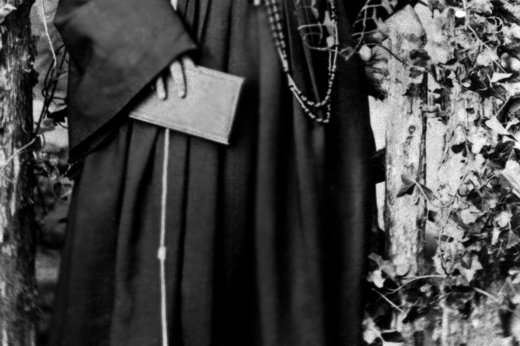
Because Damien lived into the age of photography, he is usually depicted plainly, in his black cassock, often shown in his later years with the visibly disfigured features caused by advanced leprosy — a choice devotional artists made deliberately, rather than softening his image, to emphasize that his holiness was inseparable from his physical suffering alongside those he served. He is often pictured with the tools of his manual labor — a hammer, a shovel, or building materials — rather than the more traditional palm branch or book associated with older saints, reflecting how his sanctity was expressed through construction and physical care rather than through preaching or writing.
Controversy, vindication, and a shared feast
Damien's reputation was attacked during his lifetime by a Presbyterian minister who suggested, without evidence, that his leprosy resulted from personal immorality — an accusation Robert Louis Stevenson famously rebutted in a widely published open letter after visiting Kalaupapa himself. Damien's cause was helped in the twentieth century by growing recognition of Mother Marianne Cope, a Franciscan sister who arrived at Kalaupapa in 1888 and continued his work for another three decades; she was canonized in 2012, three years after Damien, and the two are now often venerated together as co-patrons of people affected by Hansen's disease. Hawaii commemorates both saints with a state holiday, and a statue of Damien represents the state of Hawaii in the United States Capitol's National Statuary Hall — a rare distinction for a Belgian-born missionary who never held political office.
Trivia
Who was Saint Damien of Molokai?
Why did he go to Hawaii?
What did he do at the Kalaupapa settlement?
What happened to him personally?
What is Saint Damien of Molokai the patron saint of, and when is his feast day?
Did anyone else continue his work at Kalaupapa?
Was Damien's reputation ever attacked?
How is he honored today?
Related Reading