Saint Margaret of Antioch

A legend the Church itself calls fabulous
It's worth saying plainly, before telling the story at all: the Catholic Encyclopedia states outright that Margaret's surviving Acts are "entirely fabulous," adding that even the century in which she supposedly lived is uncertain. That's an unusually blunt admission from a reference work generally inclined to give traditional accounts the benefit of the doubt. And the consequence of that uncertainty wasn't just academic — in the 1969 reform of the General Roman Calendar under Pope Paul VI, the same reform that reviewed a number of ancient saints' feasts against the actual historical evidence behind them, Margaret's July 20 feast was removed from the universal calendar entirely. She joined a small group of long-venerated figures whose popular stories turned out to rest on no verifiable historical foundation. None of that erased her from Christian devotion — she remains honored, particularly in the Eastern Church under the name Marina, and in centuries of folk piety that never much cared what a modern calendar commission concluded. But it does mean everything that follows here should be read as legend, not as biography.
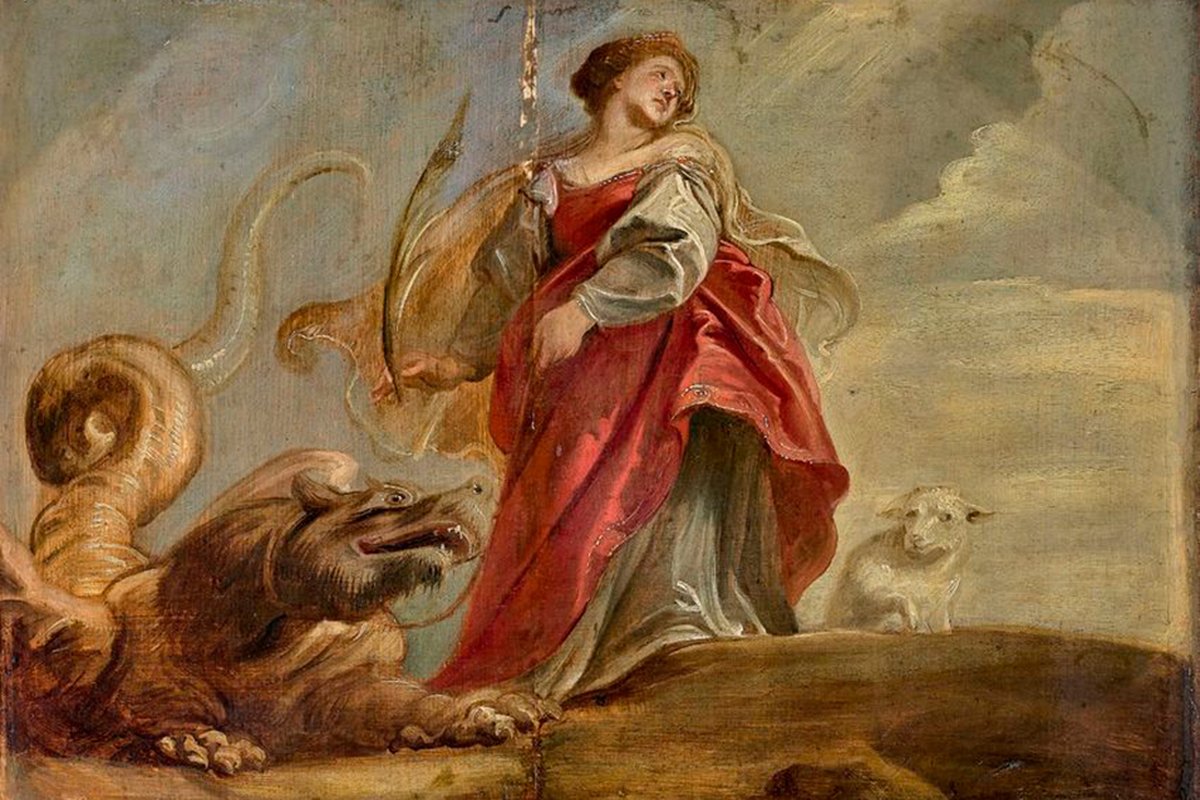
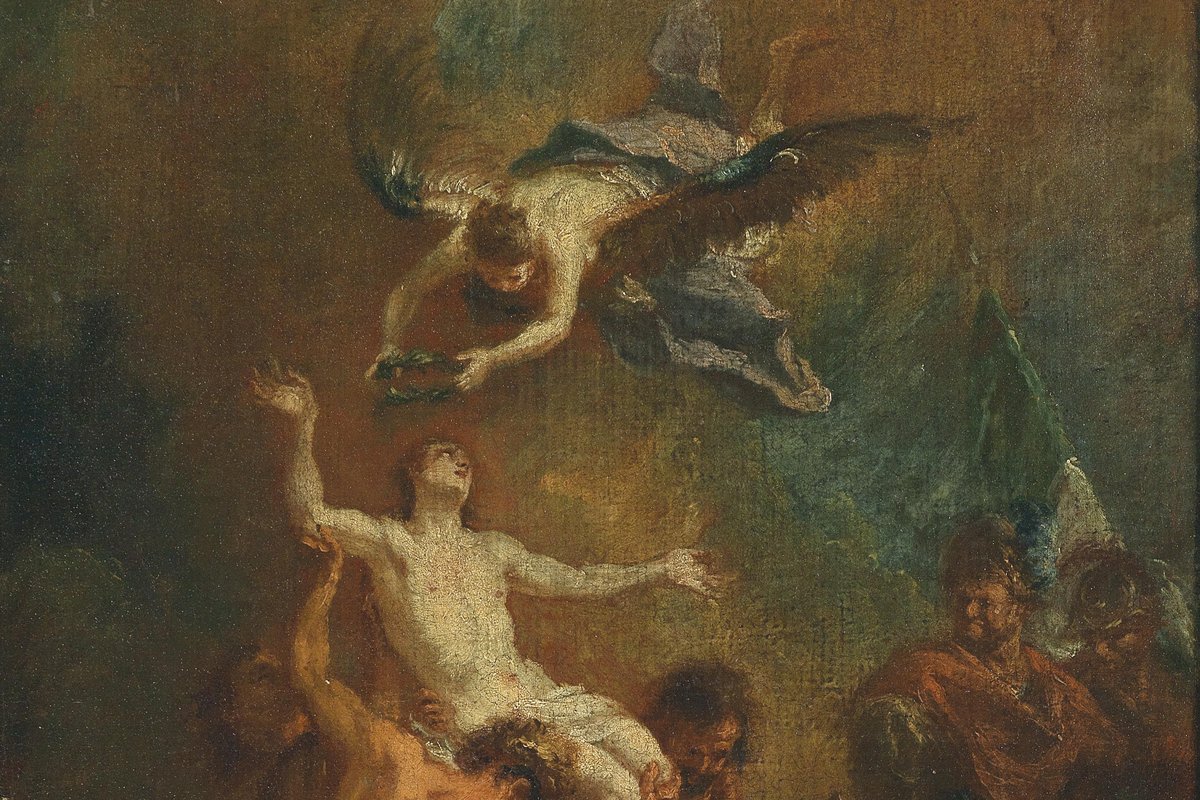
Peter Paul Rubens, oil sketch for "Saint Margaret and the Dragon" (study for a lost painting for the Jesuit church, Antwerp), early 17th century — public domain.
Daughter of a pagan priest
According to the traditional account, Margaret was born in Antioch of Pisidia, a Roman city in what's now Turkey — not to be confused with the larger and better-attested Antioch in Syria — the daughter of a pagan priest. She converted to Christianity as a young woman, consecrated her virginity to God, and was disowned by her father for it, going to live with a foster mother who kept sheep in the countryside outside the city — a fairly standard opening for the genre of virgin-martyr legend that produced dozens of similar stories across the late Roman world. The story continues predictably from there in its broad shape, if not in its specific, unverifiable details: a Roman prefect named Olybrius, riding past while she tended the flocks, saw her, wanted to marry her, and had her arrested and tortured when she refused him on account of her Christian vow, first attempting to have her burned and then imprisoning her when that failed to break her resolve.
The dragon in the prison cell
It's the next episode that made Margaret one of the most recognizable figures in medieval Christian art, and it's also the part scholars treat as the clearest fabrication in an already unreliable narrative. While imprisoned, the legend says, Margaret was confronted by a dragon — in some versions explicitly identified as Satan taking that form — which swallowed her whole. She was still holding, or wearing, a small cross, and inside the creature's body that cross began to irritate it so severely that the dragon burst open, freeing her unharmed. Even medieval writers were uneasy about the episode; the 13th-century hagiographer Jacobus de Voragine, compiling the enormously popular Golden Legend, noted the dragon story with visible skepticism even as he included it. It's precisely the kind of vivid, physically impossible detail that separates pious legend from documented history — and it's the detail nearly every painter who depicted Margaret chose to include, because visually, nothing else in her story comes close. Some medieval versions add a second episode immediately afterward: a lesser demon, disguised as a man, visits her cell to finish what the dragon failed to do, only for Margaret to seize it by the hair and force a confession of its true nature out of it before letting it go defeated. In the standard iconography that developed from these stories, Margaret is shown standing calmly on or beside a subdued dragon, often holding a small cross-tipped staff — an image repeated across countless medieval church windows, statues, and devotional paintings, including Rubens's own sketch for a lost Antwerp altarpiece.
From legend to patroness of childbirth
Whatever its historical worth, the dragon episode is the direct source of Margaret's most enduring patronage: pregnant women and women in childbirth. The logic tracks the legend closely — a young woman is swallowed whole and emerges alive and unharmed, and medieval devotion read that as a natural image of safe delivery. Women in labor sometimes kept texts of Margaret's Acts, or small images of her, close at hand specifically for that association. She's also invoked, more loosely, as a patroness of nurses and of the dying, and her story was well known enough in late medieval France that Joan of Arc later reported Margaret as one of the saints who appeared to her in vision, alongside Michael the Archangel and Catherine of Alexandria — testimony she gave, under considerable pressure, at her own trial for heresy, which is itself one of the better-documented moments in which Margaret's legend intersects with genuine, well-attested history.
One of the Fourteen Holy Helpers
Margaret's popularity earned her a place among the Fourteen Holy Helpers, a group of saints who became especially prominent across medieval Europe as intercessors against specific dangers, diseases, and fears — Blaise and throat ailments, Barbara and sudden death, and Margaret and the dangers of childbirth all belong to that same devotional tradition. It's a useful way to hold her story in mind: a saint whose entire surviving biography the Church's own scholarship declines to treat as historical fact, and who was formally dropped from the universal calendar for exactly that reason in 1969, yet whose cult — carried almost entirely by one unforgettable, impossible image of a dragon bursting open — proved durable enough to outlast the verdict.
Margaret in art and pilgrimage
Precisely because the dragon episode is so visual, Margaret became one of the most frequently painted and carved female saints of the later Middle Ages and Renaissance. Artists reached for the same handful of props again and again: a young woman in ordinary dress, a small cross or crucifix-topped staff, and a dragon either coiled beneath her feet or shown in the act of splitting open behind her. Peter Paul Rubens painted her this way in the oil sketch that illustrates her story today, and countless parish churches across England and France once kept a statue or stained-glass window of "Margaret and the dragon" near the font, since baptism, like her escape from the beast, was understood as a passage from danger into new life. Her cult reached England early and strongly — dozens of medieval English churches were dedicated to her, and a well associated with her name near King's Lynn in Norfolk became a modest pilgrimage site for expectant mothers.
Comparing Margaret to other saints whose stories combine strong popular devotion with thin historical documentation, such as Saint Barbara, helps make sense of how the medieval Church could venerate a figure so thoroughly while later scholarship quietly acknowledged that almost nothing about her could be verified. That combination — deep, sincere devotion built on a legend rather than a biography — turns out to be far more common in the history of sainthood than most people assume, and Margaret remains one of its clearest examples. In the Christian East, where she is venerated as St. Marina rather than Margaret, that same dragon-conquering image made her one of the most frequently depicted female saints in Byzantine and later Orthodox iconography, often shown in the same pose repeated in Western art: calm, upright, and entirely unbothered by the defeated creature at her feet. Readers curious about other saints whose popular devotion outran the historical record, or whose feasts were affected by the 1969 calendar reform, may find the article on the Fourteen Holy Helpers a useful companion piece.
Trivia
Who was Saint Margaret of Antioch?
Is the story of Saint Margaret of Antioch and the dragon historically true?
Was Saint Margaret of Antioch removed from the Church's calendar?
What is Saint Margaret of Antioch the patron saint of?
What are the Fourteen Holy Helpers, and is Margaret one of them?
You May Also Like
Related Reading