Saint Mary MacKillop

A Melbourne childhood, and a calling to teach
Mary MacKillop was born on January 15, 1842, in Fitzroy, a suburb of Melbourne, Australia, the eldest of eight children in a family that struggled financially for much of her early life. She worked as a governess and teacher in her teens and twenties, developing a strong interest in education for children who had little access to it — a concern that would define the rest of her life. In 1866, in the small South Australian town of Penola, she and a Catholic priest, Father Julian Tenison Woods, co-founded a new religious congregation: the Sisters of St Joseph of the Sacred Heart, known informally, from the plain brown habits the sisters wore, as the "Brown Joeys."
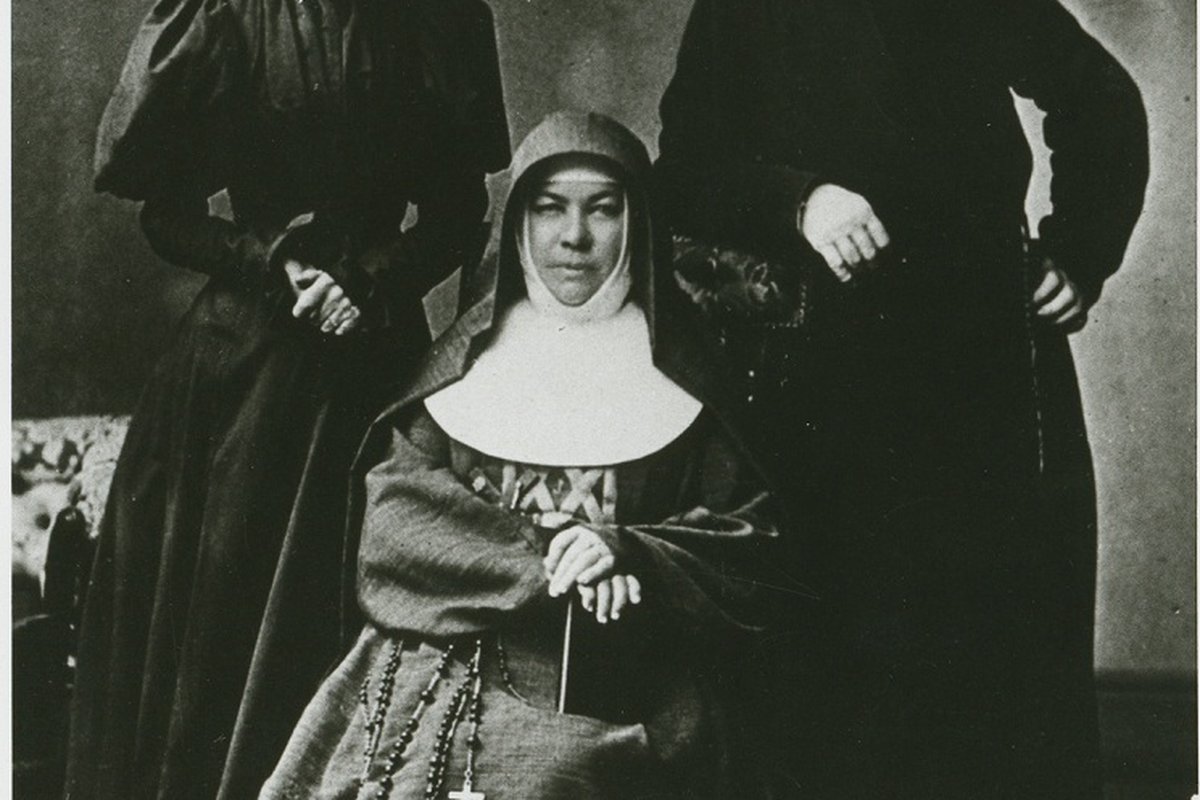
Unknown photographer, photograph of Mary MacKillop, 1890, State Library of South Australia — public domain.
Schools for children who couldn't pay
The Josephites' mission was specific and, for the time, notably egalitarian: educating poor children, especially in rural and outback Australia, in schools that were open regardless of a family's ability to pay. The order grew quickly, and within a few years MacKillop and her sisters were running numerous schools across South Australia and beyond, reaching children in remote communities that had little other access to formal education. It's a mission the Sisters of St Joseph continue today, more than a century and a half after Penola.
Excommunicated in 1871
In 1871, Bishop Laurence Sheil of Adelaide excommunicated Mary MacKillop — a real, well-documented episode in her life, not a footnote to be glossed over. The circumstances were genuinely complicated: tension had been building over how much independence her congregation should have from direct diocesan control, and the period also involved her order's reporting of a case of child sexual abuse by a priest, a matter discussed plainly in modern, reputable retrospective coverage of her life. Church authorities investigated the excommunication and found no grounds to justify it; it was lifted within months, and it was later acknowledged that MacKillop had been treated unjustly. The episode is remembered today not as a scandal attached to her name, but as evidence of an integrity that held up even under formal ecclesiastical censure — and was, in the end, vindicated.
Continuing the work
MacKillop's later decades were shaped by ongoing tension between her congregation's rule — which placed authority in a single Mother Superior rather than under the direct control of individual local bishops — and various bishops who wanted more say over the sisters working in their dioceses. She traveled extensively, including to Rome, to secure formal papal approval for the Josephites' constitutions, work that helped protect the order's independence and its distinctive mission for the long term. She continued leading and expanding the congregation until a stroke in 1902 left her partially paralyzed; she died in North Sydney on August 8, 1909.
Australia's first saint
Pope Benedict XVI canonized Mary MacKillop on October 17, 2010, making her the first Australian ever declared a saint by the Catholic Church — a milestone that carried, and still carries, real national significance in Australian religious and civic life. Her feast is kept on August 8, the anniversary of her death. She is remembered today as a founding figure of Catholic education in Australia and, informally, as a patron of the country alongside Our Lady Help of Christians, its formally designated patroness, with the Sisters of St Joseph she founded still carrying her original mission forward.
A rule built around going wherever the need was
Part of what made the Josephites distinctive from other teaching orders active in colonial Australia was a structural choice MacKillop insisted on: rather than being attached permanently to a single convent or parish, as many religious communities of the period were, the sisters lived more simply and were prepared to be sent wherever a school was needed, including remote outback settlements most other orders wouldn't reach. This mobility was directly tied to the congregation's central governance under one Mother Superior rather than under individual local bishops — the same structural independence that put MacKillop in conflict with several churchmen over the years, including Bishop Sheil in 1871. She defended that structure precisely because it was what let the order go where poor children actually were, rather than staying wherever a particular bishop preferred to keep them.
Two miracles, and a long road through Rome's process
MacKillop's canonization followed the Church's standard, deliberately slow process for verifying miracles attributed to a candidate's intercession. She was beatified in 1995 after the Vatican recognized a healing from leukemia attributed to prayers asking for her intercession, and her 2010 canonization required a second verified miracle — the unexplained recovery of a woman with inoperable lung cancer, reviewed and accepted by the Vatican's medical and theological consultors after extensive investigation. Each stage of that process, spanning decades from her death in 1909 to her eventual sainthood in 2010, reflects how carefully Rome examines claims before granting formal canonization, regardless of how strong local popular devotion to a candidate already is.
Why the excommunication still matters to how she's remembered
Modern biographers and Church historians treat the 1871 excommunication as more than a dramatic anecdote — it's often read as an early instance of a pattern that would recur, tragically, throughout the twentieth century in Australia and elsewhere: an institution's discomfort with uncomfortable disclosures about clergy misconduct. Because MacKillop's congregation was involved in reporting a priest's abuse of a child around the same period as her excommunication, some later historians have drawn a direct line between her order's willingness to speak up and the ecclesiastical pressure that followed, even though the full picture involves other genuine disputes over her congregation's governance as well. That's part of why the episode continues to be discussed openly in serious accounts of her life rather than minimized — it reflects real courage under real institutional pressure, vindicated only after careful investigation cleared her.
Trivia
Who was Saint Mary MacKillop?
Why was Mary MacKillop excommunicated?
When was Mary MacKillop canonized, and why does it matter to Australia?
What are the 'Brown Joeys'?
What is Saint Mary MacKillop the patron of, and when is her feast?
You May Also Like
Related Reading