Saint Matthias the Apostle

A problem the Twelve had never faced
Jesus had chosen twelve apostles, and after Judas's betrayal and death, eleven remained. To the earliest Christian community gathered in Jerusalem after the Ascension, that gap mattered — the number twelve echoed the twelve tribes of Israel, and leaving it broken wasn't treated as an option. Peter stood up among a crowd of about 120 believers and laid out a specific requirement for whoever would fill the seat: the candidate had to be someone who had been present for the whole of Jesus's public ministry, from John's baptism in the Jordan through the Ascension, so that he could serve alongside the others as a firsthand witness to the Resurrection — a vacancy filled just before the outpouring of the Spirit at Pentecost.
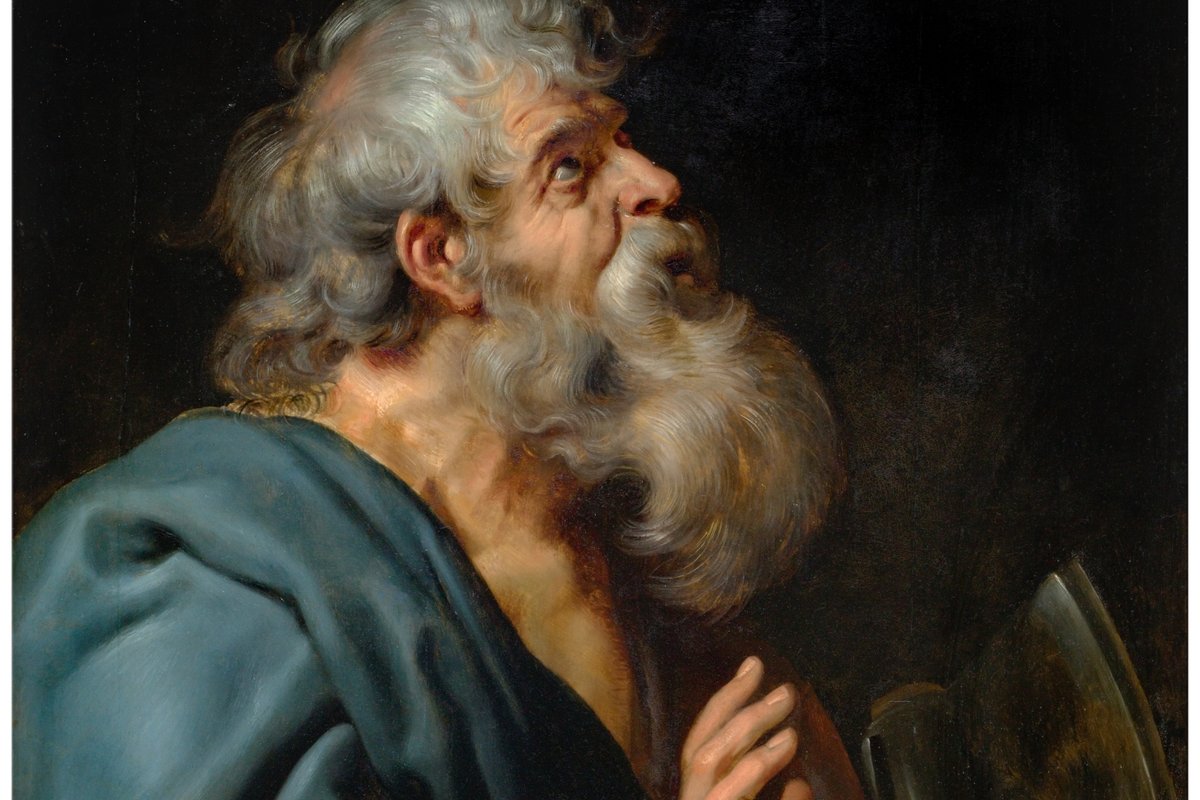
Peter Paul Rubens, Saint Matthias, c. 1611, Museo del Prado, Madrid — public domain.
Notice how narrow that requirement was. It ruled out anyone who had joined the movement after the Resurrection, no matter how gifted or devoted, and it ruled out anyone who had only heard about Jesus secondhand. The apostles weren't simply looking for a capable replacement — they needed someone who could stand up in the same way Peter and the others did and say, in effect, "I was there." That detail matters for understanding what "apostle" meant to the earliest Christians: not a title of honor so much as a specific, verifiable role, built entirely on having witnessed the risen Christ in person.
Chosen by lot, not by vote
Two men met that standard: Matthias, about whom almost nothing else is recorded, and a man known as Joseph Barsabbas, also called Justus. Rather than debating or voting between them, the apostles prayed and then cast lots. Acts 1:24-25 (RSV-CE) preserves their prayer directly: "Lord, who knowest the hearts of all men, show which one of these two thou hast chosen to take the place in this ministry and apostleship from which Judas turned aside, to go to his own place." The lot fell to Matthias, and Acts 1:26 records simply that "he was enrolled with the eleven apostles."
Casting lots can sound to modern ears like leaving something important to chance, but it followed a well-established Jewish practice for seeking God's guidance in situations too weighty for ordinary deliberation — the same logic behind, for instance, the Old Testament practice of dividing the Promised Land among Israel's tribes by lot. The prayer came first; the lot was simply how the apostles expected the answer to arrive.
It's worth pausing on Justus, the man who didn't get chosen. Scripture gives no sign that he was passed over for any failing — he met the same qualifications, was put forward with equal seriousness, and simply wasn't the one the lot pointed to. There's no recorded protest, no resentment, no schism over the loss. That quiet acceptance says something about how the earliest community understood these decisions: not as a contest to be won, but as a discernment to be received, whichever way it landed.
Everything after Acts 1 is legend, not history
Here the reliable historical record on Matthias stops entirely. He is never mentioned again by name anywhere in the New Testament. Later writers filled that silence with a range of traditions — some placing his missionary work in Cappadocia and around the Caspian Sea, others in Ethiopia, and various accounts describing his eventual martyrdom by stoning, beheading, or a combination of both. None of this appears in any source until centuries after the events it claims to describe, and the accounts frequently contradict one another. It's worth being direct about what that means: nothing beyond his selection in Acts 1 can be called documented history. Everything else belongs to pious tradition, which is a different kind of claim entirely — one that later generations found meaningful, but not one resting on eyewitness testimony.
Relics claimed centuries later
Despite the total silence of the historical record on where Matthias actually died, several places have claimed his physical remains. The most prominent claim belongs to the Abbey of St. Matthias in Trier, Germany, which holds relics said to have been brought there by Saint Helena, the mother of the Emperor Constantine, in the fourth century — making it, by tradition, the only burial site of an apostle north of the Alps. Rome's Santa Maria Maggiore basilica claims a portion of relics as well. As with so much of Matthias's story, none of this can be verified against any contemporary record; it belongs to the same category of pious tradition as the missionary journeys and martyrdom accounts, valued by the communities that hold it without functioning as documented history.
A feast day kept on two different dates
Because Matthias predates the Church's formal canonization process entirely, he's venerated simply as one of the Twelve, recognized by tradition rather than by any decree. The Roman Catholic calendar currently keeps his feast on May 14, moved there during the 1969 liturgical reform from its earlier date of February 24 (February 25 in leap years), which fell during Lent. The Greek Orthodox and Byzantine churches observe his feast separately, on August 9 — a reminder that even something as basic as a saint's calendar date isn't always uniform across the Christian world.
A patron for ordinary struggles
Tradition has attached several patronages to Matthias over the centuries — he's invoked by carpenters and tailors, by people struggling with alcoholism, and against smallpox — though none of these come with a clearly documented origin story the way some other saints' patronages do. They function today much as they likely developed originally: as devotional habits passed down through communities, attached to a man whose actual biography the Church has always been honest about not really knowing.
Trivia
How was Matthias chosen to replace Judas Iscariot?
What does the Bible actually say happened to Matthias afterward?
Why did the apostles cast lots instead of simply voting?
What happened to Matthias after the Book of Acts ends?
What is Saint Matthias the patron saint of, and when is his feast day?
You May Also Like
Related Reading