Saint Oliver Plunkett

An archbishop under the penal laws
Oliver Plunkett was born in 1625 at Loughcrew, County Meath, into a family with connections to the Irish nobility, and was ordained a priest in Rome in 1654 — a city he'd been sent to as a teenager for his education, since Catholic seminaries had effectively been driven out of Ireland by the political and religious upheaval of the time. He spent over a decade teaching theology in Rome before being appointed Archbishop of Armagh and Primate of All Ireland in 1669, at which point he returned to a country where practicing Catholic clergy operated under severe legal restriction. England's penal laws, tightened and loosened depending on the political mood of the moment, criminalized much of ordinary Catholic religious life — bishops in particular were treated as a threat, since without them there could be no new priests ordained to sustain the faith long-term. Plunkett spent years traveling his diocese in disguise, confirming thousands of Catholics and trying to hold together a Church structure that English law wanted dismantled.
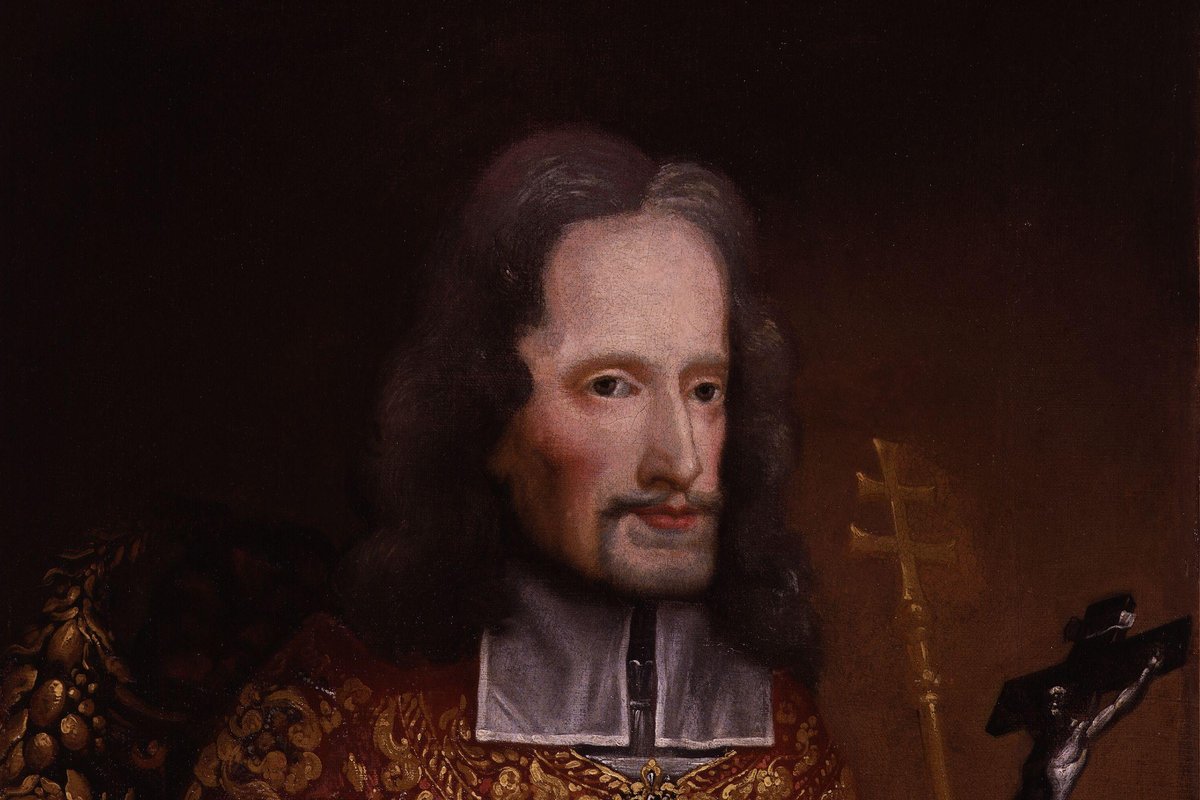
Edward Luttrell, portrait of Oliver Plunkett, 17th century — public domain.
A lie invented by a professional liar
The circumstances that killed him trace back to Titus Oates, an English clergyman turned professional fabricator who in 1678 invented a sweeping conspiracy story — the so-called Popish Plot — claiming Catholics across England were scheming to assassinate King Charles II and restore Catholic rule by force. The claims were false from top to bottom, but they landed at a moment of genuine and long-simmering anti-Catholic anxiety in English public life, and the panic that followed was real, well-documented, and devastating: dozens of innocent people were imprisoned or executed across England and Ireland between 1678 and 1681 on the strength of testimony that later collapsed under scrutiny. Oates himself was eventually convicted of perjury in 1685, once the political tide turned — but not before the hysteria he manufactured had already cost Oliver Plunkett his life.
Plunkett was arrested in December 1679 on invented charges that he was conspiring to bring a French invasion force into Ireland to support a Catholic uprising. Two trials were attempted in Ireland first, and both collapsed — Irish jurors weren't buying testimony that fell apart on the barest examination, much of it coming from disgraced or self-interested former clergy with grudges against him. English authorities responded by moving the case to London, a deliberate venue change specifically because a London jury, still gripped by the same plot hysteria consuming the capital, could be relied on to convict where an Irish one would not.
A trial on perjured testimony
The London trial in June 1681 delivered exactly the verdict the Crown needed. Plunkett was convicted of high treason on the word of paid and perjured witnesses — men whose testimony historians now regard as fabricated even by the loose evidentiary standards of Popish Plot prosecutions generally. He was sentenced to death and executed at Tyburn on July 1, 1681, by hanging, drawing, and quartering, the full traditional punishment reserved for treason. He was the last Catholic martyr to die at Tyburn, a site that had witnessed Catholic executions stretching back through the Reformation, and his death effectively marked the close of that particular chapter of English state violence against the Catholic Church.
A childhood shaped by two worlds
Plunkett's family had one foot in the old Gaelic order and one in the Anglo-Norman nobility that had settled Ireland centuries earlier, and that dual inheritance shaped his early years. His cousin Patrick Plunkett, Bishop of Ardagh and later of Meath, supervised his early education, and it was under the patronage of relatives connected to Rome that the young Oliver was sent abroad in 1647, at the age of twenty-two, to study for the priesthood. Ireland at the time was reeling from the Cromwellian conquest, a campaign that devastated Catholic landholding and church structures alike, so leaving for Rome wasn't simply a matter of academic ambition — it was often the only realistic path left open to a Catholic cleric who wanted an education at all.
A bishop who worked with the state, not just against it
What set Plunkett apart from some of his contemporaries was a pragmatic streak. Rather than treating every representative of the English administration as an enemy, he cultivated working relationships with the Duke of Ormonde, the Lord Lieutenant of Ireland, and used those connections to secure periods of relative tolerance for his clergy. He founded a Jesuit-run college in Drogheda that briefly educated both Catholic and Protestant students side by side, an unusual arrangement for the time, and he worked energetically to suppress the rampant lawlessness and factional violence — much of it the residue of decades of war — that had left parts of rural Ireland effectively ungoverned. That same reputation for effectiveness may have made him a target: an archbishop capable of holding his diocese together, even under hostile law, was a more useful scapegoat to English plot-hysteria than a weak one. Readers interested in other clergy who navigated hostile regimes might also look at Saint John of the Cross, imprisoned by his own religious brothers during a very different conflict within the Church.
A relic that still exists
Unlike so much surrounding early Christian martyrs, nothing here rests on later legend — Plunkett's arrest, trials, and execution are documented in contemporary English legal and historical records, not pious tradition written centuries after the fact. One physical object from the story survives and can still be visited today: Plunkett's head was preserved after his execution and is now displayed as a relic in St. Peter's Church, Drogheda, Ireland, where it draws pilgrims to this day.
Canonization and a modern patronage
Oliver Plunkett was beatified in 1920 and canonized by Pope Paul VI in 1975 — the first new Irish saint in almost seven hundred years at the time of his canonization. His feast is kept on July 1 in the universal calendar and on July 11 in Ireland. Given the era in which he died and the way his story ties directly to the long history of sectarian conflict on the island, he's become a natural figure to invoke for peace and reconciliation in Ireland, a patronage drawn on explicitly during peace efforts amid the Troubles in Northern Ireland in the later twentieth century — a martyr from one bitter chapter of Irish history offered as an intercessor for closing another.
Trivia
Who was Saint Oliver Plunkett?
What was the Popish Plot, and how did it lead to Plunkett's execution?
Why was Plunkett tried in London instead of Ireland?
What happened to Plunkett's body after his execution, and where is his head today?
What is Saint Oliver Plunkett the patron saint of?
You May Also Like
Related Reading