Saint Pirmin of Reichenau

A founder we can't fully account for
It's worth pausing on why the uncertainty around Pirmin matters, rather than treating it as a mere footnote. Many early medieval saints' lives were written generations after their subjects died, often by monastic communities with a direct institutional interest in enhancing their founder's prestige — a more impressive origin story lent more weight to the monastery's own claims and privileges. That doesn't mean the Vita of Pirmin is worthless as a source, only that its details about his birthplace and early career deserve the same skeptical distance a historian would apply to any similarly interested account, rather than being repeated as settled biography simply because they're the only story available.
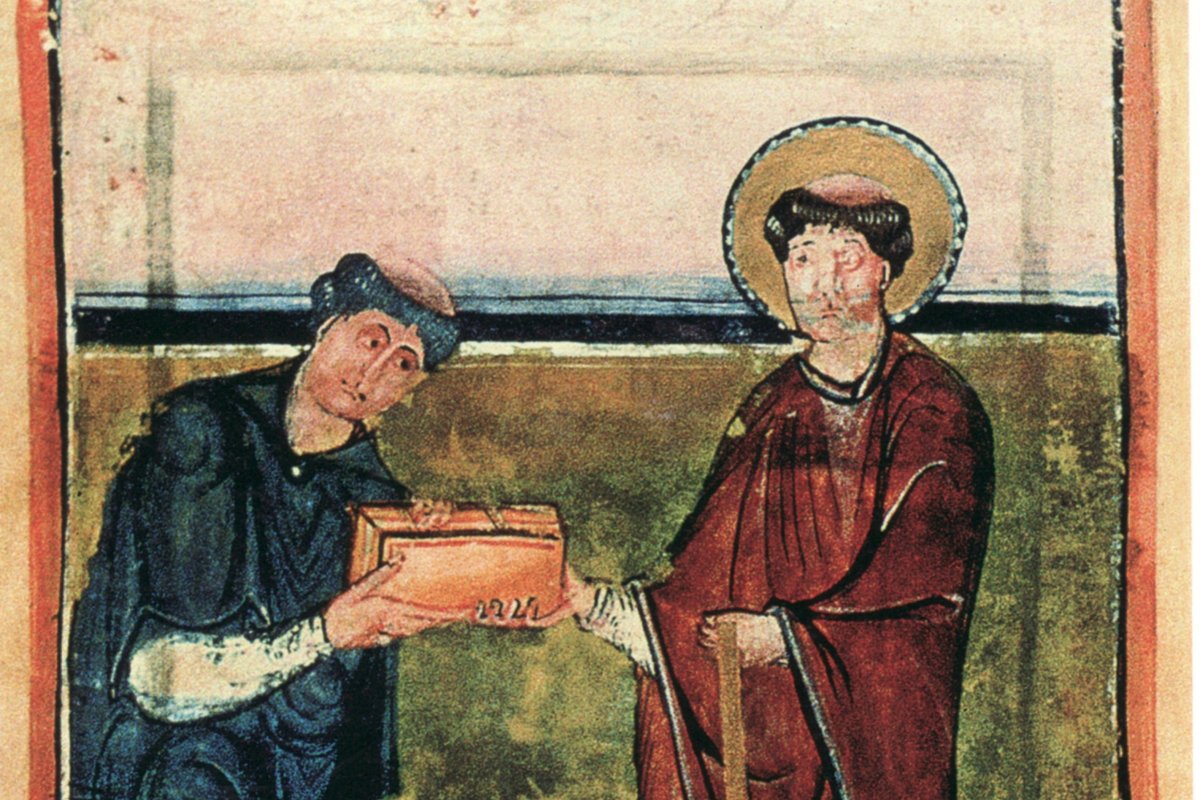
Hornbach Sacramentary, fol. 8v, showing Abbot Adalbert presenting the codex to Saint Pirmin, c. 983 — public domain.
Here's the honest starting point: we don't know when or where Pirmin was born. The main source for his early life is a Vita — a biographical account written specifically to record a saint's life — composed in the 9th century, decades after his death, and its reliability is genuinely uncertain. That Vita claims Visigothic origin, possibly from Aquitaine or somewhere in Spain, but modern scholarship treats this as a claim to weigh carefully rather than a settled biographical fact. Much of what popular accounts present as Pirmin's early life rests on that single, later, not-fully-reliable source — and any honest telling of his story has to keep that uncertainty in view rather than smoothing it over.
An island monastery that outgrew its founder
What isn't in doubt is what Pirmin built. Around 724, working with the support of local Alemannic nobility and, indirectly, the growing power of the Frankish ruling family, he founded Reichenau Abbey on an island in Lake Constance, and the choice of location — isolated, defensible, surrounded by water — turned out to be a remarkable long-term asset. He arrived, by most accounts, in a region still only partly Christianized, where older pagan practices persisted alongside a thin layer of earlier missionary work, and Reichenau was conceived from the start as both a community of prayer and a base for reaching the surrounding population.
Reichenau grew far beyond a simple monastic outpost, becoming one of medieval Europe's most significant centers of learning and manuscript production, a role it held for centuries after Pirmin himself had died; its scriptorium produced illuminated manuscripts prized across the continent, and its school helped train clergy for a wide surrounding region. He didn't stop there: he went on to found Hornbach, Gengenbach, and Schwarzach as well, and during a period of exile from his earlier foundations — reportedly the result of political conflict with the powerful Frankish nobleman Charles Martel or his allies — he established Murbach too. Taken together, this string of monasteries represents a genuinely substantial missionary and institutional legacy — the work of someone who kept building religious communities even while being pushed out of the ones he'd already established.
A rule borrowed and adapted
Pirmin didn't invent a new form of monastic life from nothing; he drew heavily on the Rule of Saint Benedict, already well established elsewhere in the Frankish world, adapting it for communities operating in a still-missionary frontier setting rather than in a long-settled Christian region. That practical, borrow-and-adapt approach shows up again in the Dicta Pirminii, described below, and reflects a consistent pattern in his work: less interested in originality for its own sake than in getting workable religious structure onto the ground quickly, in places that had very little of it before he arrived.
A missionary's tools
The frontier conditions Pirmin worked in also shaped the kind of churchman he became. Missionary bishops of this period typically operated without a fixed cathedral or settled diocese, moving instead between newly founded communities, ordaining local clergy, consecrating churches, and setting basic religious instruction in motion before moving on to the next foundation — a pattern of work closer to that of wandering missionaries like Saint Aidan of Lindisfarne, working the British Isles barely a generation earlier, than to a conventional resident bishop. Pirmin's repeated founding and re-founding of monasteries across a wide stretch of what is now southwestern Germany and Alsace fits this pattern closely, suggesting a life spent constantly on the move rather than settled in any single community for very long, Reichenau included.
A catechist as much as a builder
Beyond founding monasteries, Pirmin is credited as the likely author of the Dicta Pirminii, an early missionary catechetical handbook meant to instruct new converts in the basics of Christian teaching. It's a practical, unglamorous kind of document — not a theological treatise, but a working tool for missionaries operating among populations that were still largely pagan — and it fits naturally with everything else known about him: a churchman more interested in building durable structures, whether physical monasteries or basic instructional texts, than in leaving behind a dramatic personal narrative. Pirmin died around 753 or 754, and his feast is kept on November 3. He holds no Doctor of the Church title and no firmly established patronage, and his canonization, like so many saints of this era, came through ancient veneration rather than any later formal process. What endures instead is Reichenau itself — an island abbey that turned into a genuine center of medieval scholarship, its surviving manuscripts and illuminated books still studied by historians today, built by a founder whose own early life remains, honestly, mostly out of reach.
Trivia
Who was Saint Pirmin?
Where was Saint Pirmin born?
What monasteries did Saint Pirmin found?
What is the Dicta Pirminii?
When is the feast of Saint Pirmin, and is he a patron of anything?
You May Also Like
Related Reading