Saint Aidan of Lindisfarne

From Iona to a tidal island
Aidan was Irish by birth, trained as a monk under Saint Senan before making his way to Iona, the monastery Saint Columba had founded off the Scottish coast decades earlier. It was from that community that Aidan was sent, in 635, to become the first Bishop of Lindisfarne — a tidal island off the Northumbrian coast, cut off from the mainland by the sea twice a day. The posting came at the invitation of King Oswald of Northumbria, who had spent part of his own youth in exile among the Irish and Scots, where he'd been converted to Christianity himself. Oswald wanted his kingdom evangelized, and he wanted it done by monks trained in the Irish tradition he'd come to know firsthand. Aidan was who Iona sent.
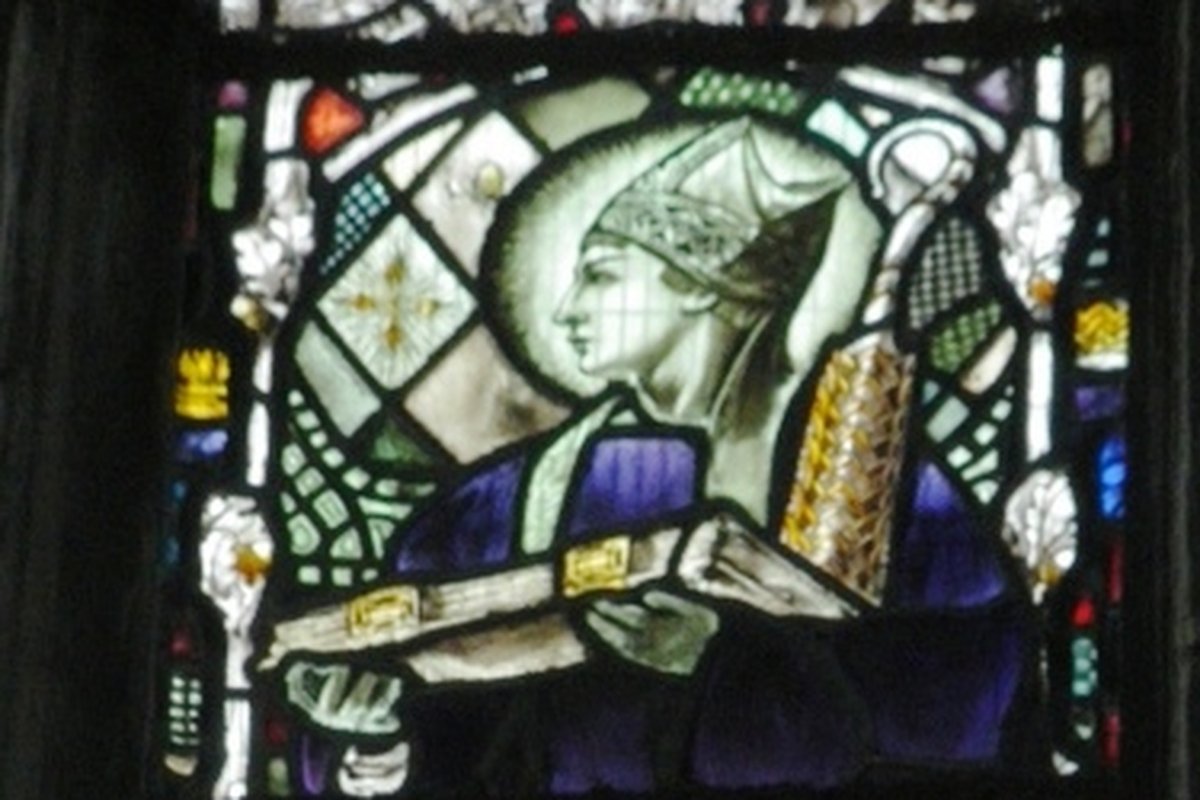
Christopher Whall, Saint Aidan (stained-glass window), Lady Chapel, Gloucester Cathedral — photograph public domain (CC0).
The king who translated for his own bishop
What happened next is one of the more vivid, specific details to survive from this period of English Christianity. Aidan arrived in Northumbria without a working command of the local language, and rather than waiting for the new bishop to learn it, King Oswald simply stepped in. According to the tradition recorded by the Venerable Bede in his Ecclesiastical History, Oswald himself acted as interpreter during Aidan's early preaching, translating the bishop's words for the crowds gathered to listen. It's a striking image — a reigning king standing beside a foreign monk, turning his sermons into words his own subjects could understand — and it says as much about Oswald's personal investment in the mission as it does about Aidan's willingness to start from nothing in a kingdom he barely knew.
Apostle of Northumbria
From that unlikely beginning, Aidan spent roughly the next sixteen years building a durable Christian presence across Northumbria. He used Lindisfarne as his base, trained local clergy, and by all surviving accounts preferred traveling on foot among the ordinary people of his diocese rather than keeping to the company of the powerful — a habit Bede singles out approvingly, contrasting it with churchmen more interested in status. Aidan's approach combined the ascetic, monastic style of Irish Christianity with a patient, personal style of evangelism, and the results outlasted him considerably: Lindisfarne went on to become one of the great centers of learning and manuscript production in early English Christianity, home a generation later to Saint Cuthbert and eventually to the illuminated Lindisfarne Gospels.
What Bede actually said, and what he didn't
It's worth being precise about the source here, since Aidan is a pre-congregation saint — venerated through ancient popular acclaim rather than any formal canonization process — and almost everything known about him comes from a single author. Bede's Ecclesiastical History of the English People, written decades after Aidan's death, is the core surviving record, and Bede's praise of Aidan's mildness and gentleness is warm and specific. But that praise belongs to Bede, describing Aidan from a distance of roughly eighty years — it isn't a quotation from Aidan himself, and no verified sayings of his own survive. Aidan died at Bamburgh on August 31, 651, and that date remains his feast today. No established patronage has attached itself to his name over the centuries — his legacy rests entirely on the sixteen years he spent walking Northumbria's roads, first with a king's voice standing in for his own.
A monastery built without much money
One detail Bede returns to more than once is how little Aidan cared for material wealth, even the wealth kings kept offering him. He is recorded giving away money and gifts given to him by Northumbrian nobility, including at least one occasion where he sold a horse King Oswine had presented to him and gave the proceeds to the poor — a decision that reportedly startled the king, who had meant the horse as a mark of royal favor. Lindisfarne itself, in its earliest years under Aidan, was built simply: modest wooden buildings rather than stone, reflecting the plain, ascetic style of Irish monasticism he'd brought with him from Iona rather than the grander building programs favored elsewhere in Christian Europe at the time. That simplicity was deliberate, not a lack of resources — kings were clearly willing to fund him generously, and he just as consistently redirected what they gave.
Twelve boys, and a school for the future Church
Aidan is also credited with founding a school at Lindisfarne to train a new generation of English clergy, rather than relying indefinitely on missionaries imported from Ireland and Iona. Among his students were twelve English boys he personally took on for education and formation, a detail Bede records because several of those students went on to become bishops themselves, extending Aidan's work into the next generation of the English Church. This mattered enormously for how quickly Christianity in Northumbria became self-sustaining rather than permanently dependent on outside missionaries — within a generation of Aidan's death, the kingdom had homegrown clergy trained in the tradition he had planted.
Two traditions meeting at one bishop's table
Aidan's Northumbria sat at a genuine crossroads between the Irish monastic Christianity he'd brought from Iona — with its own distinct customs around the dating of Easter, styles of monastic tonsure, and church governance — and the Roman practices being promoted elsewhere in England by missionaries connected to Canterbury. That tension wouldn't be formally resolved until after Aidan's death, at the Synod of Whitby in 664, when Northumbria's church officially adopted Roman rather than Irish customs. Aidan himself never lived to see that decision, and Bede, even while ultimately favoring the Roman side of the dispute, still treats Aidan with clear personal admiration — a sign of how much Aidan's evident holiness and pastoral effectiveness outweighed, for Bede at least, disagreements over calendar and custom.
Trivia
Who was Saint Aidan of Lindisfarne?
Why did King Oswald translate for Saint Aidan?
What is Lindisfarne, and why did Aidan choose it?
What did the Venerable Bede say about Saint Aidan?
When is the feast of Saint Aidan of Lindisfarne?
You May Also Like
Related Reading