Saint Remigius of Reims

A bishop at twenty-two
Remigius was elected Archbishop of Reims at the remarkably young age of 22, stepping into leadership of one of Gaul's most significant episcopal sees at a time when the Western Roman Empire was collapsing and Germanic kingdoms were carving up its former territory. He would go on to serve as bishop for decades — historical sources differ on the exact year of his death, with estimates generally landing around 533 — making him a stabilizing religious presence in Reims across an era of enormous political upheaval. But nothing in that long tenure would prove as consequential as a single ceremony he performed relatively early in his time as bishop: the baptism of a young, ambitious, and still-pagan Frankish king named Clovis.
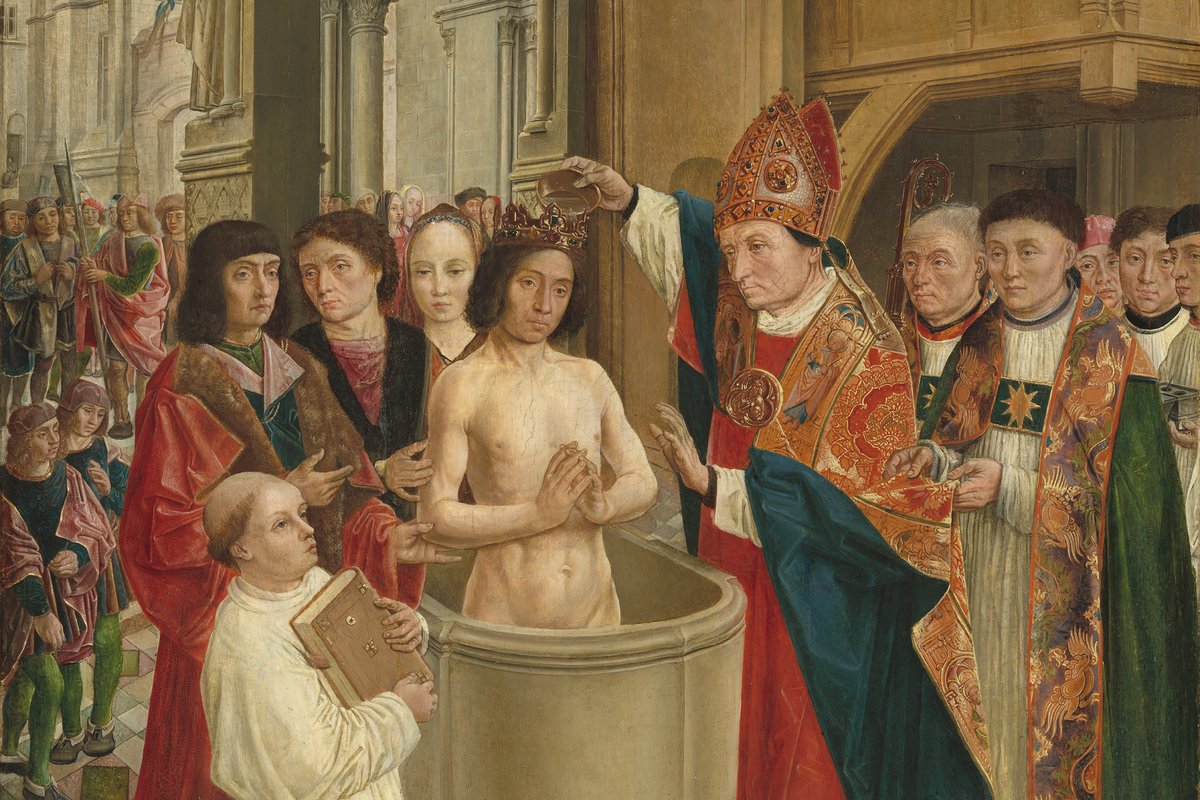
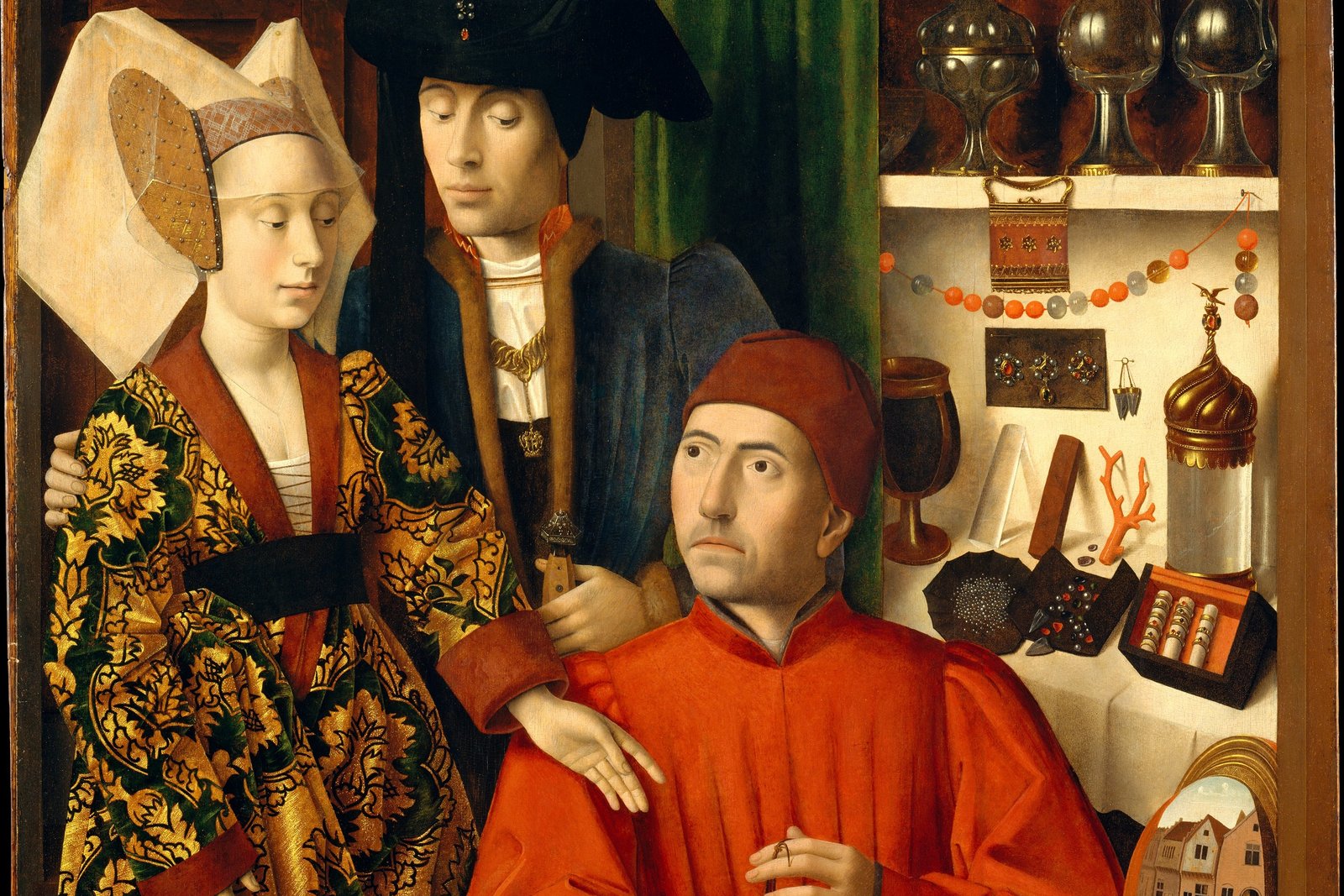
Master of Saint Giles, The Baptism of Clovis, c. 1500, National Gallery of Art, Washington — public domain (CC0).
Reims itself mattered to that outcome. The city had been a significant Roman administrative center in Gaul, and its bishop carried real regional weight even as imperial authority collapsed around it. A young man taking on that see wasn't stepping into an obscure country parish — he was inheriting one of the more prestigious and influential Christian sees left standing in a Gaul rapidly being carved up between Frankish, Visigothic, and Burgundian rulers, each with different loyalties and, in several cases, different versions of Christianity entirely.
The baptism that reshaped a kingdom
Clovis I had built the Franks into the dominant power in Gaul through years of military campaigning, but he remained a pagan king ruling over an increasingly Christian population. His wife, Clotilde — herself a Christian, and later venerated as a saint in her own right — had long urged him toward conversion, and after a decisive victory at the Battle of Tolbiac, Clovis followed through. Tradition places his baptism at Reims on Christmas Day, 496, with Remigius performing the ceremony while Clotilde and Saint Vedastus assisted; some modern scholars argue for a somewhat later date, closer to 508, since the surviving sources don't agree closely enough to settle the question definitively. What's not in dispute is the significance of the choice Clovis made: rather than adopting Arian Christianity, the form practiced by several neighboring Germanic kingdoms, he was baptized directly into Catholic, Nicene Christianity — arguably the single most consequential baptism in the story of early medieval Europe, and the moment that set the kingdom that would become France on a Catholic path it held to for the next fifteen centuries.
The choice between Catholic and Arian Christianity wasn't a minor theological footnote at the time — it was the fault line dividing Western Europe's Christian rulers. Arianism, named for the priest Arius, held that the Son was a created being, not co-eternal with the Father in the way the Council of Nicaea had defined; most of the Germanic kingdoms bordering Frankish territory, including the Visigoths and Ostrogoths, had adopted this Arian form of Christianity generations earlier. By having Clovis baptized directly into Nicene orthodoxy instead, Remigius put the Franks on the opposite side of that divide from their neighbors — a decision that, within a generation, gave Clovis's Catholic Frankish kingdom a rallying point that let it absorb Arian territories one by one, on the grounds that it alone represented the true faith shared with the pope in Rome.
Tradition also credits Remigius with a detail that would echo through French history for well over a thousand years: at the moment of the baptism, a dove is said to have descended bearing a vial of holy oil, afterward called the Sainte Ampoule, used to anoint Clovis. Later French kings, all the way through the eighteenth century, had this same oil — or oil said to be continuously replenished from it — used in their own coronation ceremonies at Reims, treating their kingship as a direct continuation of the anointing Remigius had supposedly performed. Like the famous baptismal rebuke attributed to him, the story of the dove and the vial belongs to pious legend rather than verified history, but it shows how thoroughly later generations wove Remigius into the sacred self-understanding of the French monarchy itself.
Clotilde's own role in bringing Clovis this far deserves more than a passing mention. A Burgundian princess and devout Christian, she had pressed her husband for years to abandon the gods of his ancestors, reportedly enduring his anger even after the early death of their first child, which Clovis initially blamed on her God rather than accepting it as an ordinary tragedy. Her patience mattered as much as any single battlefield victory: Clovis's eventual conversion owed at least as much to a wife's sustained, quiet persistence inside a still-pagan royal household as to Remigius's ceremony at the font, even though it's the bishop's name history attaches to the baptism itself. Clotilde was later venerated as a saint in her own right for exactly that long campaign of faith.
A famous line, loosely remembered
Popular retellings of the baptism often include a dramatic line supposedly spoken by Remigius to Clovis at the font, along the lines of telling the proud Frankish king to bow his head, worship what he had burned, and burn what he had worshipped. It's a vivid image, and it's been repeated for centuries — but the exact wording and even the precise attribution shift noticeably from one retelling to the next, which means it shouldn't be treated as a verified, word-for-word quotation. The safer way to describe it: according to a long-repeated tradition, Remigius said something along those lines as Clovis knelt before him, calling on the king to abandon the gods of his ancestors for the faith he was about to enter. Whatever his exact words, the substance of the moment — a pagan king submitting to baptism at a Catholic bishop's hands — is not in question.
A legacy measured in centuries, not years
Remigius lived to see the kingdom he'd helped bring into the Church grow into the dominant Christian power in the West, and generations of French kings after Clovis looked back to this baptism at Reims as the founding religious moment of their monarchy — so much so that Reims Cathedral became the traditional site for French coronations for centuries afterward. He was venerated as a saint through ancient popular acclaim rather than a formal canonization process, in keeping with the customs of his era, and his feast is kept on October 1, with a separate commemoration on January 13 in some calendars marking the later translation of his relics. It's a rare thing for one bishop's few minutes at a baptismal font to still be shaping a nation's religious identity a thousand years later — but that's exactly what Remigius's baptism of Clovis did.
Trivia
Who was Saint Remigius of Reims?
Why does the baptism of Clovis matter so much historically?
When exactly was Clovis baptized by Remigius?
Did Remigius really say 'Bow your head, proud Sicambrian' at the baptism?
When is the feast of Saint Remigius?
You May Also Like
Related Reading