Saint Robert Bellarmine

A nephew of one pope, teacher to a future generation
Robert Bellarmine was born in Montepulciano, Italy, in 1542, the nephew of Pope Marcellus II, though a family connection to the papacy did little to smooth his own path — he entered the newly founded Jesuit order against some family resistance and built his early reputation as a teacher rather than a courtier. He eventually became rector of the Roman College, the Jesuits' flagship school in Rome, at a time when the order was becoming one of the Catholic Church's most important intellectual engines in its response to the Protestant Reformation.
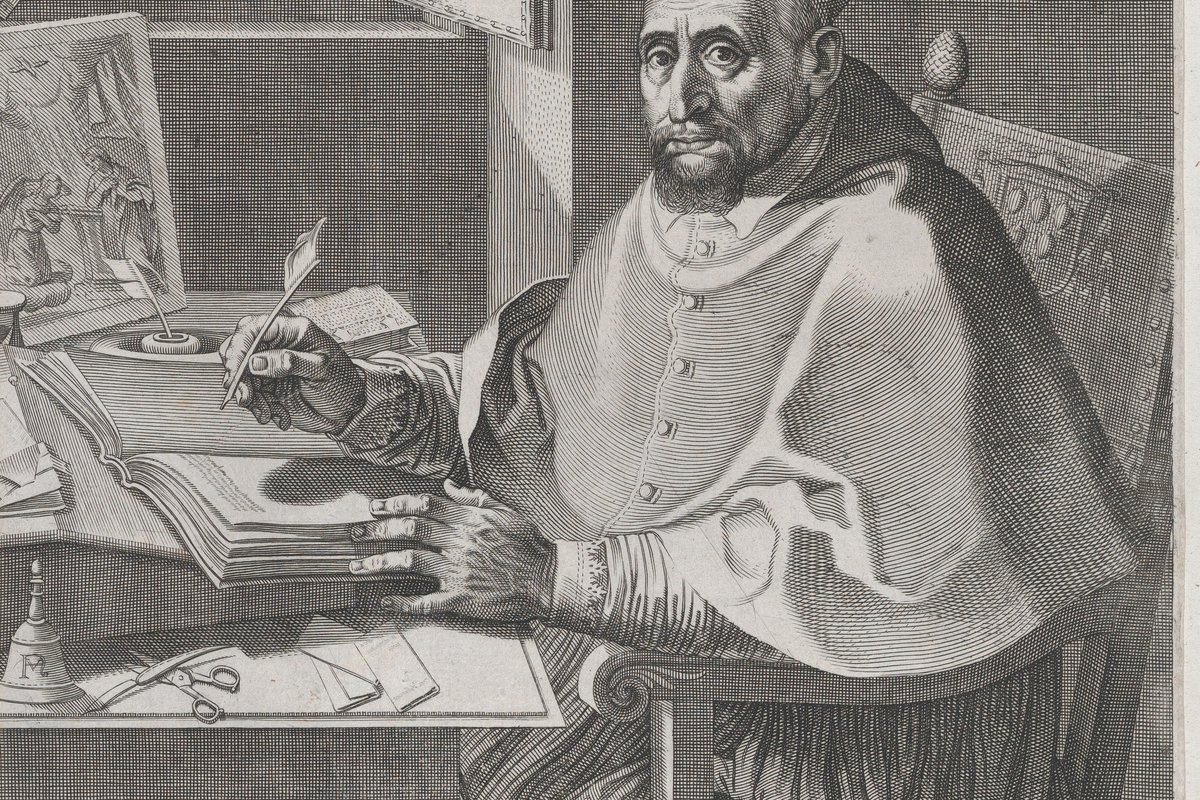
Francesco Villamena, Cardinal Roberto Bellarmino at his desk, writing, 1604, Metropolitan Museum of Art — public domain.
Bellarmine's own academic gifts had already made him a sought-after teacher years earlier, when he lectured on theology at Louvain, in the Spanish Netherlands, becoming the first Jesuit to hold a professorship at the university there. His lectures reportedly drew large crowds, including Protestant students curious to hear a Catholic scholar engage their own arguments directly rather than simply dismissing them — a habit of careful, respectful engagement with opposing views that would define his entire later career, even as he remained an uncompromising defender of Catholic doctrine on every substantive point.
A systematic defense of Catholic doctrine
Between 1586 and 1593, Bellarmine produced the work that would define his scholarly reputation: the Disputationes de Controversiis Christianae Fidei, a massive, methodical defense of Catholic teaching against the arguments Protestant reformers had been making for decades. Rather than simply restating doctrine, Bellarmine engaged reformers' specific objections point by point — much as his fellow Jesuit Saint Peter Canisius had done a generation earlier through his own widely used catechisms — and the work became a standard reference for Catholic theologians for generations afterward — thorough enough that some Protestant writers of the era devoted entire treatises just to responding to him directly.
Bellarmine's influence extended well beyond his writing desk. He was made a cardinal in 1599 and served on numerous Vatican commissions, including the body that produced the revised Clementine edition of the Latin Vulgate Bible. He was also seriously considered for the papacy itself in the conclaves following the deaths of both Clement VIII and Leo XI, though he was passed over each time — accounts suggest his reputation for personal austerity and blunt honesty, admired in a theologian, made some cardinals wary of him as a potential pope. He continued instead in roles that let him shape Church teaching and policy directly, without ever holding the papal office himself.
The warning delivered to Galileo
Bellarmine's other lasting historical footnote came late in his career, and it has nothing to do with Reformation-era polemics. As a trusted consultor to the Holy Office, he was tasked in 1616 with personally informing Galileo Galilei of the Church's position on heliocentrism, the theory that the Earth orbits the Sun rather than the reverse. Bellarmine delivered the admonition that Galileo could discuss heliocentrism as a mathematical hypothesis useful for calculation, but not present it as an established physical fact — a real, carefully documented meeting between the Church's foremost theologian and its most famous scientific critic. It's worth presenting plainly rather than glossing over: the episode captures a genuine, unresolved tension between ecclesiastical authority and emerging scientific evidence, one that wouldn't be fully worked through by the Church for centuries afterward.
It's worth being precise about Bellarmine's actual role, since the episode is often oversimplified. The 1616 admonition wasn't a formal condemnation or trial — that came later, in 1633, well after Bellarmine's own death, when Galileo was tried and condemned by a different set of Church officials for advocating heliocentrism as established fact rather than treating it merely as a hypothesis. Bellarmine's own private correspondence from the period shows a more nuanced position than he's sometimes given credit for: he acknowledged that if solid proof of heliocentrism were ever produced, theologians would need to reconsider how certain biblical passages were interpreted, rather than simply rejecting the evidence outright. He died three years before Galileo's eventual trial, and modern historians generally treat his own approach to the question as considerably more careful than the harsher judgment Galileo would face in 1633.
Canonization and a Doctor's title
Bellarmine died in Rome in 1621. He was beatified in 1923, canonized in 1930, and named a Doctor of the Church the following year, in 1931, by Pope Pius XI. His feast is kept on September 17. Alongside his scholarly legacy, he's remembered today as patron of catechists, honoring his own plainly written catechism texts meant for ordinary believers rather than fellow theologians, and of canonists, reflecting the rigor of his defense of Church doctrine and law across a body of work that shaped Catholic theology for centuries after his death.
Alongside the Disputationes, Bellarmine wrote two catechisms intended for ordinary use — one for teachers and one for children — that were translated into dozens of languages and used in Catholic instruction across the world for generations after his death, well into the twentieth century in some regions. It's a detail worth setting beside his reputation as a formidable academic controversialist: the same mind capable of a massive, technical, multi-volume theological rebuttal of the Reformation also sat down to write simple, plainly worded lessons for children learning the basics of their faith for the first time.
Trivia
Who was Saint Robert Bellarmine?
What is the Disputationes de Controversiis?
What was Bellarmine's role in the Galileo affair?
Why is Robert Bellarmine the patron saint of catechists and canonists?
Why is Bellarmine a Doctor of the Church?
You May Also Like

Related Reading