Saint Christopher


A name that describes a purpose
Christopher's name carries its own explanation: from the Greek Christophoros, joining Christo ("Christ") and phero ("to bear" or "to carry"), it translates directly to "Christ-bearer." Unusually for a saint, the name isn't a later honorific added to commemorate an achievement — in the tradition surrounding him, it describes the central event of the legend itself, almost as if the story existed to explain the name.
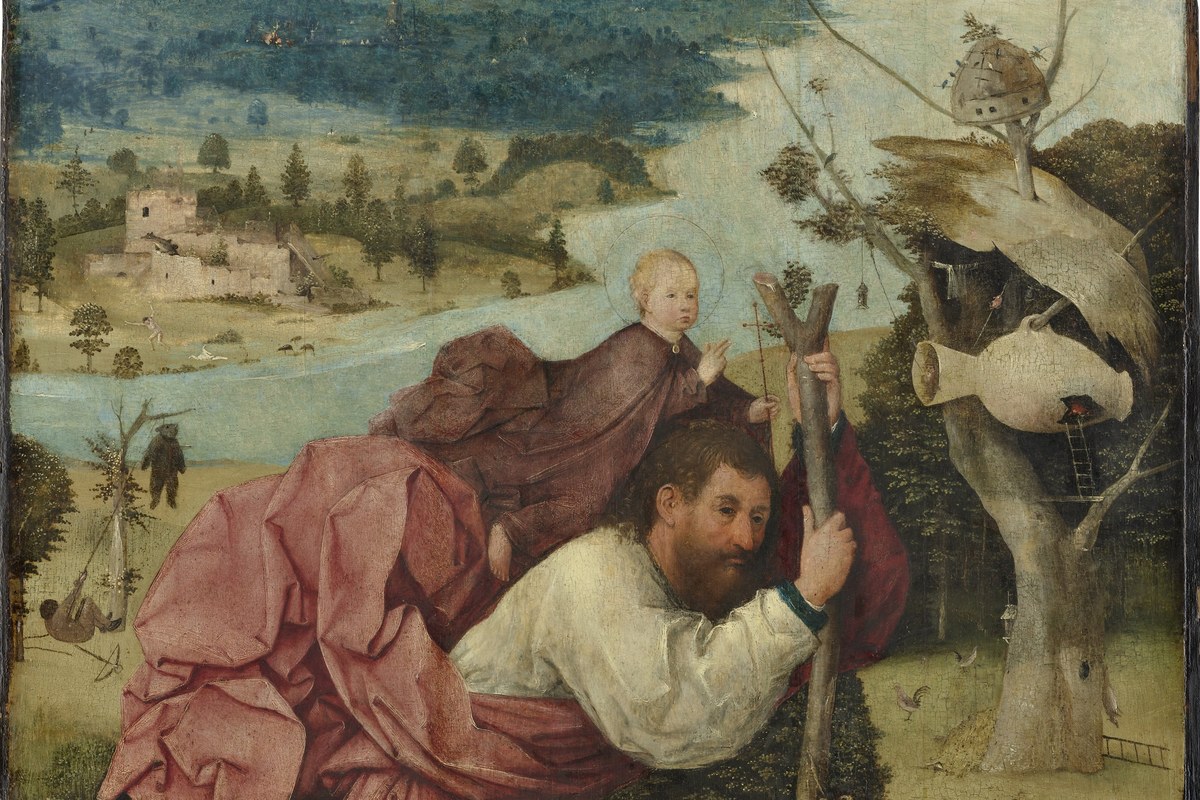
Hieronymus Bosch, "Saint Christopher," c. 1500-1516 — public domain.
Searching for the mightiest king to serve
The Golden Legend doesn't begin with Christopher already at the river. It opens earlier, with a giant of a man — some versions give him the name Reprobus before his conversion — who resolves to serve only the single greatest king in the world. He first attaches himself to a powerful earthly king, but abandons him on discovering the king fears the devil; he then seeks out the devil himself, only to abandon him in turn on realizing that even the devil fears the sign of the cross and flees from Christ's name. Searching for someone greater still, he's directed to a hermit living near a dangerous river ford, who instructs him that the way to serve Christ, the only king powerful enough to warrant his devotion, is through prayer and fasting. Christopher, according to the legend, protests that this kind of religious discipline isn't in his nature — but the hermit offers him an alternative suited to his enormous strength: using his size to help travelers cross the perilous river nearby, a service the hermit assures him Christ will recognize as faithfully as any fast or vigil.
Carrying strangers, one crossing at a time
The Golden Legend, a widely read medieval collection of saints' lives, describes Christopher as a man of enormous size and strength who took on an unusual vocation: using his physical strength to carry travelers across a river too dangerous for them to cross alone. It's presented as ordinary, repeated service — day after day, stranger after stranger, with no suggestion that any one crossing would be different from the last.
The child who grew too heavy to carry
Until one day it was. According to the legend, Christopher was asked by a small child to carry him across, and partway through the crossing, the child began to grow impossibly heavy — heavier, the story emphasizes, than Christopher had ever felt in his life, as though he were carrying the weight of the entire world. Reaching the far shore, the child revealed himself to be Jesus, explaining that the weight Christopher had felt was exactly that: the weight of the world and its Creator, carried in a single small form. It's this scene, more than any other, that hero images like the one above return to again and again — Christopher mid-river, straining under a burden that looks too small to explain.
A saint older than his best-known story
Setting the legend aside, there is a genuine, much older tradition behind the name Christopher: early Christian sources, including a fifth-century account, record a martyr of that name who died during the persecutions under the Roman emperor Decius in the third century, in the region of Lycia in modern-day Turkey. The details of his actual life are thin and often contradictory across the earliest surviving texts, which is precisely the kind of gap the Golden Legend's much richer, more vivid river-crossing story eventually filled in for medieval readers centuries later — a pattern common to many early martyrs whose historical record is sparse but whose popular devotion grew rich with narrative detail over time. Byzantine and other Eastern Christian art occasionally depicted Christopher with the head of a dog, a strange and much-debated image tied to a separate strand of legend describing him as a convert from a distant, semi-legendary tribe of dog-headed people — a tradition largely unfamiliar in the Western Church, where the river-crossing image became by far the dominant one.
Medieval devotion also grouped Christopher among the Fourteen Holy Helpers, a set of saints especially invoked together against specific dangers and sudden death, reflecting how central the fear of an unprepared, unexpected death was to late medieval religious life — a traveler crossing dangerous terrain, in that world, faced genuinely higher odds of dying suddenly and far from home than most people do today, which helps explain why a patron specifically for safe travel took on such outsized popular importance.
Still carried today, calendar or not
That legend made Christopher patron saint of travelers, a role reflected even now in the St. Christopher medals and car ornaments many people still carry, often without knowing the full story behind them. In the 1969 post-Vatican II revision of the Church's universal liturgical calendar, he was formally removed from that official list — a decision that reflected uncertainty about the historical details of his life, not a rejection of his sainthood. He remains venerated today, which is exactly why the medals never disappeared: a saint's popular devotion doesn't require a place on a calendar to keep traveling with the people who trust him. His feast day, kept by those who still observe it, falls on July 25, and the custom of looking at a Saint Christopher image before setting out on a journey — a folk practice holding that no one who does so will die that day without warning — has persisted in Catholic culture for centuries, outlasting even the saint's own removal from the official Church calendar.
Trivia
What does the name 'Christopher' mean?
What is the legend of Saint Christopher?
What is Saint Christopher the patron saint of?
Is Saint Christopher still on the Church's official calendar?
Related Reading