Saint Teresa of Calcutta

Born far from the city she'd become known for
Her early years gave little hint of the global recognition to come. She grew up in a devout Albanian Catholic family in Skopje, and by her own account felt drawn to religious life and to missionary work from a young age, inspired partly by letters from missionaries serving abroad that circulated in her parish. At eighteen she left home for the Loreto novitiate in Ireland to learn English, the language in which the Sisters of Loreto conducted their teaching missions, and from there sailed on to India — a journey that meant, in practice, that she would never again see her mother or sister in person. She took her final vows as a Loreto Sister in 1937, having taken the religious name Teresa after Saint Thérèse of Lisieux, a patronage she carried with her into the decades of teaching, and later of direct service to the poor, that followed.
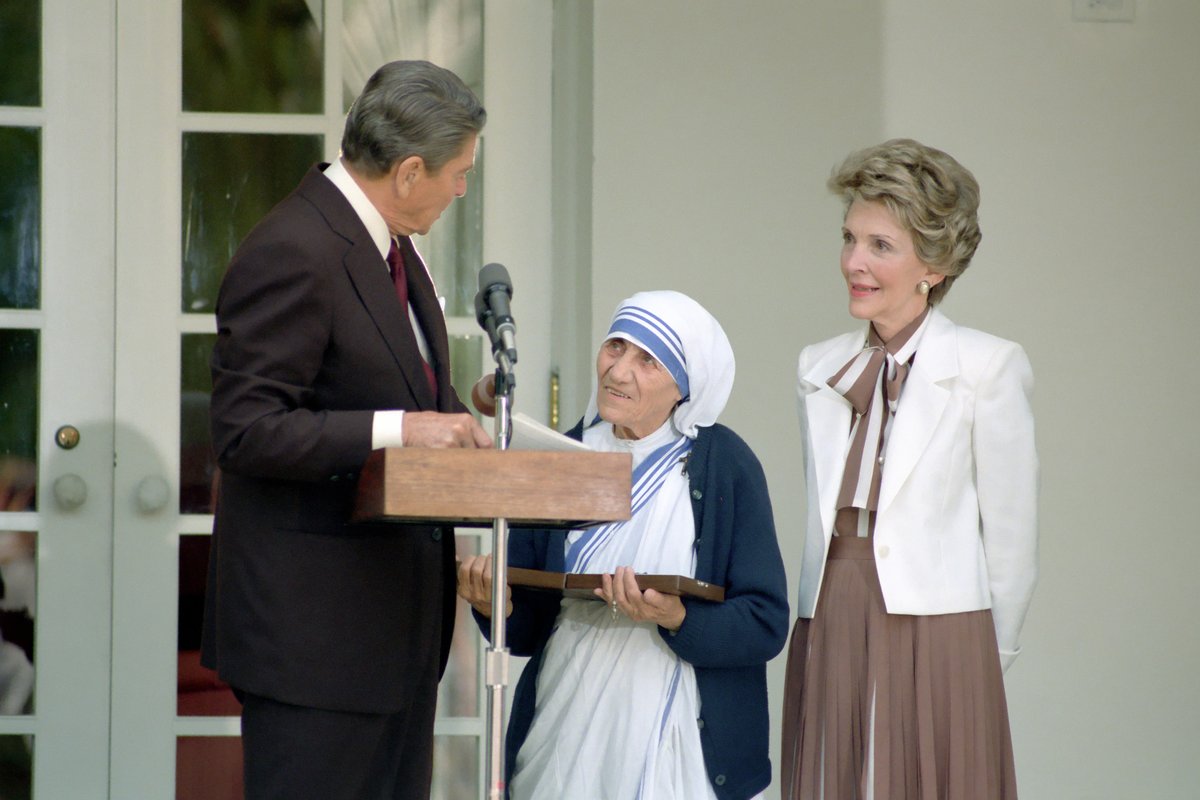
President Reagan presents Mother Teresa with the Medal of Freedom, White House Rose Garden, June 20, 1985 — White House Photographic Office, public domain via National Archives/DPLA.
Teresa of Calcutta was born Anjezë Gonxhe Bojaxhiu in 1910 in Skopje, then part of the Ottoman Empire and now the capital of North Macedonia — a detail that surprises people who assume, given her name, that she was Indian by birth. She joined the Sisters of Loreto as a young woman and was sent to India, where she spent nearly two decades teaching at a convent school in Calcutta, rising eventually to serve as its principal. By any ordinary measure, it was already a full and respectable religious vocation.
A "call within a call"
In 1946, while traveling by train, she described experiencing what she and others later called a "call within a call" — a further, more specific summons within her existing religious vocation, directing her to leave the security of convent teaching and go live directly among Calcutta's poorest and most abandoned people. It took a few years to secure the necessary permissions and training, but in 1950 she founded the Missionaries of Charity, a new religious order dedicated specifically to caring for the destitute and the dying in the city's slums.
From one house in Calcutta to a worldwide order
What began as a small community working out of very limited means in Calcutta grew, over the following decades, into a religious congregation with a presence in dozens of countries around the world, running homes for the dying, orphanages, and care centers for people with leprosy and other conditions that left them abandoned by family or society. One of her earliest and best-known projects, Nirmal Hriday ("Pure Heart"), opened in a former Hindu temple building in Calcutta to give the dying a clean bed and someone's presence in their final hours, regardless of religion or background — a mission she described simply as helping people die with dignity, whatever their beliefs.
Mother Teresa herself became one of the most recognized religious figures of the 20th century, awarded the Nobel Peace Prize in 1979 for that work, though she remained personally committed to the same direct, hands-on care for the poor that had defined her calling from the start; she reportedly asked that the funds normally spent on the Nobel banquet be redirected to feed the poor instead. Her work wasn't without critics, who over the years raised questions about the medical standards of her homes and aspects of how the order was run — a debate that continues in some circles today — but it did little to slow the growth of a congregation that, by the time of her death, had spread across more than a hundred countries.
Decades after her death, published letters revealed that Mother Teresa privately experienced a long, painful sense of spiritual dryness and absence of felt closeness to God for much of her later ministry — what spiritual writers call a "dark night of the soul." She kept that struggle almost entirely hidden from the public she served, continuing her work without any visible sign of the doubt she wrestled with in private, a detail many later found made her public perseverance even more striking rather than less.
Canonized before an enormous crowd in Rome
Mother Teresa died in Calcutta in 1997 and was canonized on September 4, 2016, by Pope Francis, formally becoming Saint Teresa of Calcutta. In his canonization homily, Francis captured what he saw as the heart of her life's work: "For Mother Teresa, mercy was the 'salt' which gave flavour to her work, it was the 'light' which shone in the darkness of the many who no longer had tears to shed for their poverty and suffering." Her feast is now kept on September 5, the anniversary of her death, and she has no single formal universal patronage — her legacy lives instead through the religious order she founded, still active today, and through her enduring reputation as one of the modern Church's clearest examples of mercy in action, one that places her, in the popular imagination, alongside other modern figures of hands-on charity such as Saint John of God.
Trivia
What made Mother Teresa decide to leave her convent teaching post?
What does the Missionaries of Charity actually do?
When was Mother Teresa canonized, and what is her official saint name?
What did Pope Francis say about her at her canonization?
Is Mother Teresa the patron saint of a specific cause?
You May Also Like
Related Reading