Saint Theodore the Studite

A family already marked by exile
Theodore was born around 759 into a well-connected Constantinopolitan family that had already tasted the cost of resisting imperial religious policy once before: his uncle, Plato, had been persecuted during the first wave of iconoclasm decades earlier and became a monk in response. Theodore followed a similar path, entering monastic life under Plato's guidance at the family estate of Sakkoudion in Bithynia before eventually moving, along with much of that community, to take charge of the Stoudios Monastery in Constantinople around 799. The move from a rural family monastery to one of the great urban houses of the empire's capital put Theodore, almost overnight, at the center of Byzantine religious life rather than at its edge.
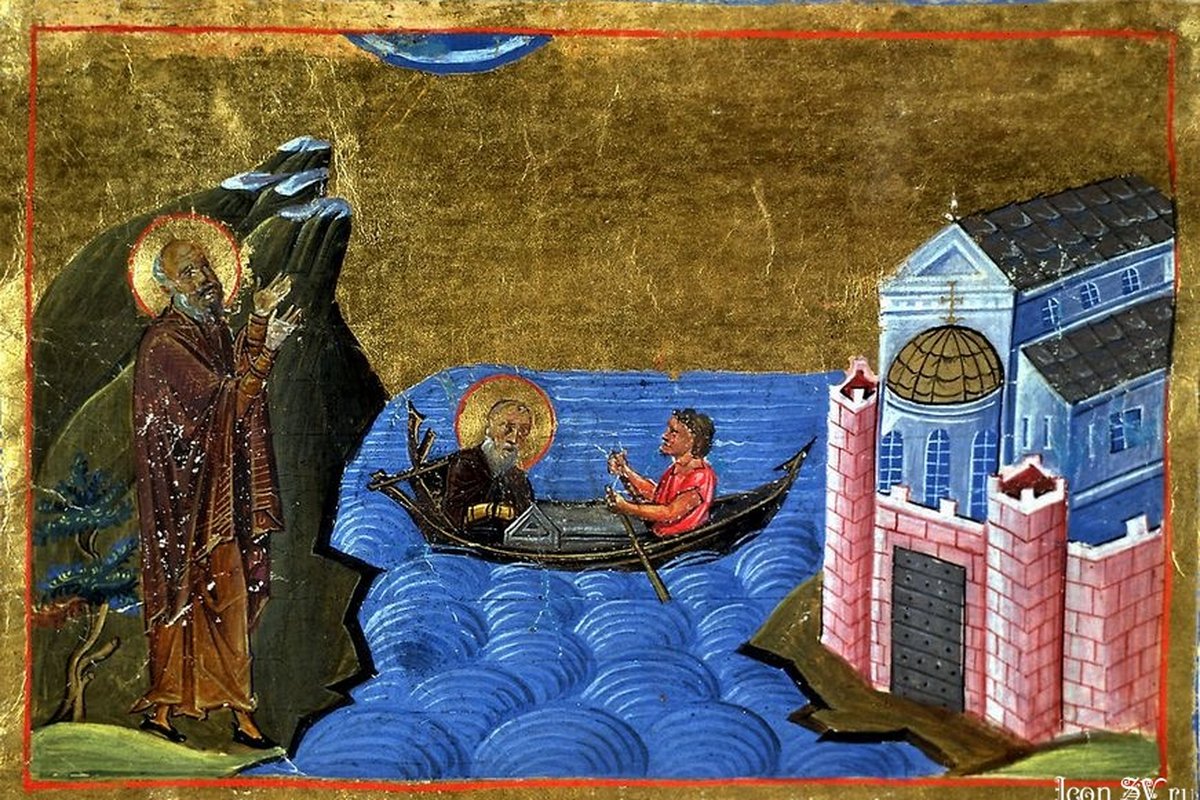
Menologion of Basil II, 11th-century Byzantine miniature depicting the Stoudios Monastery, Vatican Library — public domain.
Turning a monastery into a discipline
Theodore's defining institutional achievement was his reorganization of the Stoudios Monastery into a highly disciplined community, with a level of structure and rigor that went well beyond typical monastic practice of the time. He set firm rules governing manual labor, silence, communal prayer, and the copying of manuscripts — the Stoudios scriptorium became one of the most productive text-copying centers of the Byzantine world under his direction, helping preserve classical and patristic texts that might otherwise have been lost. This wasn't reform for its own sake — it produced a model of religious life sturdy enough to shape Byzantine monasticism for centuries afterward, and its influence eventually reached into Russian monastic practice as well. Few individual abbots in Church history can claim that kind of durable, wide-reaching institutional legacy, and it alone would make Theodore a significant figure even without what came next.
Defying an emperor over sacred images
What came next was iconoclasm — specifically its second wave, a renewed imperial campaign against the veneration of religious images that put the Byzantine emperor directly at odds with a large portion of the Church's monastic and clerical establishment. The underlying dispute was theological as much as political: defenders of icons argued that because Christ had truly taken on human flesh, he could legitimately be depicted in art, and that honoring an image of Christ or the saints was a way of honoring the person represented, not idol worship. Iconoclast emperors, by contrast, saw the veneration of painted images as dangerously close to the idolatry condemned in the Old Testament, and moved to have icons destroyed or removed from churches across the empire.
The debate had already been settled once, in Theodore's own lifetime, at the Second Council of Nicaea in 787, which affirmed that icons could be venerated (honored) without that honor amounting to the worship (adoration) reserved for God alone — a distinction the council insisted on carefully, and one Theodore would spend much of his later life defending against emperors who tried to reopen the question by force rather than by theological argument.
Theodore became one of the fiercest monastic opponents of that campaign, and he paid for it directly and repeatedly: exile, mistreatment, and prolonged conflict with imperial authority, all stemming from his refusal to accept that the emperor had any legitimate say over Church doctrine on the veneration of icons. He had already spoken out earlier in his life against a separate scandal involving the emperor's uncanonical remarriage, which shows the pattern was not new — Theodore consistently treated questions of Church discipline and doctrine as outside imperial jurisdiction, regardless of which emperor was on the throne or what the political cost of saying so might be. He kept contesting that authority across multiple rounds of exile, using the time in banishment to write a stream of letters encouraging scattered monks and clergy to hold firm, until his death.
A death in exile, a legacy on both sides of a divide
Theodore died on November 11, 826, having spent a substantial portion of his later life paying the price for that conflict, roughly seven years of it in direct exile. His feast is kept on November 11 in the Greek calendar, while the Roman Martyrology lists November 12 instead — a small discrepancy, though nowhere near as significant as the fact that his memory is honored on both sides of the line at all. Theodore's canonization, like so many saints from the first millennium, came through ancient and continuous veneration rather than any later formal process, and Rome has never conferred on him the title of Doctor of the Church, though the Eastern Church regards him as a major monastic legislator and Church Father figure in his own right, and includes many of his hymns and catechetical writings in ongoing liturgical use. He holds no established Western patronage either. What he left instead was a monastery whose discipline outlived empires, and a documented record of refusing to let political power settle a question that, in his view, was never the emperor's to decide.
Trivia
Who was Saint Theodore the Studite?
What was Byzantine iconoclasm, and why did Theodore oppose it?
What did Saint Theodore do at the Stoudios Monastery?
When did Saint Theodore the Studite die, and when is his feast?
Is Saint Theodore the Studite recognized as a Doctor of the Church?
You May Also Like
Related Reading