Saint Victoria of Albitina

An edict that made Sunday Mass a crime
In February 304 AD, the Roman Emperor Diocletian's ongoing persecution of Christians escalated with a new edict banning the possession of Christian scripture and, critically, forbidding Christian communities from gathering at all — a direct strike at the weekly Sunday assembly that stood at the center of Christian life across the empire. In the small North African town of Abitina, not far from Carthage, a community of Christians decided to keep meeting anyway, holding their Sunday Eucharistic celebration in defiance of the new law. Roman officials caught forty-nine of them in the act and arrested the entire group together.
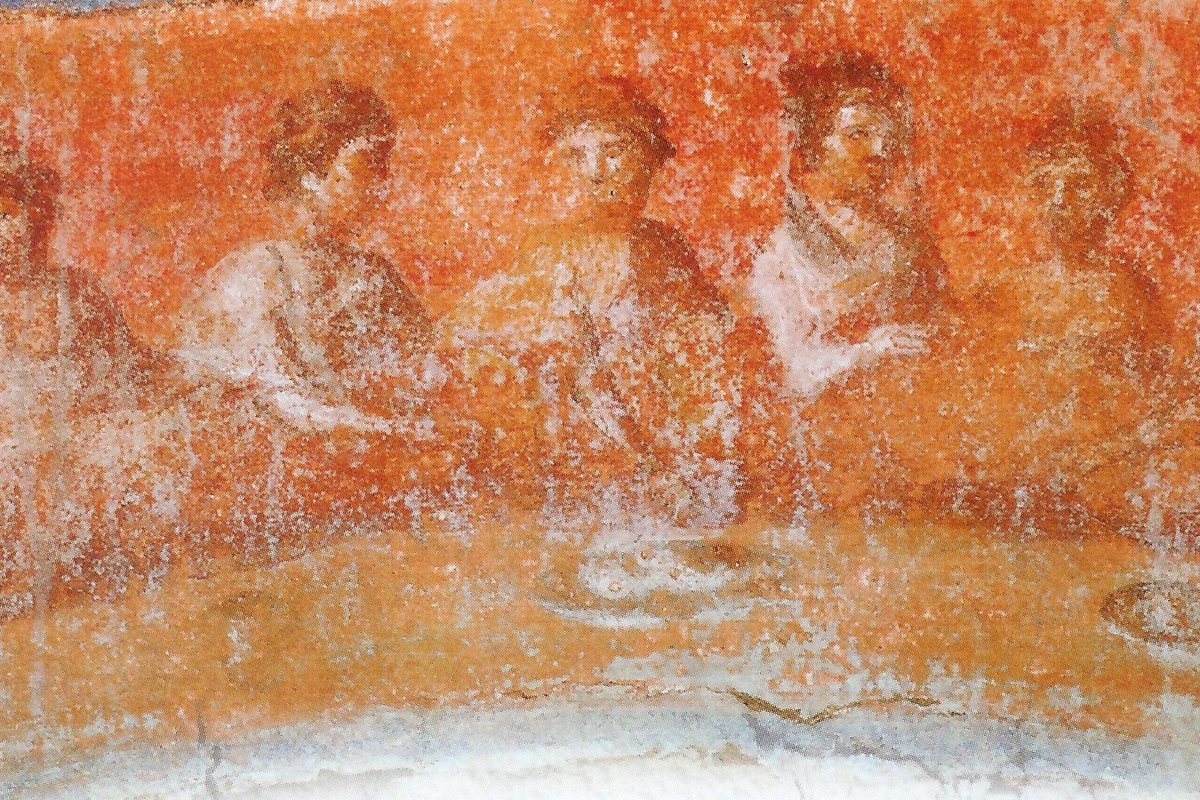
Fractio Panis (Breaking of Bread) fresco, Catacomb of Priscilla, Rome, 2nd–4th century — public domain. No individual depiction of Victoria of Albitina or the Abitinian martyrs is known to survive; this genuine early-Christian fresco of a communal Eucharistic meal was chosen as an honest, period-appropriate substitute.
A young woman's first act of defiance
Victoria's individual story, as preserved in the group's Acts, begins even before her arrest with the group. She came from a family that had arranged a marriage for her to a pagan husband, a match she wanted no part of because of her Christian commitment — and rather than go through with it, she reportedly escaped by jumping from a window of her family's house. It's a striking detail to survive in an ancient legal record, and it sets up the rest of her story: when she was later swept up with the Abitina community and her family pressed her, even during the legal proceedings, to renounce her faith and return to them, she held firm, affirming her Christian identity and refusing to abandon the group she'd been arrested alongside.
A trial that pitted her against her own brother
Victoria's family didn't let go of her easily even once she was under arrest. Her own brother, still a pagan, took part in the proceedings against her, and the presiding judge — apparently swayed by her noble birth and reluctant to condemn her along with the rest of the group — offered to release her into her brother's custody rather than sentence her with the others. Victoria refused the offer, arguing her own case before the court rather than accepting a way out that would have separated her from the community she'd been arrested with, and insisting she owed her obedience to God rather than to any earthly authority, family included.
Why the Great Persecution targeted the Eucharist specifically
Diocletian's campaign against Christianity, which historians now call the Great Persecution, unfolded in stages rather than all at once. Earlier edicts had ordered the destruction of church buildings and Christian texts and stripped Christians of legal standing; this later measure went further, striking directly at the act of gathering itself. That distinction mattered enormously to the Christians of Abitina. For them, the Sunday assembly wasn't an optional devotional extra layered on top of private faith — it was understood as the source from which the rest of Christian life flowed, the weekly re-enactment of the Last Supper that bound an otherwise scattered community into one body. Banning it wasn't a minor administrative inconvenience; it was, in the community's own eyes, being asked to let their faith quietly starve to death. That is exactly the stakes behind the line "we cannot live without the Sunday assembly" — not defiance for its own sake, but a statement that the thing being banned was, to them, literally indispensable.
A trial record that historians actually trust
What makes the Martyrs of Abitina case unusually well documented, compared to so many ancient martyr accounts built largely on later legend, is the survival of the Acta Saturnini — a trial record considered by scholars to preserve genuinely early, transcript-style material close to the actual proceedings, rather than a devotional composition written centuries afterward. The most celebrated line to come out of it is a piece of defiant Latin testimony, Sine dominico non possumus — roughly, "We cannot live without the Sunday [assembly]" — spoken during questioning to explain why the community had kept gathering despite the ban. That line is attributed in the record to a member of the group named Emeritus, or presented as characteristic of the group's shared testimony, not assigned specifically to Victoria, so it belongs to the Abitina martyrs collectively rather than to her individually.
Death and veneration
Victoria died along with the rest of the group, traditionally dated to February 12, 304 AD, having refused every opportunity — including pressure from her own family, a pressure none of the other captured Christians faced in quite the same personal form — to separate herself from the community she'd chosen over the marriage and household she'd been born into.
Feast day and how she's remembered
The Martyrs of Abitina are commemorated together, with the group's feast generally kept around February 11, and Victoria is sometimes listed individually on December 23 in certain local calendars. No specific individual patronage has developed around her the way it has for some other early martyrs covered on this blog — the Abitina story has always been remembered primarily as a group witness, forty-nine ordinary North African Christians who treated the Sunday Eucharist as something worth dying to keep, with Victoria's escape from an arranged marriage standing out as the one clearly individual thread inside that larger, collective testimony.
A pattern that repeats across the early Church
Group martyrdoms like this one are not an isolated case in the history of the persecuted early Church. Around the same broad era, a very different empire-wide crackdown produced the story told in this blog's article on the Forty Martyrs of Sebaste, soldiers condemned together for their faith on a frozen lake in Armenia. What both accounts share is a community, not a lone individual, standing at the center of the story — a reminder that a great deal of early Christian courage was communal rather than solitary, forged among people who happened to be arrested, or stationed, or born into the same small circle, and who chose to stand together rather than separately when the test came.
Modern popes have occasionally pointed back to Abitina specifically as a touchstone when speaking about the importance of Sunday worship, treating "sine dominico non possumus" as a phrase still worth quoting to describe what the Eucharist means to a community of believers, sixteen centuries after an anonymous North African Christian first said some version of it under interrogation.
Trivia
Who was Saint Victoria of Albitina?
What were the Martyrs of Abitina, and why were they arrested?
What is the famous line 'Sine dominico non possumus,' and who actually said it?
Did Victoria personally declare 'I am a Christian' in the trial record?
Is Saint Victoria of Albitina recognized with any specific individual patronage?
You May Also Like
Related Reading