Saint Virgil of Salzburg

An Irish monk on the Continent
Virgil was born around 700, likely in Ireland, and entered monastic life there, eventually becoming abbot of Aghaboe. Like a number of Irish monk-scholars of the seventh and eighth centuries, he left Ireland for the Continent, joining a broader wave of Irish missionary activity that helped shape the early medieval Church across Frankish and Germanic territory. He arrived at the court of Pepin the Short, the Frankish ruler, around 743, and from there made his way to Salzburg, where he became abbot of the monastery of St. Peter and, by around 766 or 767, bishop of Salzburg itself — a post he held for the rest of his life.
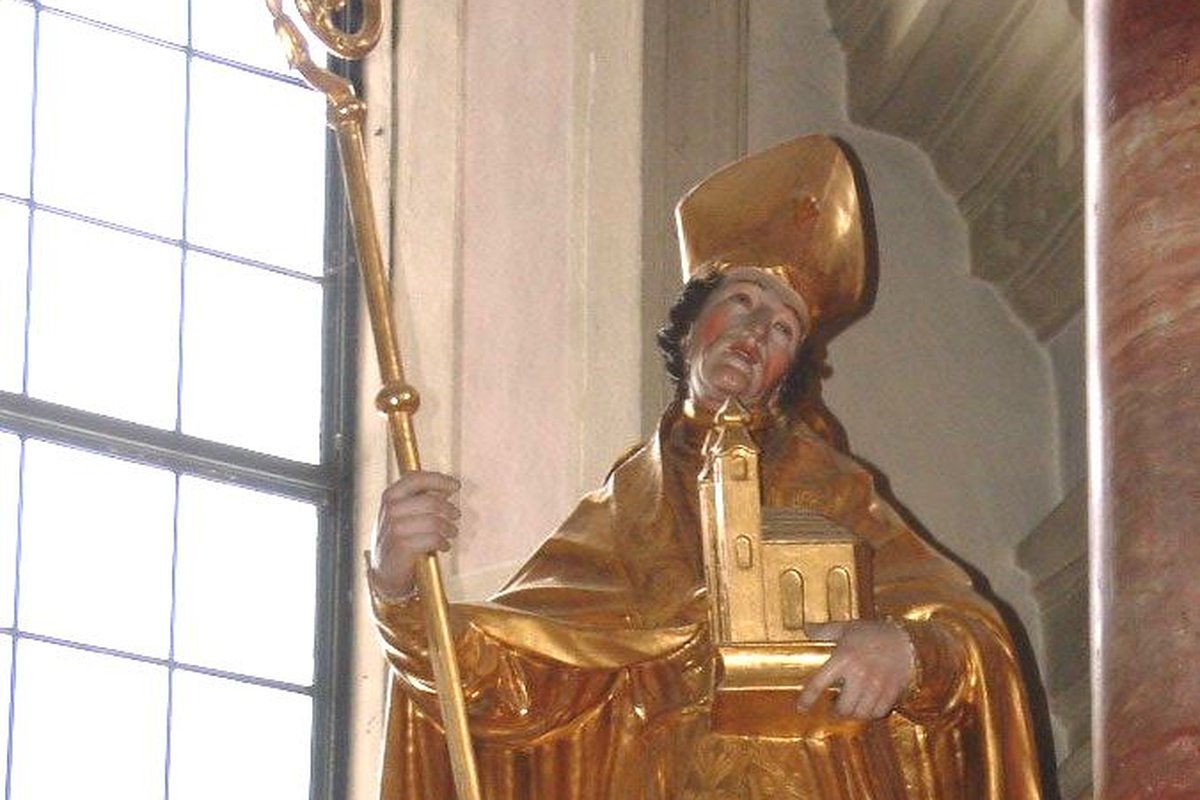
Statue of Saint Virgil by Joseph Haid, high altar, parish church of St. Stephen, Kirchdorf in Tirol, Austria; photographed by Leukentaler, 2003 — public domain.
A dispute over a garbled baptism
Virgil's tenure in Salzburg put him on a collision course, twice, with Saint Boniface, the English-born "Apostle of Germany" and one of the most influential churchmen of the era, already known on this blog for his own dramatic missionary career. The first dispute was narrowly technical but practically important: a priest in Bavaria, apparently with shaky Latin, had been baptizing people using a garbled formula — "baptizo te in nomine patria et filia et spiritu sancta" instead of the correct wording invoking the Father, Son, and Holy Spirit. Boniface considered these baptisms invalid and wanted them redone. Virgil disagreed, arguing that the priest's evident intention to baptize in the name of the Trinity was what mattered, not his faulty grammar. The matter went to Pope Zachary in Rome, who ruled in Virgil's favor — the baptisms stood.
The dispute that popular memory gets wrong
The second and far more famous dispute is also the one most often retold badly. The popular version has Virgil condemned as a heretic simply for believing the Earth was round — a tidy story that casts medieval Christianity as scientifically backward and Virgil as centuries ahead of his time. That framing doesn't hold up. A spherical Earth was already common, unremarkable knowledge among educated Christians in the eighth century, a legacy of classical astronomy transmitted through writers like Isidore of Seville, whose own encyclopedic Etymologiae — and who is, like Boniface, covered elsewhere on this blog — simply assumed a round Earth without controversy. Nobody in Rome needed persuading on that point, and nothing in the surviving record suggests Boniface challenged Virgil over the Earth's shape as such.
What Boniface actually reported to Pope Zachary was that Virgil taught the existence of "antipodes" — other lands and peoples living on the opposite side of the globe, in a hemisphere seemingly cut off from any possible contact with the known world. The real theological question this raised wasn't geographic; it was about the unity of the human family and the reach of salvation history. If there were people living in a hemisphere no missionary could ever reach, were they descended from Adam? Could Christ's redemption extend to them at all? That's a genuinely serious question by the theological standards of the time, and it's the concern Zachary's surviving letter actually addresses — a conditional instruction that, if it could be clearly established that Virgil held this teaching, a council should be convened and Virgil removed from his priestly office. It's a real document, and a real warning, but a conditional one, not a verdict.
An affair that may never have been as serious as it sounds
What happened next is genuinely uncertain, and it's worth resisting the temptation to flatten that uncertainty into a clean, dramatic "heresy trial" narrative. There's no clear record that the council Zachary described was ever convened, or that Virgil was formally censured at all. Some historians read the episode as Boniface misunderstanding or overstating a more careful theological position Virgil actually held about the antipodes question; others simply note how thin the surviving evidence is on either side. What's certain is the outcome: Virgil was never removed from his post, continued serving as bishop of Salzburg for roughly two more decades, built the city's cathedral, and died in office in 784 with his standing in the Church fully intact — not the trajectory of a man who'd been convicted of heresy.
Canonization and legacy
Virgil was canonized by Pope Gregory IX in 1233, more than four centuries after his death, formal recognition of a reputation that had evidently only grown across the intervening generations. He's remembered today as a patron of Salzburg, the city whose cathedral he built and whose diocese he led through two theological controversies that, read carefully, say more about the genuine intellectual seriousness of eighth-century Christian thought than about any conflict between faith and science. His feast is kept on November 27.
Salzburg's own cathedral crypt still holds his relics, and the city has kept his memory alive well past the medieval period — nineteenth-century restorers rediscovered his original tomb during renovations, a find that renewed local devotion to a bishop whose reputation, ironically, has spent the last century being repeatedly flattened into the flat-Earth myth his actual writings never supported. The lesson modern readers tend to draw from Virgil's story is a tidy but false one: faith versus science, with Virgil cast as the persecuted rationalist. The real dispute, over the reach of salvation to an unreachable hemisphere, says something closer to the opposite — that eighth-century theologians were willing to take a strange hypothetical seriously rather than dismiss it, and that even a conditional warning from Rome never actually cost Virgil his position, his cathedral, or his eventual sainthood.
Trivia
Who was Saint Virgil of Salzburg?
Was Virgil of Salzburg really condemned as a heretic for teaching that the Earth was round?
What was Virgil actually accused of, if not believing in a round Earth?
Was Virgil formally condemned by the Pope?
What is Saint Virgil of Salzburg known for besides the dispute with Boniface?
You May Also Like
Related Reading