Saints Cosmas and Damian

Physicians who never sent a bill
According to the traditional accounts of their lives, Cosmas and Damian were twin brothers born in Arabia and trained in medicine, who went on to practice in the Cilician city of Aegeae, in what is now southern Turkey, sometime in the third century. What set them apart from other physicians of their era, according to this tradition, wasn't a particular medical technique but a policy: they treated patients, including the poor, without ever charging for their services. In Eastern Christian tradition this earned them, along with a small number of other saints remembered for the same practice, the title anargyroi — Greek for "the silverless" or "the moneyless," a way of marking out healers whose care wasn't for sale.
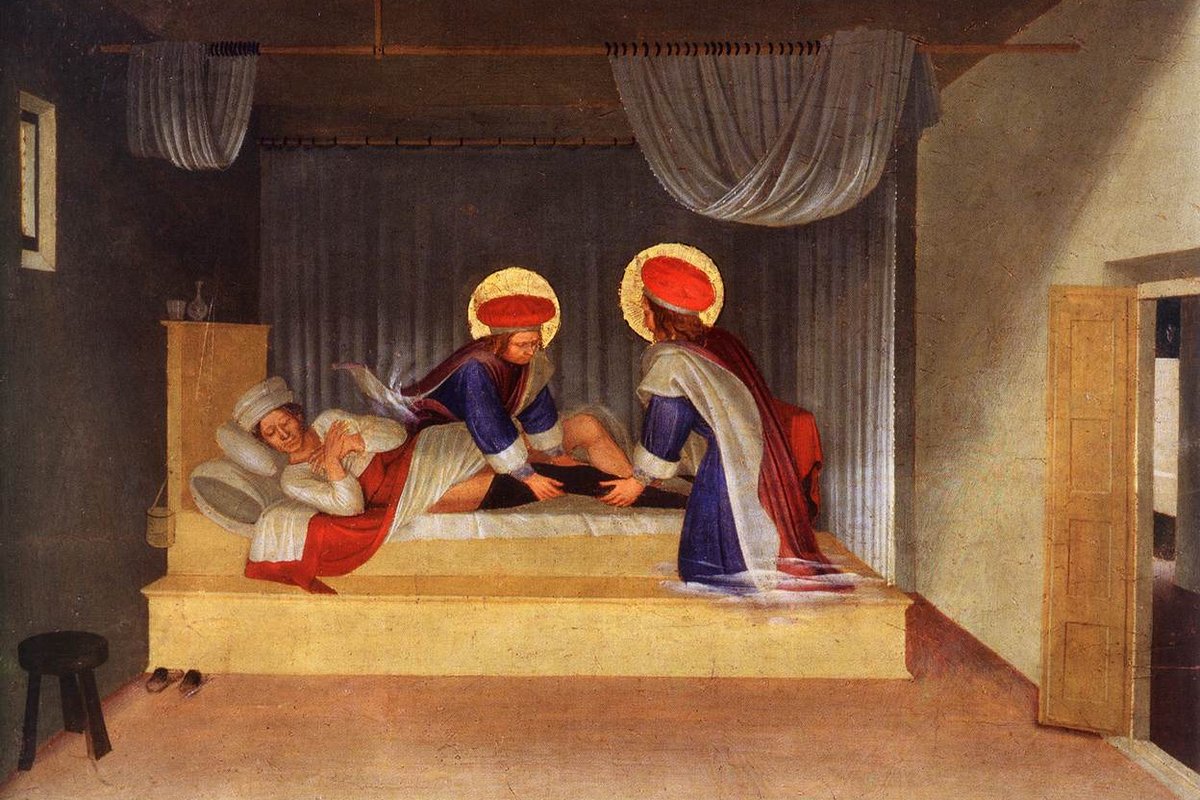
Fra Angelico, The Healing of Justinian by Saints Cosmas and Damian (San Marco Altarpiece predella), c. 1438–1440, Museo di San Marco, Florence — public domain.
Their skill and reputation reportedly grew during a period of open hostility toward Christians under the emperor Diocletian, whose persecution, beginning in 303, was among the most severe the early Church faced. Cosmas and Damian were arrested as Christians and, according to the Acts describing their martyrdom, brought before a Roman official named Lysias and ordered to sacrifice to the pagan gods. They refused.
A death that resisted several attempts
The account of their execution follows a pattern common across many ancient martyr narratives: before their eventual beheading, the brothers are said to have survived several earlier attempts on their lives — crucifixion, stoning, and being shot with arrows or thrown into fire, each of which reportedly failed to kill them before the final, successful execution by the sword. This kind of repeated-failed-execution sequence appears often enough across early hagiography that it should be read as a recognizable literary and devotional pattern rather than a verified sequence of events — a way ancient audiences expressed that the martyrs' deaths were, in a spiritual sense, not fully in their persecutors' control, rather than a court record of what specifically happened at Aegeae. What is much better attested is the fact and rough date of their martyrdom itself, and the extraordinary speed and durability of the devotion that followed it.
Named in the oldest part of the Mass
However legendary some of the narrative details around their deaths may be, the antiquity of the actual cult of Cosmas and Damian is not in question. Their names are included in the Roman Canon of the Mass — one of the oldest and most solemn eucharistic prayers in the Catholic liturgy, still in use today as Eucharistic Prayer I — placing them among a small, ancient list of martyrs the Church has commemorated at the altar for the better part of two millennia. That kind of liturgical inclusion is a genuinely significant historical marker, evidence of how quickly and how firmly their veneration took hold in Rome itself, distinct from and considerably more solid than any of the later legends that grew up around their story.
A leg transplant added centuries later
The most famous story now associated with Cosmas and Damian, the so-called Miracle of the Black Leg, isn't part of that ancient core at all. In this much later medieval Western European legend, the two saints appear after death to a man suffering from a diseased leg, amputate it in his sleep, and graft on a healthy leg taken from a recently deceased Ethiopian donor, so that the patient wakes to find himself healed with a leg of a different color than his own. The story developed in Western Christian devotional art and literature many centuries after the brothers' actual lifetimes, and it should be understood as exactly that: a medieval elaboration layered onto an already ancient cult, not a continuation of the earliest Eastern traditions about them. It became a favorite subject for painters precisely because of its vivid, almost surreal imagery — Fra Angelico's own predella panels on Cosmas and Damian, including the healing scene pictured above, were part of a broader tradition of artists depicting their posthumous miracles for churches and hospitals dedicated to their patronage.
A church built by an emperor they healed
Their veneration in Rome received a striking architectural expression in the sixth century, when the Byzantine emperor Justinian I, who according to tradition had himself been cured through their intercession, endowed a church in their honor at the edge of the Roman Forum. The Basilica of Saints Cosmas and Damian, consecrated around 527, still stands today and is known especially for its apse mosaic, one of the best-preserved works of Byzantine-style art surviving in Rome from that period, showing the twin brothers presented to Christ alongside Saints Peter and Paul. That mosaic predates the later medieval leg-transplant legend by centuries, and its imagery reflects the earlier, simpler tradition: two physician brothers honored chiefly for their healing and their refusal to profit from it, standing in the same solemn company as the apostles rather than performing the more theatrical miracle later ages would attach to their memory.
Patrons of medicine to this day
Cosmas and Damian are venerated today as patrons of physicians, surgeons, dentists, and pharmacists — a patronage that needs no legendary embellishment to make sense, given how directly it grows out of the one thing that's consistently attested about them across every version of their story: two brothers who practiced medicine and refused to make the sick pay for it. Their feast is kept on September 26, and churches, hospitals, and medical guilds dedicated to their patronage have carried their names across both the Eastern and Western Church for close to seventeen centuries.
Trivia
Who were Saints Cosmas and Damian?
What does 'anargyroi' mean, and why is it applied to them?
What is the 'Miracle of the Black Leg' associated with Cosmas and Damian?
How do we know Cosmas and Damian were venerated so early in Church history?
What is Saints Cosmas and Damian's feast day, and what are they patrons of?
You May Also Like
Related Reading